PRINTED PAGE 964NKJV · STUDY EDITION
964 | Psalm 136:4
4 d Deut. 6:22; Job
9:10; Ps. 72:18
5 e Gen. 1:1, 6-8;
Prov. 3:19; Jer. 51:15
6 f Gen. 1:9; Ps.
24:2; [Is. 42:5]; Jer.
10:12
7 g Gen. 1:14-18
8 h Gen. 1:16
10 i Ex. 12:29; Ps.
135:8
11 j Ex. 12:51;
13:3, 16
12 k Ex. 6:6; Deut.
4:34; 5:15; 7:19;
9:29; 11:2; 2 Kin.
17:36; 2 Chr. 6:32;
Jer. 32:17 1 Mighty
power
13 l Ex. 14:21
15 m Ex. 14:27
16 n Ex. 13:18; 15:22;
Deut. 8:15
17 o Ps. 135:10-12
18 p Deut. 29:7
19 q Num. 21:21
20 r Num. 21:33
21 s Josh. 12:1
2 inheritance
23 t Gen. 8:1; Deut.
32:36; Ps. 113:7
24 u Ps. 44:7
25 v Ps. 104:27;
145:15
12 k With a strong hand, and with 1 an
outstretched arm,
For His mercy endures forever;
13 l To Him who divided the Red Sea in
two,
For His mercy endures forever;
14 And made Israel pass through the
midst of it,
For His mercy endures forever;
15 m But overthrew Pharaoh and his army
in the Red Sea,
For His mercy endures forever;
16 n To Him who led His people through
the wilderness,
For His mercy endures forever;
17 o To Him who struck down great
kings,
For His mercy endures forever;
18 p And slew famous kings,
For His mercy endures forever—
19 q Sihon king of the Amorites,
For His mercy endures forever;
20 r And Og king of Bashan,
For His mercy endures forever—
21 s And gave their land as a 2 heritage,
For His mercy endures forever;
22 A heritage to Israel His servant,
For His mercy endures forever.
23 Who t remembered us in our lowly
state,
For His mercy endures forever;
24 And u rescued us from our enemies,
For His mercy endures forever;
25 v Who gives food to all flesh,
For His mercy endures forever.
26 Oh, give thanks to the God of
heaven!
For His mercy endures forever.
PSALM 137
Longing for Zion in a Foreign Land
B
y the rivers of Babylon,
There we sat down, yea, we wept
When we remembered Zion.
4 To Him d who alone does great
wonders,
For His mercy endures forever;
5 e To Him who by wisdom made the
heavens,
For His mercy endures forever;
6 f To Him who laid out the earth above
the waters,
For His mercy endures forever;
7 g To Him who made great lights,
For His mercy endures forever—
8 h The sun to rule by day,
For His mercy endures forever;
9 The moon and stars to rule by night,
For His mercy endures forever.
10 i To Him who struck Egypt in their
firstborn,
For His mercy endures forever;
11 j And brought out Israel from among
them,
For His mercy endures forever;
136:4, 5 In the OT, the term great wonders is used exclusively for
the awe-inspiring actions of God. God’s creation of the universe
is the grand display of His wisdom. The heavens give a clear pre-
sentation of the glory of God (19:1–6). Romans 1:20 teaches that
God’s “invisible attributes” are clearly seen through the things He
has made.
136:10–13 struck Egypt: The poet refers to God’s great acts of
deliverance in bringing Israel from Egypt at the dawn of Israel’s
redemption (Ps. 78; 105; 135:8–12). strong hand: This is a slogan
of redemption (118:15, 16; see Ex. 15:6). It has been said when God
created the universe, it was the work of His fingers (8:3); but when
He battled for the salvation of His people, it was with His strong
right hand. divided the Red Sea: God brought Israel across the
Jordan by dividing its waters, then used the same waters to destroy
the pursuing army of Egypt.
136:19, 20 The poet’s recital of Israel’s history includes the capture
of the lands east of the Jordan, including the territories of Sihon
and Og (Num. 21). The result was the gift of the land of Canaan to
the people of Israel.
136:23 It is possible that the words remembered us suggest the
return of the people of Judah and Jerusalem to their land follow-
ing the Babylonian captivity. Like Ps. 135, Ps. 136 may have been
written after the Exile.
136:26 Oh, give thanks: The psalm ends as it begins, with cele-
bration of God’s continuing faithfulness to His people Israel and a
call to thank Him for His goodness.
Psalm 137, a song of Zion, is also a particularly impassioned im-
precatory psalm. Although no author is named, the psalm clearly
shares with the Book of Lamentations the despair of those who
suffered the destruction of Jerusalem by the Babylonians in 586 b.c.
This troubling psalm is one of deeply felt emotion. Its pattern is as
follows: (1) weeping in Babylon at the memory of the destruction
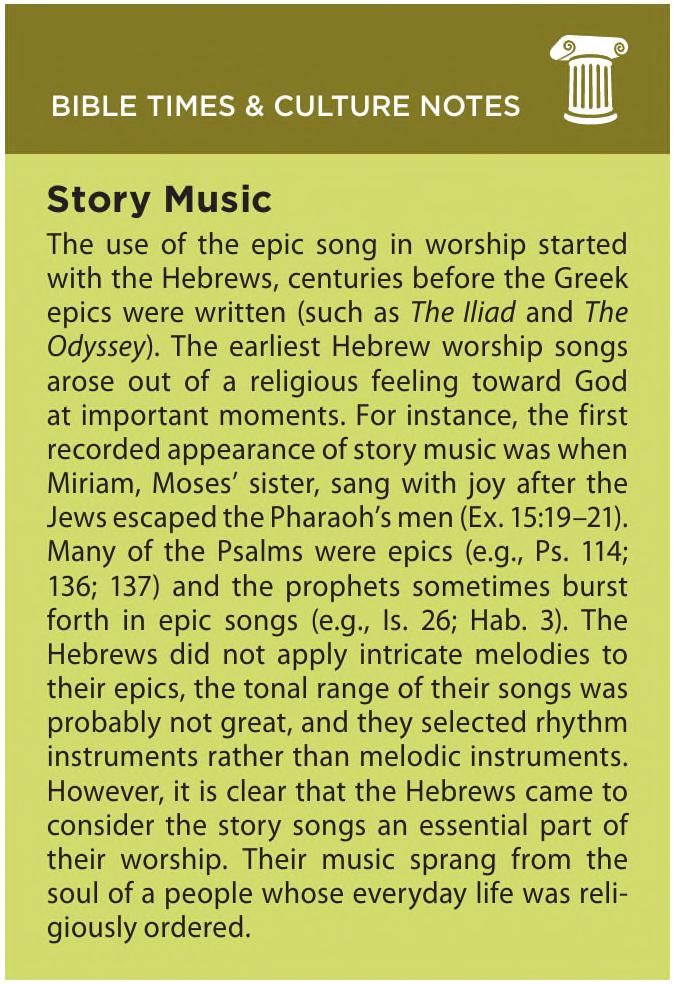
Bible Times & Culture Notes
Story Music
The use of the epic song in worship started
with the Hebrews, centuries before the Greek
epics were written (such as The Iliad and The
Odyssey). The earliest Hebrew worship songs
arose out of a religious feeling toward God
at important moments. For instance, the first
recorded appearance of story music was when
Miriam, Moses’ sister, sang with joy after the
Jews escaped the Pharaoh’s men (Ex. 15:19–21).
Many of the Psalms were epics (e.g., Ps. 114;
136; 137) and the prophets sometimes burst
forth in epic songs (e.g., Is. 26; Hab. 3). The
Hebrews did not apply intricate melodies to
their epics, the tonal range of their songs was
probably not great, and they selected rhythm
instruments rather than melodic instruments.
However, it is clear that the Hebrews came to
consider the story songs an essential part of
their worship. Their music sprang from the
soul of a people whose everyday life was reli-
giously ordered.
Original illustrations
End of source page 999