PRINTED PAGE 946NKJV · STUDY EDITION
946 | Psalm 114:5
5 g Hab. 3:8
8 h Ex. 17:6; Num.
20:11; Ps. 107:35
PSALM 115
1 a [Is. 48:11]; Ezek.
36:32
2 b Ps. 42:3, 10
1 nations
3 c [1 Chr. 16:26]
PSALM 115
The Futility of Idols and the
Trustworthiness of God
N
ot a unto us, O LORD, not unto us,
But to Your name give glory,
Because of Your mercy,
Because of Your truth.
2 Why should the 1 Gentiles say,
b“ So where is their God?”
3 c But our God is in heaven;
He does whatever He pleases.
5 g What ails you, O sea, that you fled?
O Jordan, that you turned back?
6 O mountains, that you skipped like
rams?
O little hills, like lambs?
7 Tremble, O earth, at the presence of
the Lord,
At the presence of the God of
Jacob,
8 h Who turned the rock into a pool of
water,
The flint into a fountain of waters.
114:8 God not only delivered His people from Egypt, He also pro-
vided for their needs by bringing water from a rock (Ex. 17; Num.
20). Water was a physical blessing, but also a spiritual symbol of
His salvation.
Psalm 115, a community psalm of praise, focuses on the glory
of the Lord in the salvation of His people. Several sections of this
psalm are used in Ps. 135. This poem has five movements: (1) a
glorification of the Lord who alone deserves praise (vv. 1, 2); (2) a
comparison of the false gods and the true, living God (vv. 3–8);
(3) a litany of trust in the Lord (vv. 9–11); (4) a litany of blessing in the
Lord (vv. 12–15); (5) a glorification of the Lord (vv. 16–18).
115:1, 2 Not unto us: People have a natural tendency to divert
to themselves glory that belongs to God. This psalm redirects the
glory to its proper focus, the Lord Himself. The Gentiles, who do
not know God, are prone to insult believers in times of testing when
God’s activity is not apparent (42:3).
115:3, 4 Like the prophets (Is. 40; Jer. 10), the psalms are derisive
toward the idols of the nations. The psalmist denies any reality to
the false gods created by people (135:15–18). In contrast to these
“gods” that have to be carried about, propped up, and coddled,
Israel exalted the God who is in heaven and who does whatever
He pleases. He is the only God who can demand our worship.
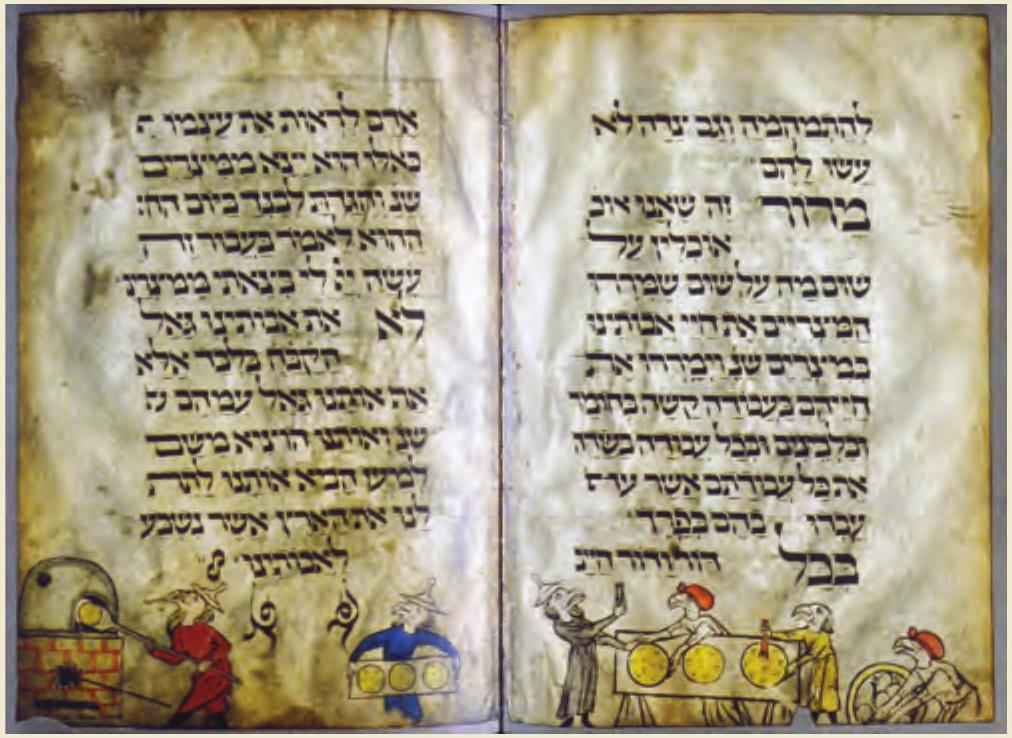
An ancient Haggadah, c. a.d. 1300, read or sung before the eating of the
Passover meal
Z. Radovan/www.BibleLandPictures.com
Psalms of the Passover
The celebrants of the Passover today either read or sing Ps. 113–118 as part of the haggadah, the liturgical retelling of the
story of God’s deliverance of Israel from Egypt. As part of the Passover commemoration of God’s saving acts during the
Exodus, these psalms lead the celebrants through a cycle of praise to their God and Savior.
Before the Passover feast, celebrating Jews read or sing Ps. 113 and 114. Both psalms remarkably capture in poetry
and song the major ideas of the prose liturgy that is also recited before the Passover meal. That is, they speak of God’s
saving works at the time of the Exodus. The first psalm focuses the worshipers on the condescending grace of God. He
is the merciful Redeemer who bends from heaven to meet the needs of His people. Then with the singing of Ps. 114, the
Jews recall Israel’s deliverance from Egypt—the reason for the Passover celebration and the central act of God’s saving
grace. This psalm begins on a light and happy note, the salvation of Israel, and ends on an arresting and somber note, the
earth trembling before the Almighty Lord. It is a wonderful companion piece to the songs of Moses and Miriam in Ex. 15.
After the meal, Ps. 115–118; 136 are read or sung. Psalm 115 is similar to a responsive reading, which includes the com-
munity’s expression of trust in the Lord
(vv. 1–8, 12, 13, 16–18) and the priest’s
blessing (vv. 9–11, 14, 15). After declaring
their confidence in God, the celebrants
praise God for saving them with the words
of Ps. 116. Then the two verses of Ps. 117
build on the previous psalm by exhorting
all the nations to praise the Lord for His
love and faithfulness. Psalm 118 contin-
ues the emphasis on God’s faithfulness by
celebrating the Lord’s enduring love in a
responsive or antiphonal song. The heart
of this psalm prophetically describes
God’s deliverance of a rejected person;
the despised or rejected One is Jesus Him-
self (v. 22; Is. 53:3; Mark 12:1–12). Finally
Ps. 136 concludes the Passover supper.
With the recitation of the history of the
Lord’s saving works, it continues the
previous psalm’s refrain “For His mercy
endures forever.” With these songs, the
celebrants leave the meal with their
hunger satisfied, their hearts filled with
thankfulness, and their lips overflowing
with praise to the Lord.
Original illustrations
End of source page 981