PRINTED PAGE 891NKJV · STUDY EDITION
Psalm 60:8 | 891
8 o Moab is My washpot;
p Over Edom I will cast My shoe;
q Philistia, shout in triumph because
of Me.”
PSALM 60
Urgent Prayer for the Restored Favor
of God
To the Chief Musician. a Set to 1 “Lily of
the Testimony.” A Michtam of David.
For teaching. b When he fought against
Mesopotamia and Syria of Zobah, and Joab
returned and killed twelve thousand
Edomites in the Valley of Salt.
O
God, c You have cast us off;
You have broken us down;
You have been displeased;
Oh, restore us again!
2 You have made the earth tremble;
You have broken it;
d Heal its breaches, for it is
shaking.
3 e You have shown Your people hard
things;
f You have made us drink the wine of
2 confusion.
4 g You have given a banner to those
who fear You,
That it may be displayed because of
the truth.
Selah
5 h That Your beloved may be
delivered,
Save with Your right hand, and
hear me.
6 God has i spoken in His holiness:
“ I will rejoice;
I will j divide k Shechem
And measure out l the Valley of
Succoth.
7 Gilead is Mine, and Manasseh is
Mine;
m Ephraim also is the 3 helmet for My
head;
n Judah is My lawgiver.
Jer. 25:15 2 staggering 4 g Ps. 20:5; Is. 5:26; 11:12; 13:2
5 h Ps. 108:6-13 6 i Ps. 89:35 j Josh. 1:6 k Gen. 12:6 l Josh.
13:27 7 m Deut. 33:17 n [Gen. 49:10] 3 Lit. protection
8 o 2 Sam. 8:2 p 2 Sam. 8:14; Ps. 108:9 q 2 Sam. 8:1
PSALM 60
title a Ps. 80
b 2 Sam. 8:3, 13;
1 Chr. 18:3 1 Heb.
Shushan Eduth
1 c Ps. 44:9
2 d [2 Chr. 7:14]; Is.
30:26
3 e Ps. 71:20 f Is.
51:17, 22;
Psalm 60, a psalm of community lament (Ps. 80), expresses David’s
great faith in the eventual victory he would find in the Lord. In this
psalm, we hear the voice of God breaking into the poem itself and
pronouncing His judgment on David’s enemies (vv. 6–8; see also
Ps. 12; 75; 87; 91). Since the tone of the psalm is military in nature,
it is possible that this poem was used in military training. Along
with training in weapons and tactics, David gave ongoing instruc-
tion to his soldiers about how to trust their Lord. The heading and
content of this psalm add additional information to the account in
2 Sam. 8:3–8. The campaign of David and his general Joab against
Hadadezer, the king of Zobah, did not succeed at first. This psalm
describes the feelings of David and his army at the time of their de-
feat. But it also records their confident expectation that they would
eventually succeed, something celebrated in the heading of the
psalm and confirmed in 2 Sam. 8. The psalm has four movements:
(1) a lament of the people when they experienced defeat (vv. 1–3);
(2) an expression of confidence and a prayer for deliverance (vv. 4,
5); (3) the voice of God giving assurance of ultimate victory (vv. 6–8);
(4) an expression of confidence in the Lord (vv. 9–12).
60:1–3 David accuses God of having broken them down. This is a
poetic description of an otherwise unknown defeat of the armies
of Israel in a battle that was part of the campaign against Aram
of Zobah and Mesopotamian allies (2 Sam. 8). The defeat was so
startling that it caused the people of Israel to feel as though God
had made the earth tremble, a metaphor for devastation. wine
of confusion: The defeat sent the people reeling; they could not
understand how it could have happened.
60:4, 5 a banner: Despite the recent defeat, the people still had
reason to hope in a final victory for Israel over its foes. The term
beloved (127:2; Is. 5:1; Jer. 11:15) is particularly endearing. God had
a reason to act on behalf of His people: He loved them.
60:6–8 At this point in the poem, God speaks (75:2–5, 10; 91:14–16).
The Lord affirms that He is in charge, that the land belongs to Him,
and that He will give victory to His people. In His holiness can
also mean “in His holy place.” I will rejoice: It gives God pleasure
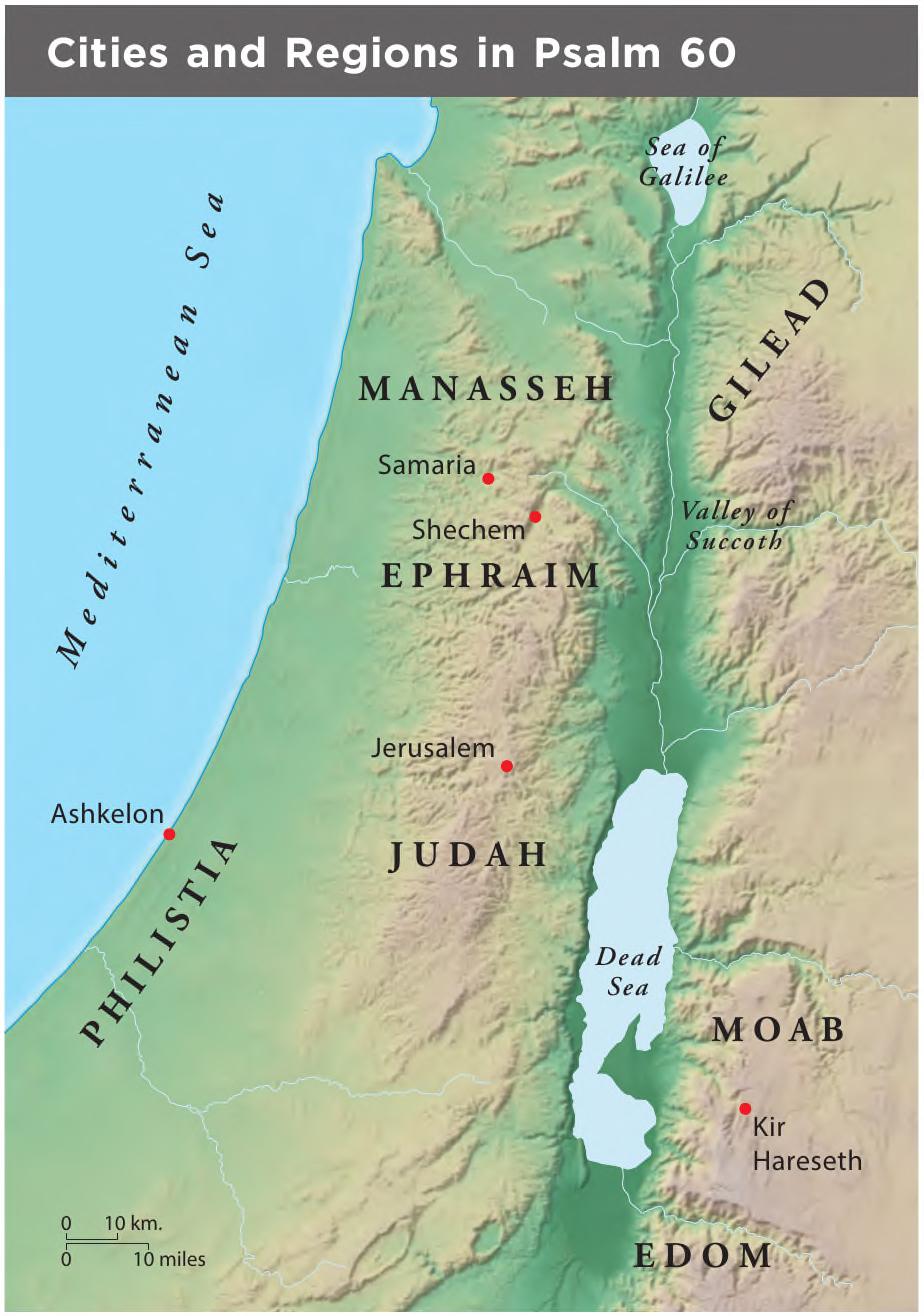
to grant His people success. Shechem and the Valley of Succoth
represent regions west and east of the Jordan River in the central
parts of the land. Gilead and Manasseh are also regions east and
west of the Jordan; Ephraim and Judah are regions in the north
and south. The Lord was asserting His sovereignty over the entire
land of Israel. Moab . . . Edom . . . Philistia: These traditional
enemies of Israel were also enemies of God. The Lord would not
allow them to disturb His people.
0
10 miles
0
10 km.
Shechem
G I L E A D
Jerusalem
Kir
Hareseth
Samaria
Ashkelon
M A N A S S E H
E P H R A I M
J U D A H
M O A B
E D O M
P H I
L I S
T I
A
Valley of
Succoth
Sea of
Galilee
Dead
Sea
M e d i
t e r r
a n e a
n S e a
Cities and Regions in Psalm 60
Original illustrations
End of source page 926