PRINTED PAGE 862NKJV · STUDY EDITION
862 | Psalm 30:8
PSALM 31
The LORD a Fortress in Adversity
To the Chief Musician. A Psalm of David.
I
n a You, O LORD, I 1 put my trust;
Let me never be ashamed;
Deliver me in Your righteousness.
2 b Bow down Your ear to me,
Deliver me speedily;
Be my rock of 2 refuge,
A 3 fortress of defense to save me.
3 c For You are my rock and my fortress;
Therefore, d for Your name’s sake,
Lead me and guide me.
4 Pull me out of the net which they
have secretly laid for me,
For You are my strength.
5 e Into Your hand I commit my spirit;
You have redeemed me, O LORD God
of f truth.
6 I have hated those g who regard
useless idols;
But I trust in the LORD.
7 I will be glad and rejoice in Your
mercy,
For You have considered my
trouble;
You have h known my soul in
4 adversities,
8 And have not i shut 5 me up into the
hand of the enemy;
j You have set my feet in a wide place.
9 Have mercy on me, O LORD, for I am
in trouble;
k My eye wastes away with grief,
Yes, my soul and my 6 body!
10 For my life is spent with grief,
And my years with sighing;
My strength fails because of my
iniquity,
And my bones waste away.
8 I cried out to You, O LORD;
And to the LORD I made
supplication:
9 “ What profit is there in my blood,
When I go down to the pit?
j Will the dust praise You?
Will it declare Your truth?
10 Hear, O LORD, and have mercy
on me;
LORD, be my helper!”
11 k You have turned for me my
mourning into dancing;
You have put off 5 my sackcloth and
clothed me with gladness,
12 To the end that my 6 glory may
sing praise to You and not be
silent.
O LORD my God, I will give thanks to
You forever.
5 given me over 9 k Ps. 6:7 6 Lit. belly
9 j [Ps. 6:5]
11 k Eccl. 3:4; Is.
61:3; Jer. 31:4 5 The
sackcloth of my
mourning
12 6 soul
PSALM 31
1 a Ps. 22:5 1 have
taken refuge
2 b Ps. 17:6;
71:2; 86:1; 102:2
2 strength 3 Lit.
house of fortresses
3 c [Ps. 18:2] d Ps.
23:3; 25:11
5 e Luke 23:46
f [Deut. 32:4]; Ps.
71:22
6 g Jon. 2:8
7 h [John 10:27]
4 troubles
8 i [Deut. 32:30];
Ps. 37:33 j [Ps. 4:1;
18:19]
30:9, 10 As in 6:5, the psalmist pleads with God to save his life so
that he can fulfill his promise to praise God in the worship of the
community. The emphasis is on singing praise to God in this life.
Helper can be translated “power” or “strength” (33:20). What a sick
person needs is strength for recovery: God is that powerful force.
30:11, 12 mourning into dancing: The psalmist has been trans-
formed and renewed because of God’s blessing on his life. He
boasts in God as he fulfills his vow of praise. My glory refers to
the psalmist’s inner being (16:9).
Psalm 31 is a psalm of lament, but it has such a strong element
of trust that it can also be classified as a psalm of trust (see Ps. 23
for an example). The psalms of trust grow out of the confession
of trust that occurs in the psalms of lament. In this psalm, the re-
lationship between the two classifications is apparent. There are
two major sections: (1) the presentation of lament in the context
of trust (vv. 1–18); (2) the presentation of praise in the context of
lament (vv. 19–24).
31:1–3 The phrase I put my trust pictures the action of a bird
seeking refuge under its mother’s wings (11:1; 17:7; 91:1–4). A dif-
ferent word for trust occurs in vv. 6, 14, which has the connotation
of leaning on someone or something (Prov. 3:5, 6). The imagery of
God as the rock and fortress for the believer recurs often in the
Psalms (91:1–3).
31:5 With the words into Your hand I commit my spirit, David
expresses a complete dependence on God—his life is in God’s
hands to do with as He pleases. These words were spoken by Jesus
on the cross shortly before His death (Luke 23:46) and by Stephen
before his death (Acts 7:59).
31:9–11 I am in trouble are classic words of lament and thus begin
the lament section of this psalm. My eye wastes away: David uses
similar language in 6:7 to express his sorrow. a reproach: As in the
case of Ps. 30, it is possible that what faces the psalmist is a terrible
illness—perhaps a physical condition that makes him repulsive
to others.
Bible Times & Culture Notes
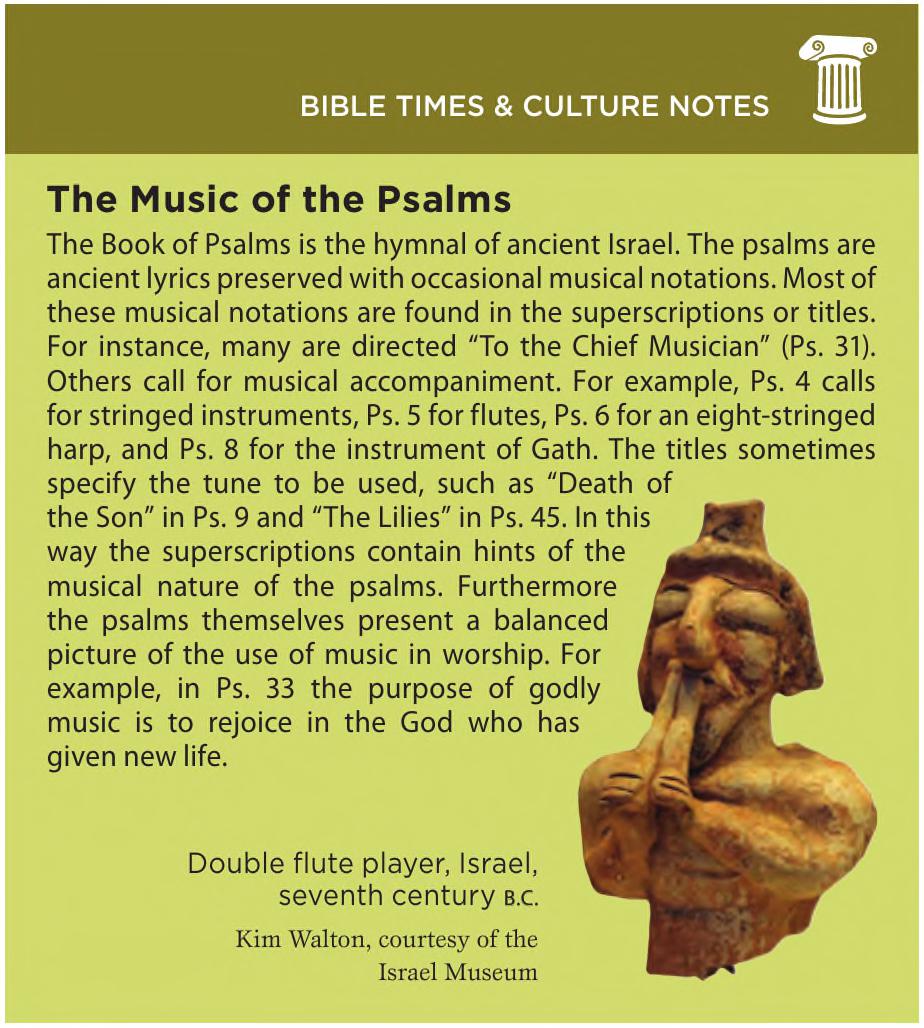
The Music of the Psalms
The Book of Psalms is the hymnal of ancient Israel. The psalms are
ancient lyrics preserved with occasional musical notations. Most of
these musical notations are found in the superscriptions or titles.
For instance, many are directed “To the Chief Musician” (Ps. 31).
Others call for musical accompaniment. For example, Ps. 4 calls
for stringed instruments, Ps. 5 for flutes, Ps. 6 for an eight-stringed
harp, and Ps. 8 for the instrument of Gath. The titles sometimes
specify the tune to be used, such as “Death of
the Son” in Ps. 9 and “The Lilies” in Ps. 45. In this
way the superscriptions contain hints of the
musical nature of the psalms. Furthermore
the psalms themselves present a balanced
picture of the use of music in worship. For
example, in Ps. 33 the purpose of godly
music is to rejoice in the God who has
given new life.
Double flute player, Israel,
seventh century b.c.
Kim Walton, courtesy of the
Israel Museum
Original illustrations
End of source page 897