PRINTED PAGE 834NKJV · STUDY EDITION
834 Psalms INTRODUCTION
The psalms of Zion focus on Jerusalem, using its endearing name Zion. These psalms rhapsodize on the city
as God’s choice for the site of His holy temple, the place for true worship of His name.
The penitential psalms are poems in which the poet confesses sin to the Lord, asks for and receives forgive-
ness, and then praises God for the renewed relationship that God’s forgiveness provides.
The wisdom psalms focus on some of the same issues that are found in the Book of Proverbs. These psalms
present sharp contrasts between the righteous and the wicked, address God’s blessing and cursing, and often
focus on righteous living.
One subcategory of the wisdom psalms is the Torah psalms. These are poems that focus on the beauty, truth,
and sufficiency of the Law of God. Two other subcategories of the wisdom psalms are the creation psalms and
the history psalms. In the creation psalms, the poet calls for the believer to praise God as the Creator of the
universe and the Savior of His people. In the history psalms, the poet recounts the history of Israel and asks for
a renewed commitment to God—even in the face of a history of rebellion.
Some of the most troubling psalms are those that contain prayers asking God to curse the wicked. These
imprecatory psalms are sometimes thought to conflict with the sentiment of the gospel, but in fact they accu-
rately reflect God’s abhorrence of evil.
In contrast to the imprecatory psalms are the joyful and prophetic Passover psalms that became a part of
the Passover celebration in Judaism. These psalms are a remarkable celebration of the great acts of the Lord in
delivering His people from Egypt, the theme of the Passover celebration. They point forward to the deliverance
that would come through the Savior Jesus.
A final group of psalms is clustered at the end of the book. These are the Hallel psalms, named for the
principal Hebrew word for praise, hallel. As their name suggests, these psalms praise God for His character and
saving works.
Characteristics In order to fully appreciate the Psalms, a certain number of their characteristics should be
kept in mind.
First, the psalms were written for singing. These were songs for public worship in the temple of ancient
Israel. They are not merely poems, but lyrics for music from the ancient world. As such they contain musical
conventions peculiar to music and
worship during that time.
Second, the poems in the
Psalms were written over a period
of a thousand years, from the time
of Moses in the fifteenth cen-
tury b.c. to the time of Ezra in the
fifth century b.c. Although David
is the main author associated with
the composition of the Psalms,
many other authors from various
time periods contributed psalms
to what would become the Book
of Psalms.
Third, the psalms were collected
and arranged over a long period of
time. This process involved some
editorial additions to the poems,
some cutting and expanding, and
some rearranging and restructur-
ing of various psalms. The Holy
Spirit who had inspired these
poems in the beginning oversaw
this process of restructuring them
for temple worship.
Fourth, the psalms were writ-
ten in the language of the human
spirit, the utterances of the soul.
The psalms are not cool, reasoned
prose, but deeply emotional works
that use wrenching language, dra-
matic exaggeration, and figurative
speech.
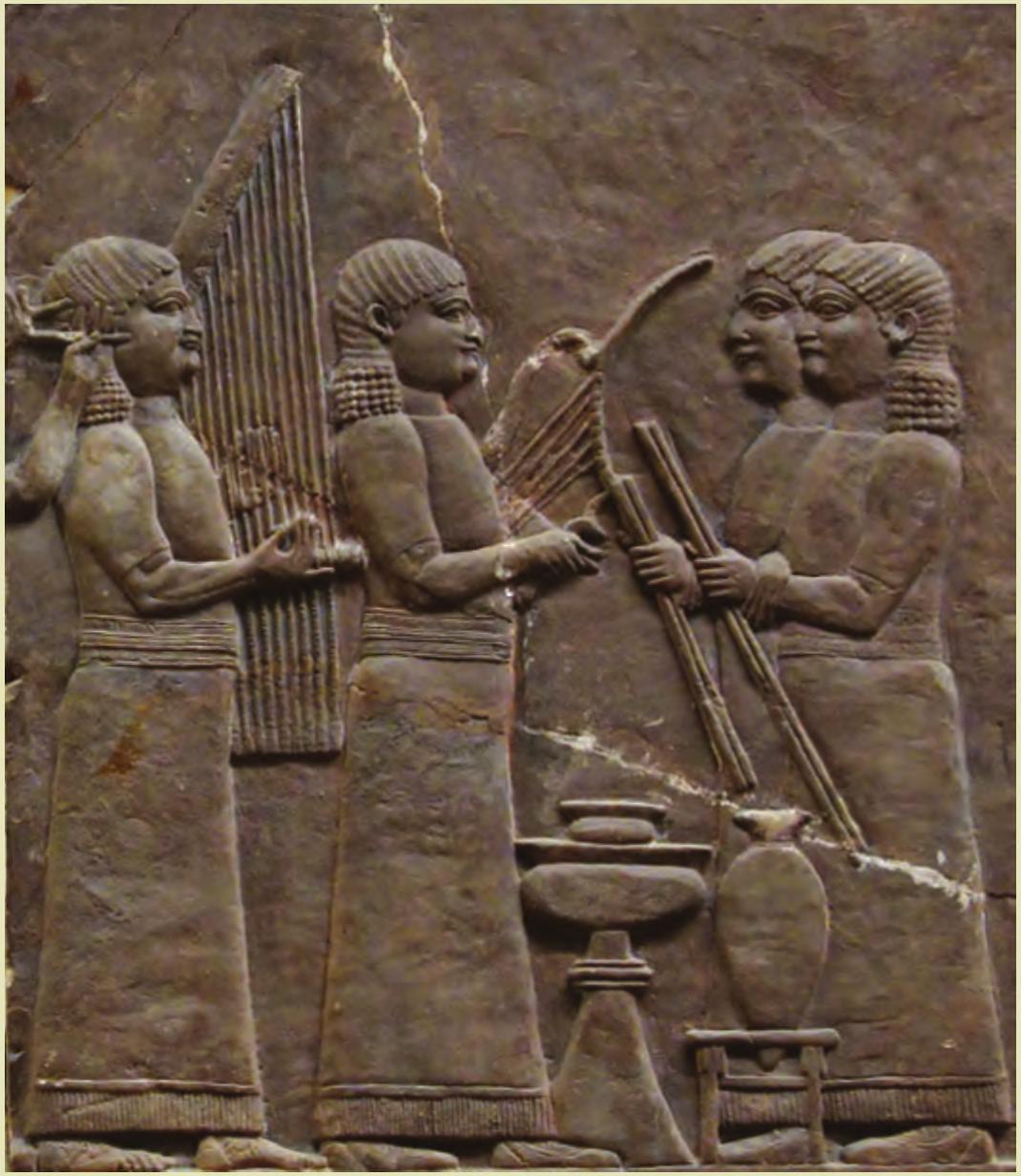
Musicians with two different harps, Assyria 645 – 635 b.c.
Kim Walton, courtesy of the British Museum
Original illustrations
End of source page 869