PRINTED PAGE 50NKJV · STUDY EDITION
50 | Genesis 27:12
27:18–20 I am Esau: Jacob lied, then his lies led him to blasphemy.
27:21–27 come near: Isaac had to feel Jacob (vv. 21, 22), hear him
(v. 22), question him (v. 24), kiss and smell him (vv. 26, 27) before
he finally believed Jacob’s repeated lies. Each one of Jacob’s lies
needed another lie.
11 i Gen. 25:25
12 j Gen. 27:21, 22
k Gen. 9:25; Deut.
27:18
13 l Gen. 43:9;
1 Sam. 25:24;
2 Sam. 14:9; Matt.
27:25
14 m Prov. 23:3;
Luke 21:34 3 tasty
15 n Gen. 27:27
19 o Gen. 27:4
21 p Gen. 27:12
23 q Gen. 27:16
And he said, “Here I am. Who are you,
my son?”
19 Jacob said to his father, “I am Esau
your firstborn; I have done just as you
told me; please arise, sit and eat of my
game, o that your soul may bless me.”
20 But Isaac said to his son, “How is
it that you have found it so quickly, my
son?”
And he said, “Because the LORD your
God brought it to me.”
21 Isaac said to Jacob, “Please come near,
that I p may feel you, my son, whether you
are really my son Esau or not.” 22 So Jacob
went near to Isaac his father, and he felt
him and said, “The voice is Jacob’s voice,
but the hands are the hands of Esau.”
23 And he did not recognize him, because
q his hands were hairy like his brother
Esau’s hands; so he blessed him.
24 Then he said, “Are you really my son
Esau?”
“Look, i Esau my brother is a hairy man,
and I am a smooth-skinned man. 12 Perhaps
my father will j feel me, and I shall seem to
be a deceiver to him; and I shall bring k a
curse on myself and not a blessing.”
13 But his mother said to him, l “Let
your curse be on me, my son; only obey
my voice, and go, get them for me.” 14 And
he went and got them and brought them
to his mother, and his mother m made
3 savory food, such as his father loved.
15 Then Rebekah took n the choice clothes
of her elder son Esau, which were with
her in the house, and put them on Jacob
her younger son. 16 And she put the skins
of the kids of the goats on his hands and
on the smooth part of his neck. 17 Then
she gave the savory food and the bread,
which she had prepared, into the hand of
her son Jacob.
18 So he went to his father and said,
“My father.”
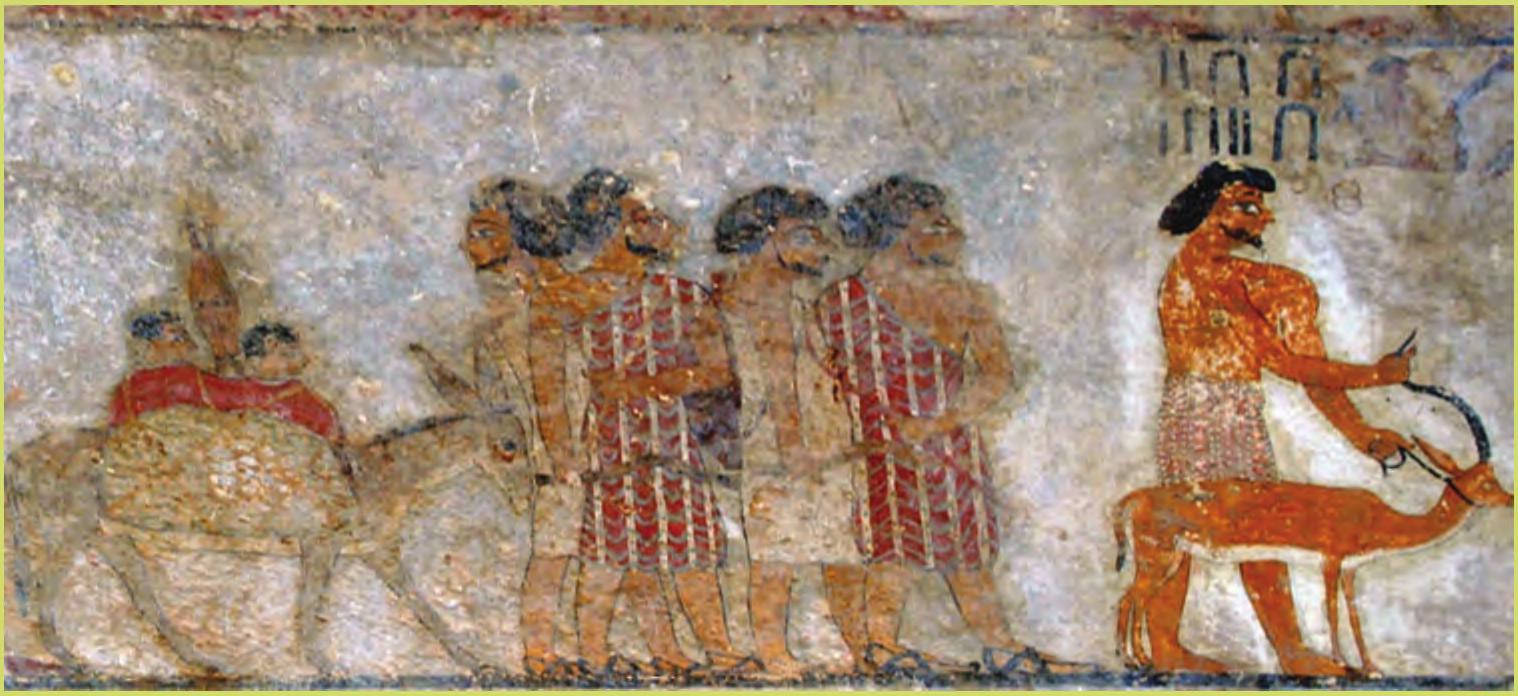
Bible Times & Culture Notes
Clothing
The warmth of Canaan’s climate led the people to prefer loose-fitting clothes, while the drab landscape may have con-
tributed to their preference for bright colors in their garments. Clothing styles remained essentially the same throughout
the period covered by the Old and New Testaments. Clothing was made from simple material, such as leather or goat’s
hair. In the early period of their history, the Hebrews were a people who tended flocks and herds. Thus they wove most of
their clothes from plentiful wool. The flax plant provided linen for the more formal clothing of the priests or the wealthier
classes. Many Hebrew homes had looms for weaving cloth. Colorful embroidery enlivened the fancier clothes. Purple dye
was taken from a Mediterranean shellfish. Red came from insects taken from oak trees. Pomegranate and other plants
provided blue dye.
Semites depicted on Beni-Hassan tomb painting. Note the brightly-colored, loose-fitting clothing.
Baker Photo Archive
Original illustrations
End of source page 85