PRINTED PAGE 798NKJV · STUDY EDITION
798 | Job 9:22
9:22–24 Job contradicts Bildad’s claims of 8:3, 20 by accusing God
of unjustly destroying both the blameless and the wicked (see 8:20,
21). Thus Job accuses God of being an unjust Judge who blindfolds
earthly judges (v. 24).
9:28 Job desires to stand before God as an innocent man—not ab-
solutely sinless, but innocent of any sin comparable to his suffering.
9:32, 33 Job complains that God is not a man who would go to
court with Him (see 9:3). Neither does Job have an impartial me-
diator between God and himself—a mediator who can present
his case before God. The desire for a mediator between God and
humanity is a key theme in Job (see 16:19; 19:25), and it anticipates
the NT emphasis on Jesus as the true Mediator between God and
all of humanity (see 1 Tim. 2:5).
10:2 Show me: Job dares to speak to God as an equal. Again using
legal language (see 9:3), Job demands that God give him a fair trial
through proper court protocol. Here Job comes close to unjustified
indignation at God’s sovereign will for his life.
10:7 This verse serves as a transition from Job’s complaint (vv. 1–6)
to his brief description of how God had lovingly created him (vv.
8–12). Job knows that he is not wicked, and he thinks that God is
unjust in oppressing him. Yet Job also realizes that there is no one
who can deliver him from God’s hand.
10:8–17 In these verses, Job paints a portrait of the apparently
contradictory nature of God, contrasting His loving character with
His judgment. Job wonders how the God who had so carefully
fashioned him in the womb can turn against him like a fierce
22 n [Eccl. 9:2, 3];
Ezek. 21:3
25 o Job 7:6, 7
26 p Job 39:29;
Hab. 1:8 7 Lit. ships
of reeds
27 q Job 7:13
28 r Ps. 119:120
s Ex. 20:7
30 t [Jer. 2:22] 8 lye
31 9 loathe
32 u Eccl. 6:10; [Is.
45:9; Jer. 49:19;
Rom. 9:20]
33 v [1 Sam. 2:25];
Job 9:19; Is. 1:18
34 w Job 13:20, 21;
Ps. 39:10
CHAPTER 10
1 a 1 Kin. 19:4; Job
7:16; Jon. 4:3 b Job
7:11 1 Lit. leave on
myself
4 c [1 Sam. 16:7; Job
28:24; 34:21]
8 d Job 10:3; Ps.
119:73 e [Job 9:22]
29 If I am condemned,
Why then do I labor in vain?
30 t If I wash myself with snow water,
And cleanse my hands with 8 soap,
31 Yet You will plunge me into the pit,
And my own clothes will 9 abhor me.
32 “ For u He is not a man, as I am,
That I may answer Him,
And that we should go to court
together.
33 v Nor is there any mediator between us,
Who may lay his hand on us both.
34 w Let Him take His rod away from me,
And do not let dread of Him
terrify me.
35 Then I would speak and not fear Him,
But it is not so with me.
Job: I Would Plead with God
10
“My a soul loathes my life;
I will 1 give free course to my
complaint,
b I will speak in the bitterness of my
soul.
2 I will say to God, ‘Do not condemn me;
Show me why You contend with me.
3 Does it seem good to You that You
should oppress,
That You should despise the work of
Your hands,
And smile on the counsel of the
wicked?
4 Do You have eyes of flesh?
Or c do You see as man sees?
5 Are Your days like the days of a
mortal man?
Are Your years like the days of a
mighty man,
6 That You should seek for my iniquity
And search out my sin,
7 Although You know that I am not
wicked,
And there is no one who can deliver
from Your hand?
8 ‘ Your d hands have made me and
fashioned me,
An intricate unity;
Yet You would e destroy me.
22 It is all one thing;
Therefore I say, n ‘He destroys the
blameless and the wicked.’
23 If the scourge slays suddenly,
He laughs at the plight of the
innocent.
24 The earth is given into the hand of
the wicked.
He covers the faces of its judges.
If it is not He, who else could it be?
25 “ Now o my days are swifter than a
runner;
They flee away, they see no good.
26 They pass by like 7 swift ships,
p Like an eagle swooping on its prey.
27 q If I say, ‘I will forget my
complaint,
I will put off my sad face and wear
a smile,’
28 r I am afraid of all my sufferings;
I know that You s will not hold me
innocent.
Bible Times & Culture Notes
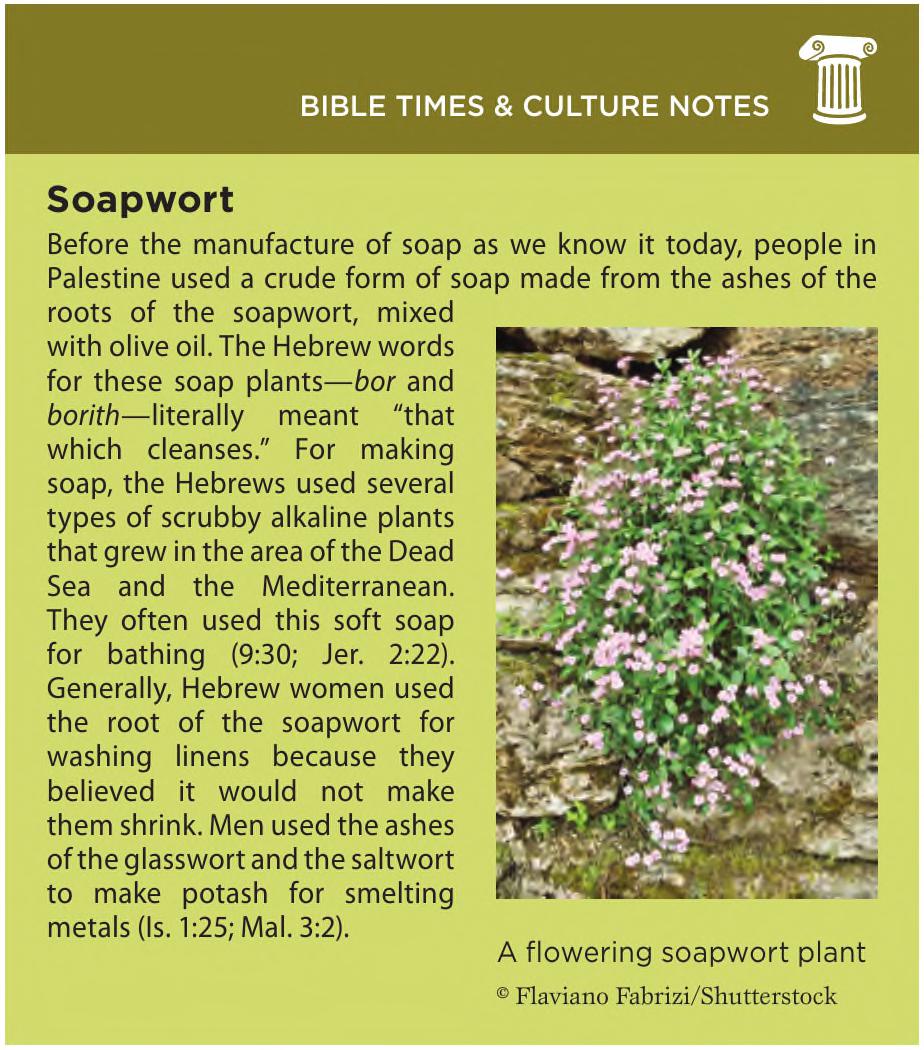
Soapwort
Before the manufacture of soap as we know it today, people in
Palestine used a crude form of soap made from the ashes of the
roots of the soapwort, mixed
with olive oil. The Hebrew words
for these soap plants—bor and
borith—literally
meant
“that
which cleanses.” For making
soap, the Hebrews used several
types of scrubby alkaline plants
that grew in the area of the Dead
Sea and the Mediterranean.
They often used this soft soap
for bathing (9:30; Jer. 2:22).
Generally, Hebrew women used
the root of the soapwort for
washing linens because they
believed it would not make
them shrink. Men used the ashes
of the glasswort and the saltwort
to make potash for smelting
metals (Is. 1:25; Mal. 3:2).
A flowering soapwort plant
© Flaviano Fabrizi/Shutterstock
Original illustrations
End of source page 833