PRINTED PAGE 787NKJV · STUDY EDITION
Job INTRODUCTION 787
In this way, the Book of Job is an extended refutation of Satan’s challenge that prosperity is connected to peo-
ple’s goodness, and consequently that people’s suffering is connected to their sin.
In this way, the Book of Job teaches that the Lord is not bound to anyone’s preconceived theological system.
Elihu’s speech on God’s greatness and His sovereign majesty over nature (36:1—37:24) serves as a prelude to
the climax of the book: the Lord’s answer to Job (38:1—42:6). In His speech, God lowers Himself to Job’s level
in order to answer Job’s questions. In the process, He reveals to all people that He is completely free but also
truly good. He is the sovereign and benevolent Creator who continues to determine the course of the universe
according to His own hidden plan. Just like Job, we must learn to submit to the Almighty God and accept by
faith that He has a good plan for us.
Christ in the Scriptures
Although Jesus is not named in the Book of Job, He is the only Redeemer Job could have been referring to when
he says, “For I know that my Redeemer lives, and He shall stand at last on the earth” (19:25). No one else can be
called our Redeemer who came to earth as a human being to die for us. No other book in the Bible includes
such graphic detail of the problems and questions that believers wrestle with and skeptics ask. In this book
are found the wide range of human hurts that Jesus identified with in His earthly life, as well as the ones He
empathizes with as He intercedes for us in heaven (Heb. 4:15).
Job Outline
I. Prose prologue 1:1—2:13
A. Job’s piety and prosperity 1:1–5
B. Job’s perseverance during two tests 1:6—2:13
II. Poetic body 3:1—42:6
A. Job’s initial monologue 3:1–26
B. A dialogue in three cycles 4:1—27:23
C. Interlude: a poem on wisdom 28:1–28
D. Job’s concluding monologues 29:1—31:40
E. Elihu’s speeches 32:1—37:24
F. God’s speeches and Job’s responses 38:1—42:6
III. Prose epilogue 42:7–17
A. God’s rebuke of Job’s three friends 42:7–9
B. God’s restoration of Job’s prosperity 42:10–17
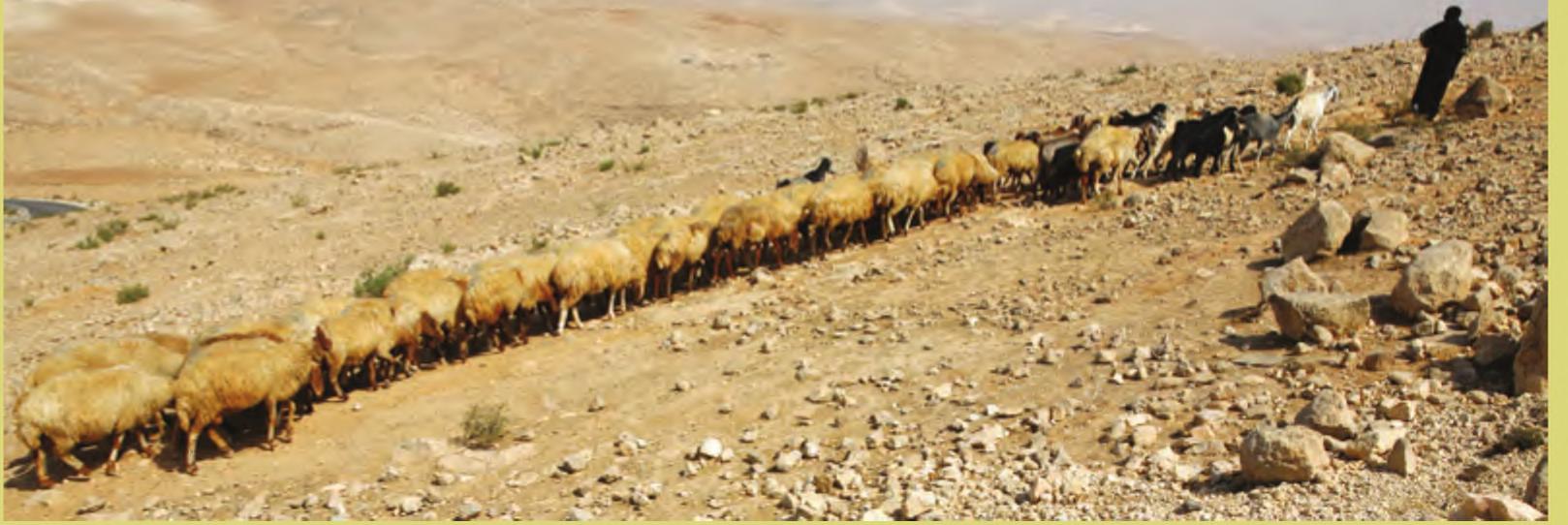
Job was a great man with thousands of animals, including sheep, camels, oxen, and donkeys. The animals and
servants were the first things taken from Job (Job 1:14 – 17).
© Ronen Boidek/Shutterstock
Original illustrations
End of source page 822