PRINTED PAGE 772NKJV · STUDY EDITION
772 Esther INTRODUCTION
Esther and Vashti would be understandable. Even so, some still balk at the idea that a Persian ruler would marry a
Jewish woman rather than choosing someone from the aristocratic Persian families. However, the Book of Esther
makes it clear that Esther initially hid her Jewish identity. She used her Persian name Ishtar or Esther instead
of her Hebrew name Hadassah. The climax of the story involves her surprising revelation that she was a Jew.
Importance in the Canon The Book of Esther has held an important place in the canon due to its strong
testimony to God’s providence and protection of His people. However, the book has been challenged by some.
One of the main points in the dispute is the remarkable fact that neither the word God nor God’s name Yahweh
is found in the book. There are two explanations that may account for this. First, it may be a result of the author’s
chosen point of view. The author might have viewed the Jewish people who remained in Persia and did not
return to the land of Israel (Ezra 1:1) as a people cut off from the principal blessings of God. Thus the absence
of God’s name in the book might be a way of expressing God’s distance from the exiles. At the same time, the
book clearly reveals God’s surprising protection of them.
Second, the author may have written the book in the form of a Persian state chronicle in order to explain
to the Persians the Jewish celebration of Purim. In accordance with this style, the author emphasizes the king’s
name, titles, and lists, but writes about
the Jewish people in a detached tone.
This could help explain why the Book of
Esther is the only book in the Bible that
does not directly mention God.
Themes Through the twists and
turns of the Book of Esther’s story line,
the author weaves an underlying story
about God’s character. The narrative
demonstrates God’s providence and
sovereignty in a situation that seemed
hopeless. The Israelites were living
among foreigners who did not fear
God and who did not care about them.
An implacable enemy of the Israelites
had gained power at court and was
laying a plan to destroy the Jews. But
at a time when God seemed so distant,
He was actually preparing to deliver
His people. God was in control of every
event—even the sleeplessness of a for
eign king (6:1).
Thus in the Persian capital, God
demonstrated His covenant loyalty to
the Israelites. Long ago, God had prom
ised Abraham that He would curse any
individual who cursed the Israelites
(Gen. 12:2, 3). The downfall of Haman
dramatically illustrated God’s faithful
ness to His promise. Even to the Isra
elites who remained in a foreign land,
God remained true to His word, for they
were still His people. Thus the author of Esther clearly illustrates what the Israelites were celebrating at the Feast
of Purim: God’s faithful protection of His people.
Christ in the Scriptures
Esther puts herself in harm’s way for her people as she attempts to be an advocate. The similarities to Jesus’
mission on our behalf are staggering. Esther’s rise to power was orchestrated by God “for such a time as this”
(4:14), the apostle Paul describes Jesus’ entrance into our world as something that occurred “when the fullness
of the time had come” (Gal. 4:4).
Another remarkable similarity between Esther’s story and Jesus is the satanic attempt to destroy the divine
plot of redemption God set in motion. But in both cases, God brings about His purpose by preserving His people
in spite of opposition and danger.
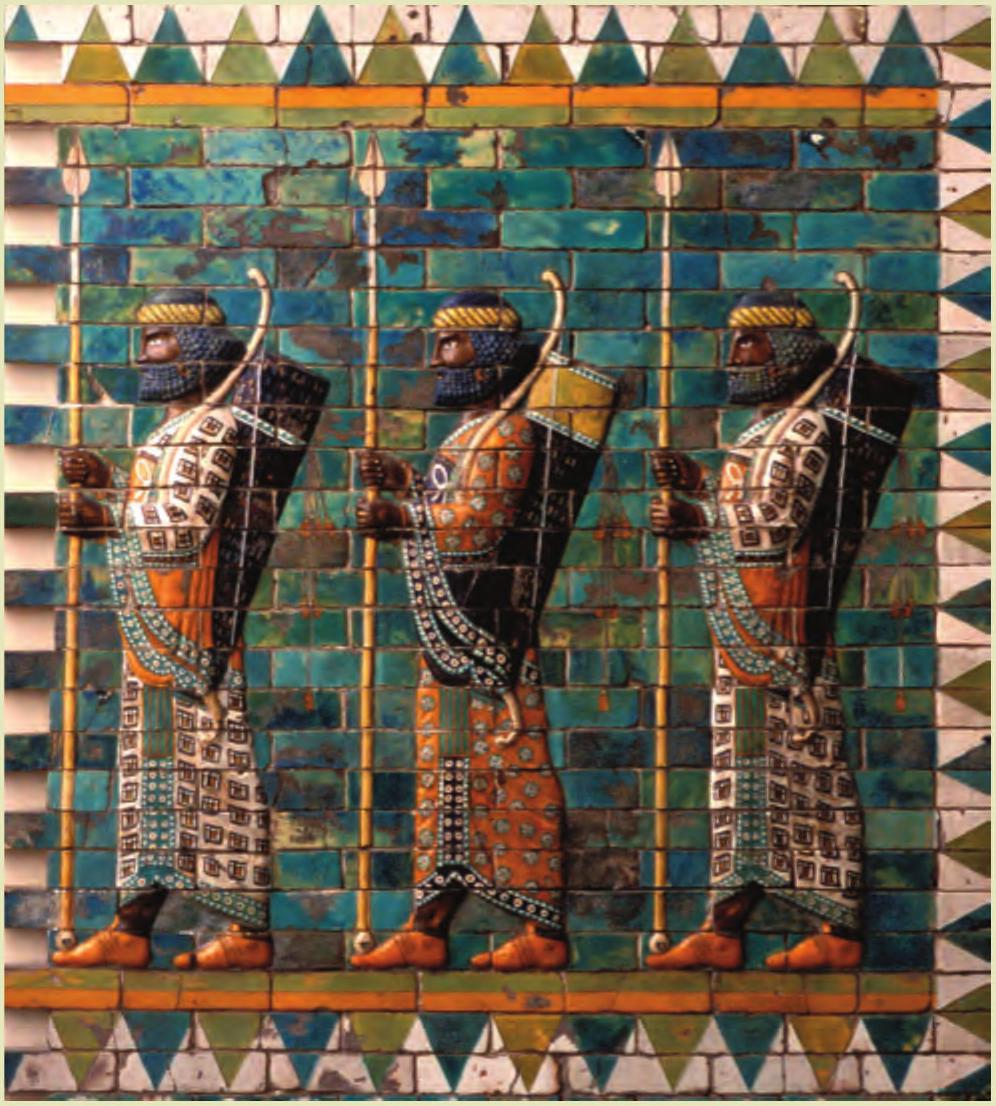
Persian archers on glazed brick from the Achaemenid palace in Susa
(sixth century b.c.)
Z. Radovan/www.BibleLandPictures.com
Original illustrations
End of source page 807