PRINTED PAGE 747NKJV · STUDY EDITION
Nehemiah INTRODUCTION 747
thoroughly teach the people God’s law (8:9). Apparently, the compiler of Nehemiah
wanted to show that the wall of the city would mean nothing without the wall of
the Law surrounding the people.
Purpose In His covenant with Israel, God had spoken of a place where He would
establish His name. In fact, Moses had told the Israelites to “seek the place where
the Lord your God chooses, out of all your tribes, to put His name for His dwelling
place” (Deut. 12:5). Later, it was revealed that this place was Jerusalem. When the
temple was built during Solomon’s reign, Jerusalem was at the height of its glory.
Its fame helped to spread the glory of God’s name throughout the nations. But
God allowed Jerusalem to be destroyed because of the faithlessness of the Israel
ites. Even though Jerusalem lay in ruins during Nehemiah’s time, it was still God’s
purpose to establish His name there.
The Book of Nehemiah records the restoration of Jerusalem under the leader
ship of Nehemiah. In the book, the returning Jews showed spiritual lethargy and
a coldhearted indifference toward God. This problem continued, for the Book
of Malachi denounces the Israelites for the same attitudes. It took a determined,
godly leader like Nehemiah to motivate this group to act on God’s promises and
rebuild Jerusalem’s walls.
However, the completion of Jerusalem’s walls is only half the story of Nehemiah.
The walls are rebuilt by chapter 6, but the book has seven more chapters. These
last chapters record a revival and describe the repopulation of the city. The subject
of the book is not merely the rebuilding of the walls, but the complete restoration
of the people of Jerusalem.
The Book of Nehemiah makes it clear that God did not restore His people only
one time; rather, He repeatedly, constantly, and continually restored His people. He
sent a number of prophets and leaders to teach, motivate, and guide the people
into righteousness. Zerubbabel led a group of exiles to Jerusalem and began to
rebuild the temple (see Ezra 1–6). Then Ezra led a second group of exiles back to
Jerusalem and helped restore the people to obedience to the Mosaic law (see Ezra
7–10). Then Nehemiah returned and motivated the people to rebuild the walls of
Jerusalem (chs. 1–6). Finally, Nehemiah returned a second time and exhorted the
people to adhere closely to God’s law (ch. 13). The pattern is clear: God continually
restored His people. In spite of their unfaithfulness, God accomplished His will.
The restored walls of Jerusalem, the repopulation of Jerusalem, and the repeated
reformation of the Israelites were clearly God’s work. In the end, His name would
be glorified.
586 b.c.
The Babylonians
take Judah captive
539 b.c.
Cyrus of Persia
conquers Babylon
538 b.c.
The return of the
Jews to Judea
begins
536–515 b.c.
The temple is
rebuilt
464–424 b.c.
Artaxerxes
Longimanus
reigns in Persia
458 b.c.
Ezra leads a group
of returnees
444 b.c.
Nehemiah leads a
group of returnees
c. 443 b.c.
Jerusalem’s wall is
reconstructed
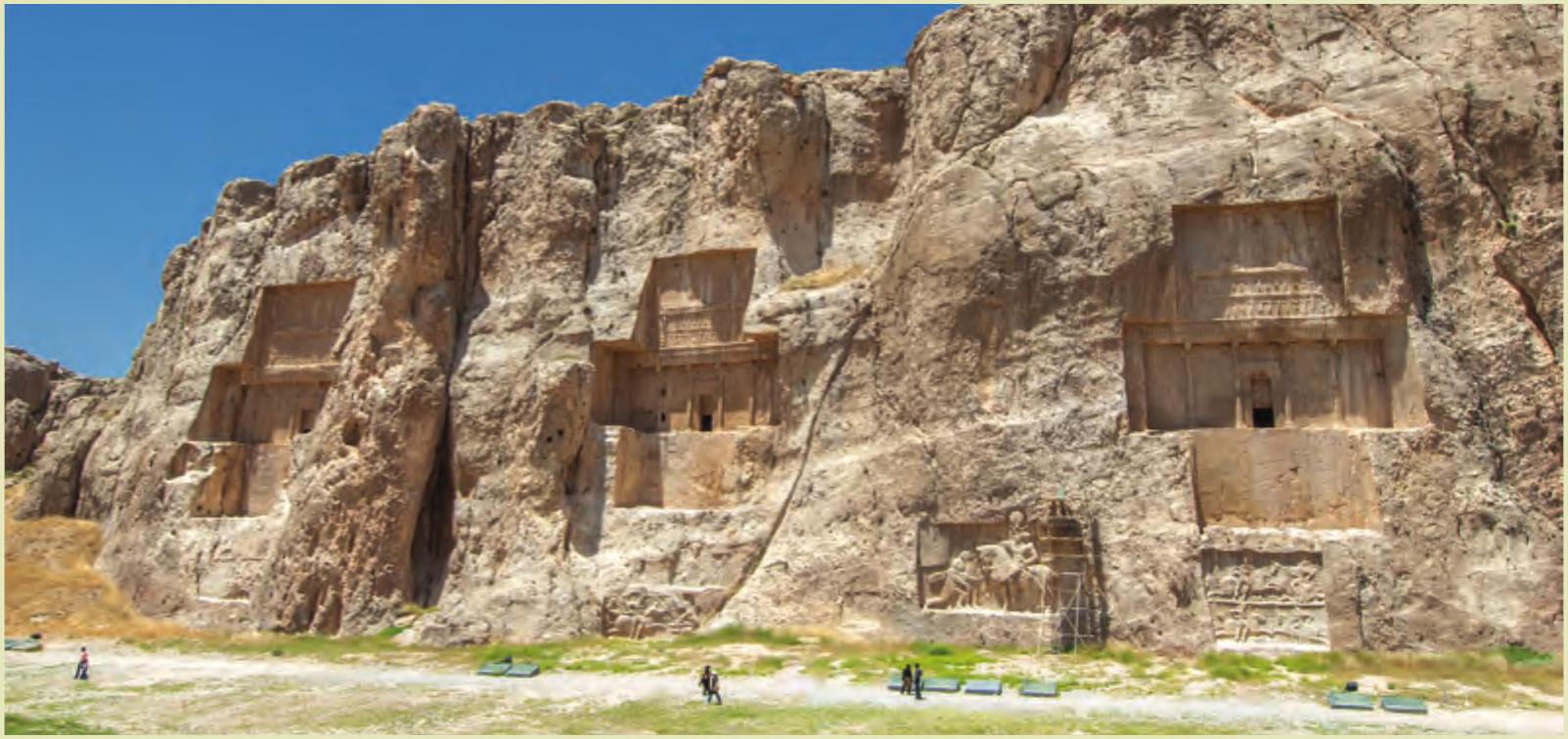
Achaemenid Tombs at Naqsh-i-Rustam, Iran, from left to right: Darius I, Xerxes I,
Artaxerxes I. Nehemiah was the cupbearer for Artaxerxes and was sent by him to
Jerusalem to help rebuild the city walls (Neh. 2).
© javarman/Shutterstock
Original illustrations
End of source page 782