PRINTED PAGE 740NKJV · STUDY EDITION
740 | Ezra 7:7
6 f Ezra 7:9, 28; 8:22
7 g Ezra 8:1-14
h Ezra 8:15 i Ezra
2:43; 8:20
9 j Ezra 7:6; Neh.
2:8, 18
10 k Ps. 119:45
l Deut. 33:10; Ezra
7:6, 25; Neh. 8:1-8;
[Mal. 2:7] 1 Study
12 m Ezek. 26:7;
Dan. 2:37 n Ezra
4:10 2 The original
language of Ezra
7:12-26 is Aramaic.
3 Lit. and now
14 o Esth. 1:14
4 from before
15 p 2 Chr. 6:2; Ezra
6:12; Ps. 135:21
16 q Ezra 8:25
r 1 Chr. 29:6, 9
5 Temple
17 s Num. 15:4-13
t Deut. 12:5-11
13 I issue a decree that all those of the
people of Israel and the priests and
Levites in my realm, who volunteer to
go up to Jerusalem, may go with you.
14 And whereas you are being sent 4 by
the king and his o seven counselors
to inquire concerning Judah and
Jerusalem, with regard to the Law
of your God which is in your hand;
15 and whereas you are to carry the
silver and gold which the king and
his counselors have freely offered to
the God of Israel, p whose dwelling
is in Jerusalem; 16 q and whereas all
the silver and gold that you may
find in all the province of Babylon,
along with the freewill offering of the
people and the priests, are to be r freely
offered for the 5 house of their God
in Jerusalem— 17 now therefore, be
careful to buy with this money bulls,
rams, and lambs, with their s grain
offerings and their drink offerings,
and t offer them on the altar of the
house of your God in Jerusalem.
18 And whatever seems good to you and
your brethren to do with the rest of
the silver and the gold, do it according
to the will of your God. 19 Also the
articles that are given to you for the
his request, f according to the hand of the
LORD his God upon him. 7 g Some of the
children of Israel, the priests, h the Le
vites, the singers, the gatekeepers, and
i the Nethinim came up to Jerusalem in
the seventh year of King Artaxerxes.
8 And Ezra came to Jerusalem in the fifth
month, which was in the seventh year of
the king. 9 On the first day of the first
month he began his journey from Bab
ylon, and on the first day of the fifth
month he came to Jerusalem, j according
to the good hand of his God upon him.
10 For Ezra had prepared his heart to
k seek 1 the Law of the LORD, and to do it,
and to l teach statutes and ordinances in
Israel.
The Letter of Artaxerxes to Ezra
11 This is a copy of the letter that King
Artaxerxes gave Ezra the priest, the
scribe, expert in the words of the com
mandments of the LORD, and of His stat
utes to Israel:
12 2 Artaxerxes, m king of kings,
To Ezra the priest, a scribe of the Law
of the God of heaven:
Perfect peace, n and 3 so forth.
prophet in importance, and eventually eclipsing even the role of
the priest. The Law of Moses actually refers to God’s law. Moses
may have been the person most closely associated with the Law,
but it was the Law that the Lord God of Israel had given. The
latter is by far the more significant designation (see John 1:17). The
phrase according to the hand of the Lord his God upon him is
used repeatedly throughout this chapter and the next one (7:9, 28;
8:18, 22, 31; Neh. 2:8, 18). The phrase depicts God’s grace working
on Ezra’s behalf.
7:8, 9 The first month is March–April; the fifth month is July–
August. The route traveled by Ezra was dangerous because a rebel
lion had broken out in Egypt and spring was the time when ancient
armies began their campaigns.
7:10 Throughout his life, Ezra had concentrated fully on the study,
practice, and communication of the Word of God. Heart indicates
the whole of one’s being. Ezra diligently searched the Scriptures so
that he could live by them and teach them to Israel. Because of this,
the gracious hand of God empowered him (v. 9).
7:11 the priest, the scribe, expert: These words describe Ezra
with exceptional praise. Ezra is referred to as “the scribe’s scribe”
or the teacher of scribes.
7:12 Ancient Middle Eastern monarchs commonly took self-
aggrandizing titles such as king of kings (see Ezek. 26:7; Dan.
2:37). The Persian kings were literally kings over many kings because
the Persian Empire included many conquered kingdoms. Perfect
peace describes a treaty relationship between the Persian emperor
and the vassal state of Judah.
7:15, 16 Three sources of offerings for the temple are listed: (1) the
silver and gold of the king and his counselors, (2) the silver
and gold of the people of Babylon, and (3) the freewill offering of
the Jewish people who remained in Babylon. Note that God accepts
the gifts of those who do not know Him, as well as the gifts of those
who know and serve Him in truth. The only gifts God rejects are
those given by people who appear to know Him but whose hearts
are far from Him (see Is. 1:10–15). The dwelling of God in Jerusalem
is a reference to the temple.
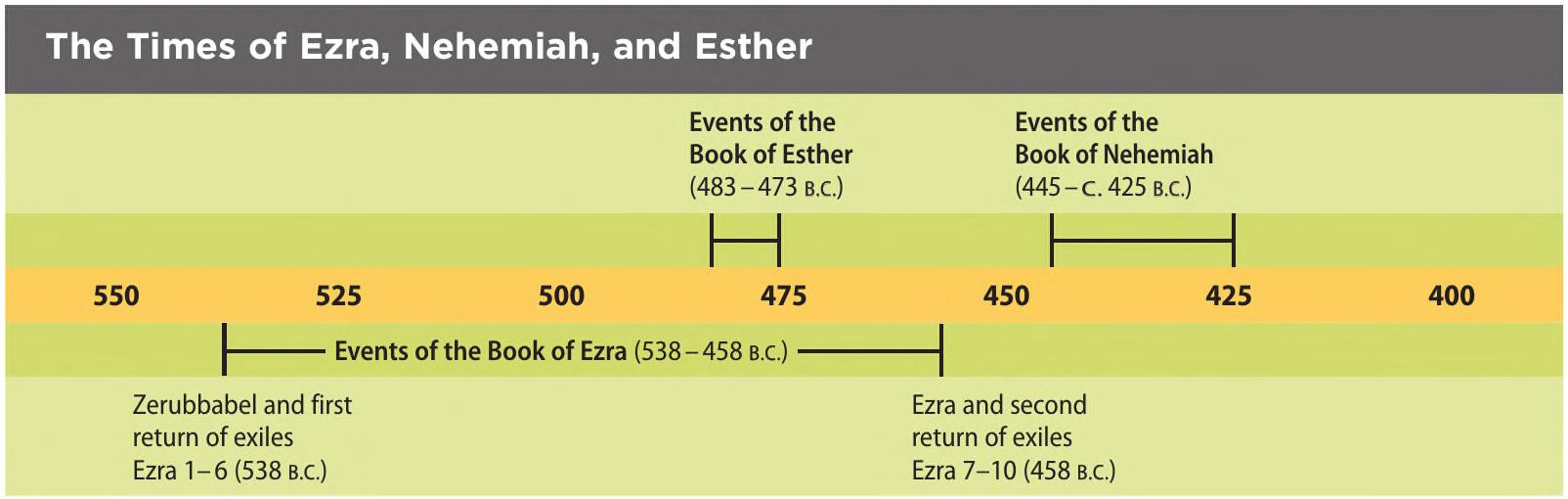
The Times of Ezra, Nehemiah, and Esther
Events of the
Book of Esther
(483 – 473 b.c.)
Events of the
Book of Nehemiah
(445 – c. 425 b.c.)
550
525
500
475
450
425
400
Events of the Book of Ezra (538 – 458 b.c.)
Zerubbabel and first
return of exiles
Ezra 1– 6 (538 b.c.)
Ezra and second
return of exiles
Ezra 7–10 (458 b.c.)
Original illustrations
End of source page 775