PRINTED PAGE 734NKJV · STUDY EDITION
734 | Ezra 3:6
7 k 1 Kin. 5:6, 9;
2 Chr. 2:10; Acts
12:20 l 2 Chr. 2:16;
Acts 9:36 m Ezra
1:2; 6:3
8 n Ezra 3:2; 4:3
o 1 Chr. 23:4, 24
4 Jehozadak, 1 Chr.
6:14
9 5 Hodaviah, Ezra
2:40
God at Jerusalem, n Zerubbabel the son
of Shealtiel, Jeshua the son of 4 Jozadak,
and the rest of their brethren the priests
and the Levites, and all those who had
come out of the captivity to Jerusalem,
began work o and appointed the Levites
from twenty years old and above to over
see the work of the house of the LORD.
9 Then Jeshua with his sons and broth
ers, Kadmiel with his sons, and the sons
of 5 Judah, arose as one to oversee those
working on the house of God: the sons of
Henadad with their sons and their breth
ren the Levites.
10 When the builders laid the foun
LORD. 6 From the first day of the seventh
month they began to offer burnt offerings
to the LORD, although the foundation of
the temple of the LORD had not been laid.
7 They also gave money to the masons
and the carpenters, and k food, drink,
and oil to the people of Sidon and Tyre
to bring cedar logs from Lebanon to the
sea, to l Joppa, m according to the permis
sion which they had from Cyrus king of
Persia.
Restoration of the Temple Begins
8 Now in the second month of the sec
ond year of their coming to the house of
3:7 When Solomon built the first temple, he purchased materials
from Sidon and Tyre, had them shipped to Joppa, and paid for
them with grain, wine, and oil (see 2 Chr. 2:10–16).
3:8 The construction of Solomon’s temple had begun in the second
month of the year (see 1 Kin. 6:1). Likewise, construction of the sec
ond temple began in the second month. from twenty years old
and above: The Law had required that Levites be at least 30 years
old before they entered into service (Num. 4:1–3). Later, the mini
mum age was reduced to 25 (see Num. 8:24). Finally, David lowered
the minimum age to 20 (see 1 Chr. 23:24, 27). The lower minimum
age allowed more Levites to enter into temple service. This provision
was vital in view of the small number of Levites who made the trip
back to Jerusalem (2:40).
3:10, 11 The returnees to Jerusalem celebrated laying the temple’s
foundation in almost the same way that the previous generation had
celebrated the first temple (see 2 Chr. 5:13). Two choruses were sung
responsively. One group sang For He is good; the other group
responded with For His mercy endures forever (see Neh. 12:31).
Archaeological evidence confirms that the Persian period in the Holy Land was
a comparatively impoverished one in terms of material culture. Later Aramaic
documents from Elephantine in Upper Egypt illustrate the official process of
gaining permission to construct a Jewish place of worship and the opposition
engendered by such a project.
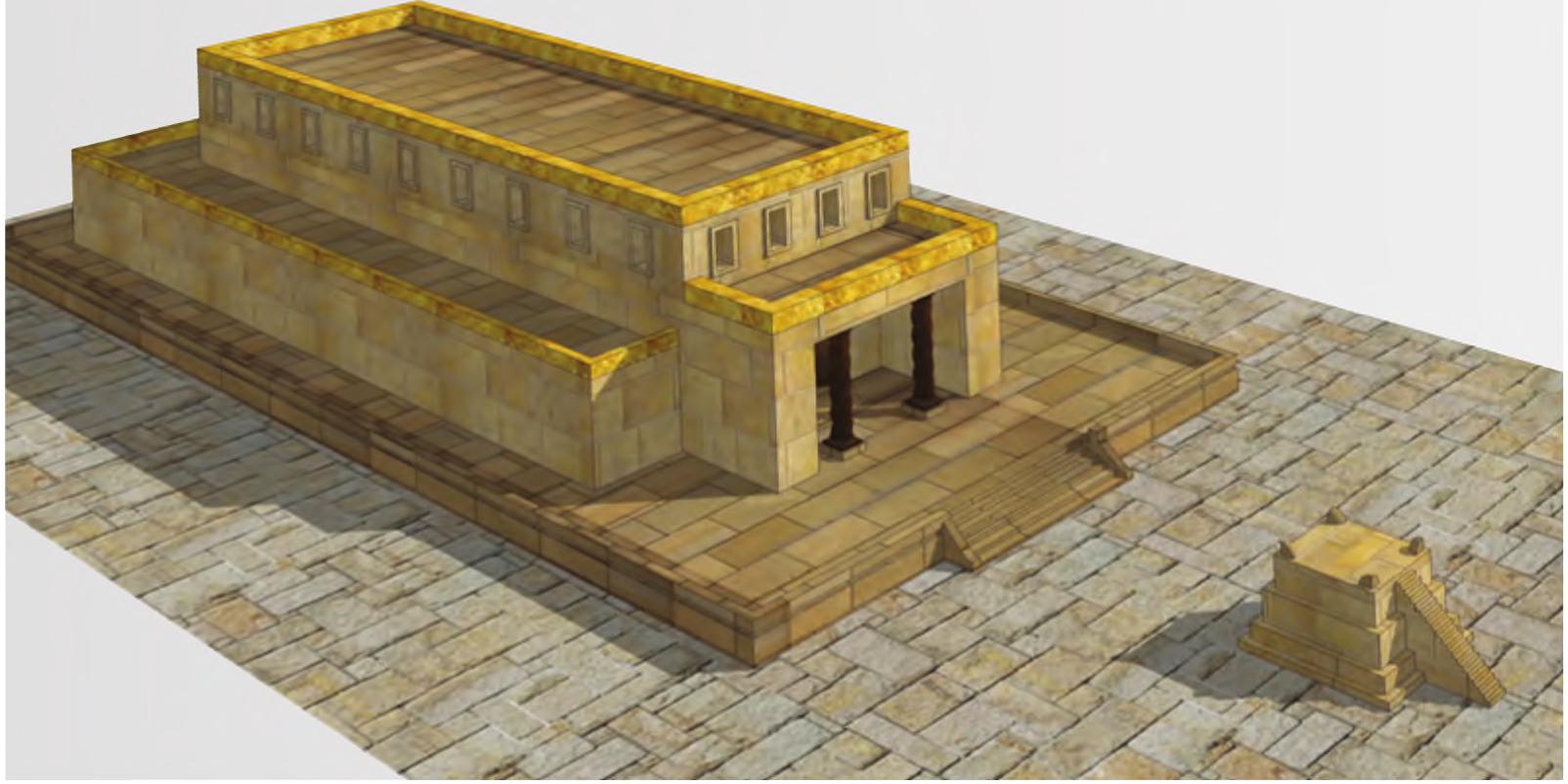
Of the temple and its construction, little is known. Consequently, all art recon
structions of it are tentative. Among the few contemporary buildings, the Persian
palace at Lachish and the Tobiad monument at Iraq al-Amir may be compared
in terms of technique.
Unlike the more famous structures razed in 586 b.c. and a.d. 70, the temple begun
by Zerubbabel suffered no major hostile destruction, but was gradually repaired
and reconstructed over a long period of time. Eventually it was replaced entirely
by Herod’s magnificent edifice.
Construction of the second tem
ple was started in 536 b.c. on the
Solomonic foundations leveled
a half-century earlier by the Bab
ylonians. People who remembered
the earlier temple wept at the com
parison (Ezra 3:12). Not until 516 b.c.,
the 6th year of the Persian emperor
Darius I (522–486), was the temple
finally completed at the urging of
Haggai and Zechariah (Ezra 6:13–15).
Zerubbabel’s Temple
Original illustrations
End of source page 769