PRINTED PAGE 39NKJV · STUDY EDITION
Genesis 21:21 | 39
21:14 This scene must have been exceedingly difficult for Abra-
ham. He had no idea that another morning in his life would be even
worse (see 22:3). Bread and a skin of water are meager provisions.
The skin refers to a water bag made of animal skin. sent her away:
Years before, Hagar had had to leave the same household while
pregnant with Ishmael (16:6). Wilderness of Beersheba (see also v.
31): Later there would be a city built in this place; in this early period
it was merely a region for herding sheep and goats. Isaac was later
to rediscover water in this region (26:33).
21:15 water . . . used up: It would not take long for the two refugees
to use up their meager provisions.
21:16 Let me not see: Despite her sometimes mean spirit against
Sarah, Hagar loved her son. The thought that she was about to lose
her son to the desert heat was unbearable for her.
21:17 God heard: What wonderful words these are! There is no pain
of His people that He does not see or hear about (see Is. 40:27, 28;
Heb. 2:10, 18; 4:15). God was near to deliver; the child would not die.
21:18 God renewed his promise to Hagar and Ishmael; Ishmael
would become a great nation (see 16:10–12).
21:19 Hagar was so overcome with grief that she was unaware of
the provision of water right before her. God showed a well of water.
How fitting that the promise of God would again be beside a pro-
vision of water (see 16:7, 14). Often in the pages of the OT, a spring
or well of water is a symbol of spiritual salvation as well as physical
deliverance (see Is. 12:3; Jer. 2:13).
21:20 God’s promise was realized in Ishmael’s life. He became an
archer; that is, he learned to hunt.
21:21 wife: Hagar made sure that Ishmael married an Egyptian, one
of her own people, much as Abraham’s servant searched for a wife
for Isaac from among his parents’ people (24:4).
12 p Matt. 1:2; Luke
3:34; [Rom. 9:7,
8] ; Heb. 11:18
13 q Gen. 16:10;
17:20; 21:18; 25:12-
18 5 descendant
14 r John 8:35 6 A
water bottle made
of skins
17 s Ex. 3:7; Deut.
26:7; Ps. 6:8 t Gen.
22:11
18 u Gen. 16:10;
21:13; 25:12-16
19 v Gen. 3:7; Num.
22:31; 2 Kin. 6:17;
Luke 24:31
20 w Gen. 28:15;
39:2, 3, 21 x Gen.
16:12
see the death of the boy.” So she sat op-
posite him, and lifted her voice and wept.
17 And s God heard the voice of the lad.
Then the t angel of God called to Hagar
out of heaven, and said to her, “What
ails you, Hagar? Fear not, for God has
heard the voice of the lad where he is.
18 Arise, lift up the lad and hold him with
your hand, for u I will make him a great
nation.”
19 Then v God opened her eyes, and she
saw a well of water. And she went and
filled the skin with water, and gave the
lad a drink. 20 So God w was with the lad;
and he grew and dwelt in the wilderness,
x and became an archer. 21 He dwelt in
the Wilderness of Paran; and his mother
of the lad or because of your bondwoman.
Whatever Sarah has said to you, listen to
her voice; for p in Isaac your seed shall be
called. 13 Yet I will also make q a nation of
the son of the bondwoman, because he is
your 5 seed.”
14 So Abraham rose early in the morn-
ing, and took bread and 6 a skin of water;
and putting it on her shoulder, he gave it
and the boy to Hagar, and r sent her away.
Then she departed and wandered in the
Wilderness of Beersheba. 15 And the
water in the skin was used up, and she
placed the boy under one of the shrubs.
16 Then she went and sat down across
from him at a distance of about a bow-
shot; for she said to herself, “Let me not
Bible Times & Culture Notes
Wells
References in English versions of the Bible sometimes confuse wells,
natural springs, and cisterns. The Bible mentions different types of
wells including a cistern dug in the ground (Gen. 16:14; 2 Sam. 17:18);
a spring (Ps. 84:6); a fountain (Neh. 2:13); and a pit (John 4:11, 12).
Wells in Palestine were dug from solid limestone rock, sometimes
with descending steps (Gen. 24:16). The brims of still other wells
had a curb or low wall of stone. There is no information on how
biblical wells were dug, but the process must have been very dif-
ficult because only crude tools were available. Many ancient wells
descended to a great depth. Jacob’s Well is still 75 feet deep and at
one time it may have been twice as deep. These deep wells were
necessary because of the problem of shallow wells running dry in
the summer.
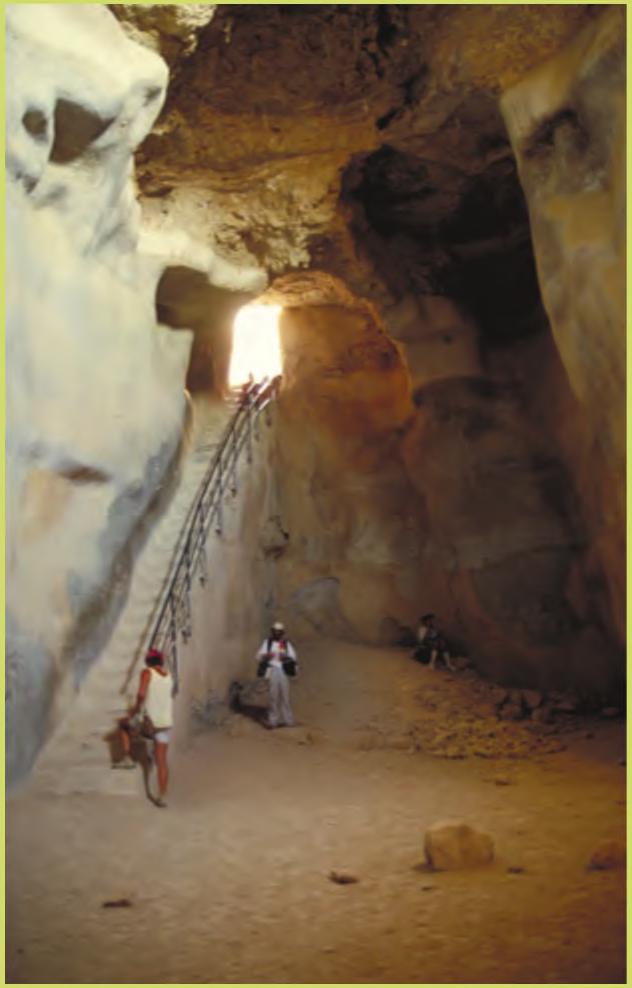
A very large cistern at the southwest corner of
Masada (note the steps). A cistern is one of the
types of wells mentioned in the Bible.
© 1995 by Phoenix Data Systems
Original illustrations
End of source page 74