PRINTED PAGE 679NKJV · STUDY EDITION
2 Chronicles 3:1 | 679
had warned the Israelites not to take spouses committed to pagan
religions (Deut. 7:1–5).
2:16 Joppa, now known as Jaffa, was the only seaport on the Isra
elite Mediterranean coast between Dor on the north and Philistia to
the south. Jonah sailed from Joppa to escape God’s call to Nineveh
(Jon. 1:3). Though Hiram’s rafts helped transport the timber from
Lebanon to Israel, the route from Joppa to Jerusalem was not so
easy—it was a winding, steep ascent of nearly 40 miles.
2:17 Solomon’s policy of forced labor drafted aliens first into the
hard work of carrying loads and quarrying stone (v. 18). The term
suggests any persons living in Israel who were not native Israelites.
The census refers to David’s ill-advised count in the closing years
of his reign (1 Chr. 21:1–5).
3:1 Mount Moriah was sacred and therefore an appropriate
place for the temple not only because the threshing floor of
Ornan was there (see 1 Chr. 21:18–30), but also because it was
the “land of Moriah” to which Abraham took Isaac for sacrifice
(Gen. 22:2). David had received explicit instructions from the Lord
that the very site that he had purchased from Ornan, and where
he had already built an altar, should be the location of the future
temple (1 Chr. 21:18, 26). Mount Moriah is known today as the
temple mount and the site of the Muslim Dome of the Rock. It is
15 r 2 Chr. 2:10
16 s 1 Kin. 5:8, 9
8 Heb. Japho
17 t 1 Kin. 5:13;
2 Chr. 8:7, 8
u 1 Chr. 22:2
18 v 2 Chr. 2:2
CHAPTER 3
1 a 1 Kin. 6:1 b Gen.
22:2-14 c 1 Chr.
21:18; 22:1 1 Lit. He,
following MT, Vg.;
LXX the Lord; Tg. the
Angel of the Lord
2 Araunah, 2 Sam.
24:16
after the census in which u David his fa
ther had numbered them; and there were
found to be one hundred and fifty-three
thousand six hundred. 18 And he made
v seventy thousand of them bearers of
burdens, eighty thousand stonecutters
in the mountain, and three thousand six
hundred overseers to make the people
work.
Solomon Builds the Temple
3
Now a Solomon began to build the
house of the LORD at b Jerusalem on
Mount Moriah, where 1 the LORD had
appeared to his father David, at the
place that David had prepared on the
threshing floor of c Ornan 2 the Jebusite.
stone and wood, purple and blue, fine
linen and crimson, and to make any
engraving and to accomplish any plan
which may be given to him, with your
skillful men and with the skillful men
of my lord David your father.
15 Now therefore, the wheat, the barley,
the oil, and the wine which r my lord
has spoken of, let him send to his
servants. 16 s And we will cut wood
from Lebanon, as much as you need;
we will bring it to you in rafts by sea
to 8 Joppa, and you will carry it up to
Jerusalem.
17 t Then Solomon numbered all the
aliens who were in the land of Israel,
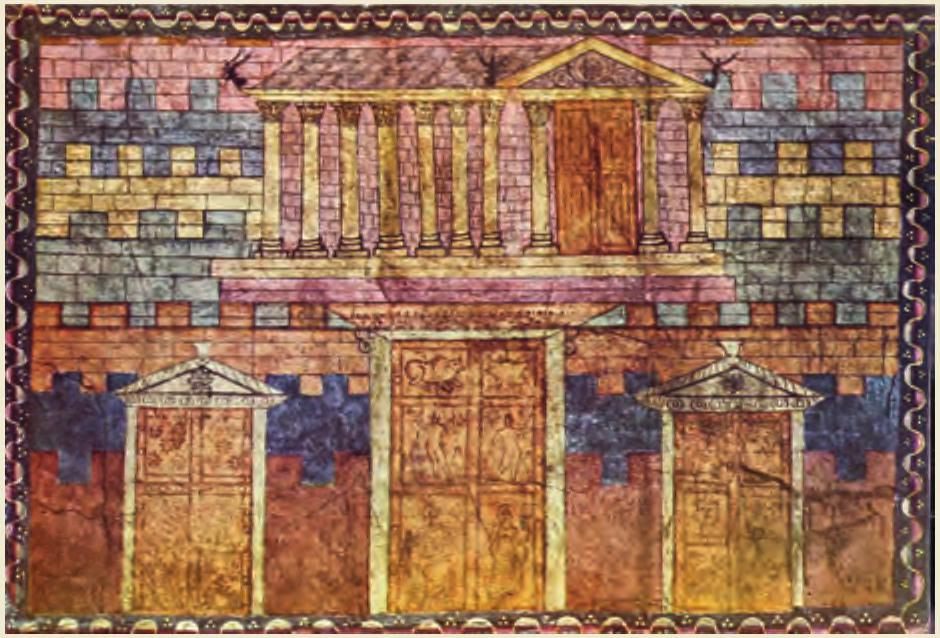
A third-century a.d. interpretation of Solomon’s temple from a wall
painting at Dura-Europos
Z. Radovan/www.BibleLandPictures.com
Solomon’s Temple
Solomon’s temple was the first of three temples that Israel built in its long history. David wanted to build it, but as a man
of war he was unqualified to build such a holy place. So with the plans that God gave David and David passed on to him,
King Solomon built the house of God. As God had instructed, Solomon built it on Mount Moriah just north of the ancient
City of David.
Solomon wanted to build a temple worthy of being the center of worship for the entire nation, so he used only the best
craftsmen and materials. The materials included cedar and algum logs, gold and silver, cut stone, and fine linen. Most of
the temple’s beams, posts, walls, and doors were overlaid with gold, decorated with carvings of palm trees, garlands, and
cherubim. The Most Holy Place alone was overlaid with 23 tons of fine gold. In this room two giant gold cherubim, with
seven-and-a-half-foot wings overshadowed the ark of the covenant. A veil of crimson and fine linen separated the Most
Holy Place from the holy place. The temple’s furnishings included ten lampstands of gold, ten tables, and one hundred
bowls of gold. Only the most skilled craftsmen
worked on these details. The temple was 60
cubits long and 20 cubits wide or 90 by 30 feet.
It took seven years for Solomon’s workers to
complete this grand building, and the finished
structure dazzled all who saw it. Yet for all its
beauty, Solomon knew that no manmade build
ing could contain God, as heaven itself could
not contain Him (6:18). The temple served
mainly as a reminder of God’s covenant. To all
who came and worshiped there, God held out
His promised presence.
However, the temple was no guarantee of
that presence. God had promised to live among
the Israelites forever, and the temple was God’s
so-called “dwelling place,” but for the Holy God
to live among His people they had to remain
faithful to Him. Unfortunately they did not
remain faithful, and consequently the temple
was looted and destroyed as were the second
and third temples after it.
Original illustrations
End of source page 714