PRINTED PAGE 659NKJV · STUDY EDITION
1 Chronicles 18:11 | 659
25 5 Lit. have
uncovered the ear of
26 6 Or You alone
are
CHAPTER 18
1 a 2 Sam. 8:1-18
1 Lit. struck
2 b 2 Sam. 8:2;
Zeph. 2:9 c Ps. 60:8
2 Lit. struck
3 d 2 Sam. 8:3
3 Lit. struck 4 Heb.
Hadarezer
4 5 seven hundred,
2 Sam. 8:4
6 crippled
5 e 2 Sam. 8:5, 6;
1 Kin. 11:23-25
8 f 2 Sam. 8:8
g 1 Kin. 7:15, 23;
2 Chr. 4:12, 15, 16
7 Betah, 2 Sam.
8:8 8 Berothai,
2 Sam. 8:8 9 Heb.
Hadarezer 1 Great
laver or basin
9 2 Toi, 2 Sam. 8:9,
10 3 Lit. struck
10 h 2 Sam. 8:10-12
4 Joram, 2 Sam. 8:10
5 Lit. struck
of Damascus; and the Syrians became
David’s servants, and brought tribute.
So the LORD preserved David wherever
he went. 7 And David took the shields of
gold that were on the servants of Had
adezer, and brought them to Jerusalem.
8 Also from 7 Tibhath and from 8 Chun,
cities of 9 Hadadezer, David brought a
large amount of f bronze, with which
g Solomon made the bronze 1 Sea, the pil
lars, and the articles of bronze.
9 Now when 2 Tou king of Hamath
heard that David had 3 defeated all the
army of Hadadezer king of Zobah, 10 he
sent 4 Hadoram his son to King David, to
greet him and bless him, because he had
fought against Hadadezer and 5 defeated
him (for Hadadezer had been at war
with Tou); and Hadoram brought with
him all kinds of h articles of gold, silver,
and bronze. 11 King David also dedicated
own people forever; and You, LORD, have
become their God.
23 “And now, O LORD, the word which
You have spoken concerning Your ser
vant and concerning his house, let it be
established forever, and do as You have
said. 24 So let it be established, that Your
name may be magnified forever, saying,
‘The LORD of hosts, the God of Israel, is
Israel’s God.’ And let the house of Your
servant David be established before You.
25 For You, O my God, 5 have revealed to
Your servant that You will build him a
house. Therefore Your servant has found
it in his heart to pray before You. 26 And
now, LORD, 6 You are God, and have
promised this goodness to Your servant.
27 Now You have been pleased to bless the
house of Your servant, that it may con
tinue before You forever; for You have
blessed it, O LORD, and it shall be blessed
forever.”
David’s Further Conquests
18
After this a it came to pass that Da
vid 1 attacked the Philistines, sub
dued them, and took Gath and its towns
from the hand of the Philistines. 2 Then
he 2 defeated b Moab, and the Moabites
became David’s c servants, and brought
tribute.
3 And d David 3 defeated 4 Hadadezer
king of Zobah as far as Hamath, as he
went to establish his power by the River
Euphrates. 4 David took from him one
thousand chariots, 5 seven thousand
horsemen, and twenty thousand foot
soldiers. Also David 6 hamstrung all the
chariot horses, except that he spared
enough of them for one hundred chariots.
5 When the e Syrians of Damascus came
to help Hadadezer king of Zobah, David
killed twenty-two thousand of the Syr
ians. 6 Then David put garrisons in Syria
17:23 the word which You have spoken: David referred here to
the covenant God had just made with him concerning his dynasty
(17:7–14). David’s appeal to God to establish His word came imme
diately after his reference to the Exodus and the Mosaic covenant.
David knew that God’s covenant with him was founded on God’s
previous promises to Abraham.
18:1 This is the only record of David taking a Philistine city, although
he had defeated the Philistines many times in battle. Gath was the
Philistine city closest to Israelite territory, so it offered the greatest
threat to Israel.
18:2 It must have been with mixed feelings that David undertook a
campaign against the Moabites, for he had strong emotional links
with Moab. His great-grandmother Ruth came from Moab (Ruth
4:13–17) and David had sent his own family there for protection
when he was hiding from Saul (1 Sam. 22:3, 4).
18:3 The campaign here may be connected to the Aramean war
more fully outlined in 19:1–19, because Hadadezer is mentioned
in both places. His kingdom, Zobah, lay immediately north of
Damascus. David pursued him as far as Hamath, a hundred miles
beyond Damascus, in an effort to extend the Israelite empire all
the way to the River Euphrates. David’s justification may have been
God’s promise to Abraham that the land He was giving him would
extend “from the river of Egypt to the great river, the River Euphra
tes” (Gen. 15:18).
18:5 The capital of the Aramean kingdom just north and northeast
of Israel was Damascus.
18:6 servants . . . tribute: These technical terms, as in the case of
Moab (v. 2), suggest that Damascus became a vassal state under
Israel. Very quickly, Moab and Damascus became client states and
Zobah an occupied territory.
18:8 To the two cities Tibhath . . . Chun, Samuel added a third
Berothai (2 Sam. 8:8). All three are referred to in Egyptian texts. They
were northeast of Baalbek in central Lebanon.
18:10 greet . . . bless: This apparently casual language covers a
more formal situation in which Tou, king of Hamath, was approach
ing David in willing submission to him as king. In other words, what
Moab and Damascus did involuntarily, Hamath was doing voluntari
ly, making itself a vassal state under Israel.
18:11 The fact that David dedicated all the spoils of war to God
suggests that he viewed the battles as campaigns of holy war. In
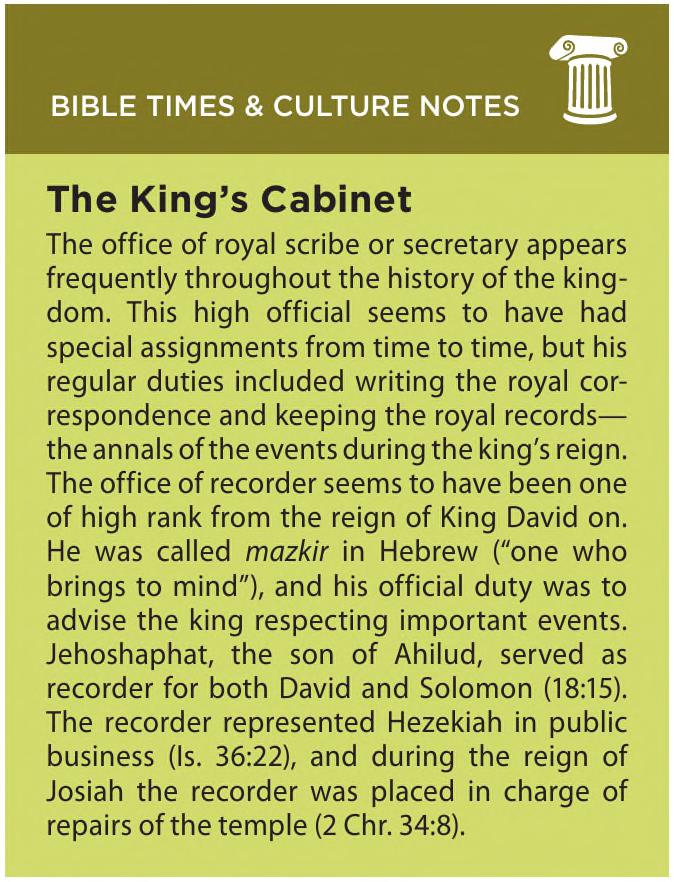
Bible Times & Culture Notes
The King’s Cabinet
The office of royal scribe or secretary appears
frequently throughout the history of the king
dom. This high official seems to have had
special assignments from time to time, but his
regular duties included writing the royal cor
respondence and keeping the royal records—
the annals of the events during the king’s reign.
The office of recorder seems to have been one
of high rank from the reign of King David on.
He was called mazkir in Hebrew (“one who
brings to mind”), and his official duty was to
advise the king respecting important events.
Jehoshaphat, the son of Ahilud, served as
recorder for both David and Solomon (18:15).
The recorder represented Hezekiah in public
business (Is. 36:22), and during the reign of
Josiah the recorder was placed in charge of
repairs of the temple (2 Chr. 34:8).
Original illustrations
End of source page 694