PRINTED PAGE 33NKJV · STUDY EDITION
Genesis 18:4 | 33
17:23–25 Abraham took Ishmael: Again we see Abraham com-
pletely obey the command of the Lord (see 12:4; 22:3). On the very
day he received the command from God, he did just as the Lord
commanded. All the males in his household from little boys to aged
men were treated alike.
18:1–15 God reaffirmed His covenant with Abraham, reconfirming
His promise to Sarah. This section is also a part of the complex of
texts that make up the Abrahamic covenant (see the list at 15:1–21).
18:1 This is the fifth time the Lord appeared to Abraham since
he had come into the land of Canaan. (1) The first was the appear-
ance at the altar Abram built in Shechem when he first entered the
land (12:7). (2) The second was after Lot had separated from Abram
when they came back to Canaan from Egypt (13:14–17). (3) The third
followed Abram’s heroic rescue of Lot from the league of invading
kings and the subsequent encounter with Melchizedek (15:1–21).
(4) The fourth came 13 years after the birth of Ishmael, when the
Lord renewed His covenant with Abraham and instituted the rite of
circumcision (17:1–22). Mamre was one of Abram’s allies in his battle
against the invading kings from Mesopotamia (see 14:13). The place
name Mamre was probably associated with a personal name. This
region came to be known as Hebron (see 13:18; 23:17). in the heat
of the day: The southern desert or the Negev (see 12:9) can become
very hot in the summer, reaching above 110° F. People usually did
hard, physical work early in the morning or late in the afternoon.
18:2, 3 Verse 1 states that it was the Lord who appeared to Abraham;
v. 2 speaks of three men; v. 13 suggests that one of these men was
the Lord. Who were the other two? Probably attending angels; each
of the three visitors looked like men, but one was even greater than
angels (see 19:1). The writer of Hebrews used this account to encour-
age hospitality to strangers, “for by so doing some have unwittingly
entertained angels” (Heb. 13:2). Abraham’s words My Lord suggests
that he suspected the identity of the visitors, but perhaps he was
not sure until later of the full significance of the event.
27 j Gen. 18:19
CHAPTER 18
1 a Gen. 13:18; 14:13
1 Heb. Alon Mamre
2 b Gen. 18:16, 22;
32:24; Josh. 5:13;
Judg. 13:6-11; Heb.
13:2 c Gen. 19:1;
1 Pet. 4:9
4 d Gen. 19:2; 24:32;
43:24
house or bought with money from a for-
eigner, were circumcised with him.
The Son of Promise
18
Then the LORD appeared to him
by 1 the a terebinth trees of Mamre,
as he was sitting in the tent door in the
heat of the day. 2 b So he lifted his eyes
and looked, and behold, three men were
standing by him; c and when he saw them,
he ran from the tent door to meet them,
and bowed himself to the ground, 3 and
said, “My Lord, if I have now found
favor in Your sight, do not pass on by
Your servant. 4 Please let d a little water
be brought, and wash your feet, and rest
He finished talking with him, and God
went up from Abraham.
23 So Abraham took Ishmael his son, all
who were born in his house and all who
were bought with his money, every male
among the men of Abraham’s house, and
circumcised the flesh of their foreskins
that very same day, as God had said to
him. 24 Abraham was ninety-nine years
old when he was circumcised in the
flesh of his foreskin. 25 And Ishmael his
son was thirteen years old when he was
circumcised in the flesh of his foreskin.
26 That very same day Abraham was
circumcised, and his son Ishmael; 27 and
j all the men of his house, born in the
Bible Times & Culture Notes
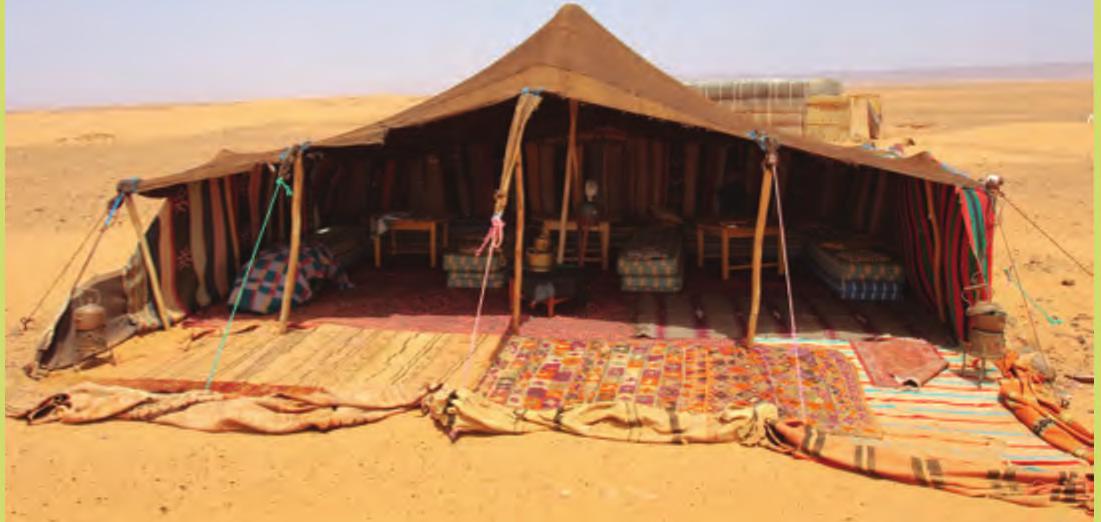
Tents
Temporary shelters made of cloth, supported usually by poles and ropes. In biblical times tents were frequently made
of a cloth woven out of black goat’s hair. The cloth was woven on a loom in long strips, which were then sewn together
until the desired length was reached. While tents came in a variety of sizes and shapes, the traditional shape has been
a rectangle. The side and end
walls were made of reed mats,
which were removable to
catch the breeze. The interior
of a tent was quite plain. The
floor was covered with mats or
a rug upon which the people
sat. A chest or two and a low
table might be the only furni-
ture. Since a family’s belong-
ings had to be packed and
moved frequently, even the
wealthy did not accumulate
numerous pieces of furniture.
A modern bedouin tent. The
tents bedouins use today are
still very similar to the ones
used during the biblical era.
© Seleznev Oleg/Shutterstock
Original illustrations
End of source page 68