PRINTED PAGE 633NKJV · STUDY EDITION
1 Chronicles 1:34 | 633
CHAPTER 1
1 a Gen. 1:27; 2:7;
5:1, 2, 5 b Gen. 4:25,
26; 5:3-9
4 c Gen. 5:28–10:1
1 So with MT, Vg.;
LXX adds the sons
of Noah
5 d Gen. 10:2-4
6 2 Riphath, Gen.
10:3
7 3 Tarshish, Gen.
10:4 4 Dodanim,
Gen. 10:4
8 e Gen. 10:6
9 5 Sabtah, Gen.
10:7 6 Raamah,
Gen. 10:7
10 f Gen. 10:8-10, 13
12 g Deut. 2:23
13 h Gen. 9:18,
25-27; 10:15
17 i Gen. 10:22-29;
11:10 j Luke 3:36
7 Mash, Gen. 10:23
19 8 Lit. Division,
Gen. 10:25 9 Or
land
20 k Gen. 10:26
22 1 Obal, Gen. 10:28 24 l Gen. 11:10-26; Luke 3:34-36
25 m Gen. 11:15 27 n Gen. 17:5 28 o Gen. 21:2, 3 p Gen. 21:2
q Gen. 16:11, 15 29 r Gen. 25:13-16 30 2 Hadar, Gen. 25:15
32 s Gen. 25:1-4 34 t Gen. 21:2 u Gen. 25:9, 25, 26, 29; 32:28
1:1 Adam, Seth, Enosh: The names of these ancient, pre-Flood
characters were included in the genealogical record with people
whose historical identities have never been questioned, such as
David (2:15) and Zerubbabel (3:19). This indicates that the chronicler
had no question as to their historicity.
1:7, 8 Rodanim referred to the Rhodites, natives of the Greek island
of Rhodes. sons of Ham: Great nations were indicated by some of
the names here: Cush referred to the Ethiopians, Mizraim to the
Egyptians, Canaan to the Canaanites.
1:10 Cush begot Nimrod: It seems that the chronicler used the
genealogy of Gen. 10 as the primary source for this genealogy.
However, he used it selectively. For example, Gen. 10:9–12 was not
included. The apparent purpose of this genealogy was to establish
the line between Adam and David, and between David and the
reigning Davidic monarch.
1:12 Caphtorim: These people lived in Caphtor (Deut. 2:23), known
in ancient Akkadian texts as Kaptara and probably to be identified
as Crete. The Caphtorim were related to the Philistines, or the two
terms might even be interchangeable (see Jer. 47:4; Amos 9:7).
1:13 Heth founded the nation of the Hittites, a people in what is
now central Turkey who achieved great power and prominence in
the middle of the second millennium b.c. After the Hittite kingdom
fell to the Sea Peoples around 1200 b.c., many Hittites settled in
enclaves in Syria and Palestine.
1:18 Eber was the ancestor of Abraham, Isaac, and Jacob. The name
Hebrew, a derivative of Eber’s name, was applied to the Israelites.
The central place Eber occupies in the genealogies of Abram in Gen
esis and 1 Chronicles suggests a connection between the names
Hebrew and Eber (1:24–27; see Gen. 10:21; 11:10–26). Indeed the
name Hebrew may simply mean an “Eberite.”
1:19 the earth was divided: This refers to the division of the
earth’s population by the scattering of the human race following
the judgment of God on the Tower of Babel. Chronologically, Peleg
apparently fits about halfway between Shem and Abram (1:24–27),
a most suitable place for the Tower of Babel episode.
1:28 Isaac was the son of the covenant, so his name occurs first
when the names Isaac and Ishmael are mentioned together, even
though Ishmael was born first. Moreover, Ishmael was the son of
Abraham’s concubine Hagar—not of his wife Sarai.
1:32, 33 Both Ishmael and Midian were descendants of Abraham,
Ishmael by a concubine and Midian by another wife Abraham mar
ried after Sarah’s death (Gen. 25:1, 2). The Ishmaelites and Midianites
were tribes that lived in the Arabian deserts.
The Family of Adam—
Seth to Abraham
A
dam, a b Seth, Enosh, 2 Cainan,
Mahalalel, Jared, 3 Enoch, Me
thuselah, Lamech, 4 c Noah, 1
Shem, Ham, and Japheth.
5 d The sons of Japheth were Gomer,
Magog, Madai, Javan, Tubal, Meshech,
and Tiras. 6 The sons of Gomer were
Ashkenaz, 2 Diphath, and Togarmah.
7 The sons of Javan were Elishah, 3 Tar
shishah, Kittim, and 4 Rodanim.
8 e The sons of Ham were Cush, Mizra
im, Put, and Canaan. 9 The sons of Cush
were Seba, Havilah, 5 Sabta, 6 Raama, and
Sabtecha. The sons of Raama were Sheba
and Dedan. 10 Cush f begot Nimrod; he
began to be a mighty one on the earth.
11 Mizraim begot Ludim, Anamim, Le
habim, Naphtuhim, 12 Pathrusim, Cas
luhim (from whom came the Philistines
and the g Caphtorim). 13 h Canaan begot
Sidon, his firstborn, and Heth; 14 the
Jebusite, the Amorite, and the Girgashite;
15 the Hivite, the Arkite, and the Sinite;
16 the Arvadite, the Zemarite, and the
Hamathite.
17 The sons of i Shem were Elam, As
shur, j Arphaxad, Lud, Aram, Uz, Hul,
Gether, and 7 Meshech. 18 Arphaxad begot
Shelah, and Shelah begot Eber. 19 To Eber
were born two sons: the name of one was
8 Peleg, for in his days the 9 earth was di
vided; and his brother’s name was Jok
tan. 20 k Joktan begot Almodad, Sheleph,
Hazarmaveth, Jerah, 21 Hadoram, Uzal,
Diklah,
22 1 Ebal, Abimael, Sheba,
23 Ophir, Havilah, and Jobab. All these
were the sons of Joktan.
24 l Shem, Arphaxad, Shelah, 25 m Eber,
Peleg, Reu, 26 Serug, Nahor, Terah, 27 and
n Abram, who is Abraham. 28 o The sons
of Abraham were p Isaac and q Ishmael.
The Family of Ishmael
29 These are their genealogies: The
r firstborn of Ishmael was Nebajoth;
then Kedar, Adbeel, Mibsam, 30 Mishma,
Dumah, Massa, 2 Hadad, Tema, 31 Jetur,
Naphish, and Kedemah. These were the
sons of Ishmael.
The Family of Keturah
32 Now s the sons born to Keturah, Abra
ham’s concubine, were Zimran, Jokshan,
Medan, Midian, Ishbak, and Shuah. The
sons of Jokshan were Sheba and Dedan.
33 The sons of Midian were Ephah, Epher,
Hanoch, Abida, and Eldaah. All these
were the children of Keturah.
The Family of Isaac
34 And t Abraham begot Isaac. u The
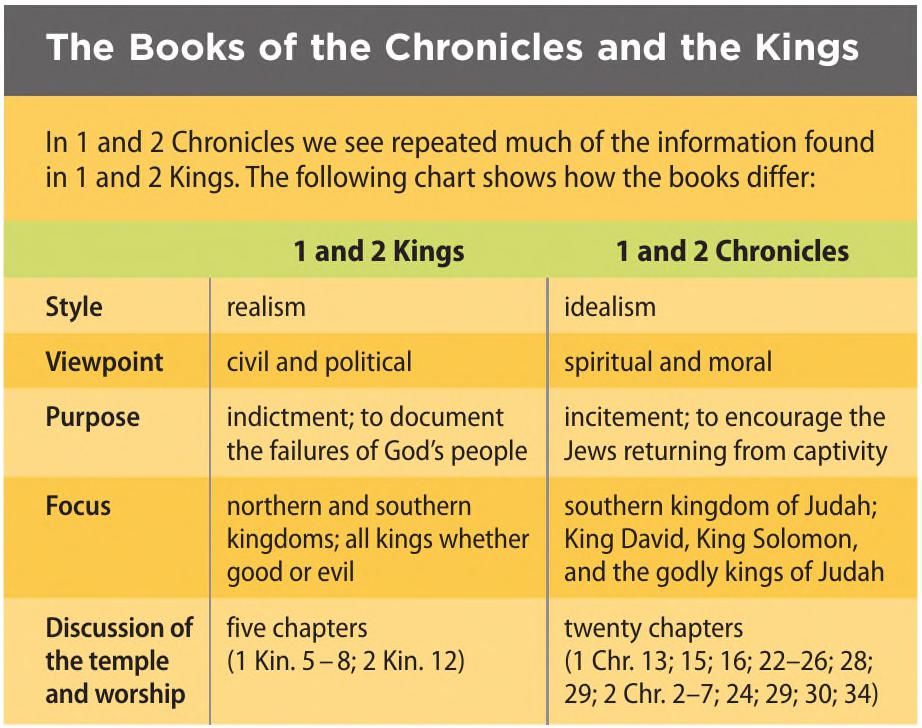
The Books of the Chronicles and the Kings
In 1 and 2 Chronicles we see repeated much of the information found
in 1 and 2 Kings. The following chart shows how the books differ:
1 and 2 Kings
1 and 2 Chronicles
Style
realism
idealism
Viewpoint
civil and political
spiritual and moral
Purpose
indictment; to document
the failures of God’s people
incitement; to encourage the
Jews returning from captivity
Focus
northern and southern
kingdoms; all kings whether
good or evil
southern kingdom of Judah;
King David, King Solomon,
and the godly kings of Judah
Discussion of
the temple
and worship
five chapters
(1 Kin. 5 – 8; 2 Kin. 12)
twenty chapters
(1 Chr. 13; 15; 16; 22–26; 28;
29; 2 Chr. 2–7; 24; 29; 30; 34)
Original illustrations
End of source page 668