PRINTED PAGE 630NKJV · STUDY EDITION
630 1 Chronicles INTRODUCTION
This chronicler’s different emphases explain many of the differences between
the narratives of Chronicles and Samuel. Some of the other apparent contradic
tions, especially in matters of spelling and numbers, can be explained as inadver
tence in copying and text transmission. Numerals appear to have been written
in notations that could easily be confused, and most of the deviations between
Chronicles and Samuel can be accounted for in this manner. In many instances,
the discrepancies are only apparent and suitable ways have been suggested to
harmonize them. In any case, none of them threatens the inspiration and iner
rancy of the original text.
Purpose Writing approximately when the Israelites returned from captivity,
the chronicler wanted to emphasize the Israelites’ continuity with their past. The
remnant was returning to Jerusalem to rebuild the temple because of the prom
ises God had given to David many years before (see Ezra 7:10–23). God’s promises
were still in effect—even though the people had been in exile.
The long genealogical section in 1 Chronicles emphasizes this continuity with
the past (chs. 1–9). The genealogies point out that the promises to David were
founded on God’s ancient promises to the patriarchs. God had pledged to Abra
ham that He would make him the father of a great nation, one through which
He would bless the whole earth (Gen. 12:1–3). God had also promised that a king
would rule over this special nation (Gen. 17:6). It was revealed to Jacob that the
king would descend specifically from Jacob’s son Judah (Gen. 49:10). Finally,
the genealogy in the Book of Ruth explains the link between the promise and
the fulfillment by tracing the line of Judah through his son Perez to King David
(Ruth 4:18–22). God had faithfully fulfilled His promise.
First Chronicles recounts the lineage of the people of God’s promise and
emphasizes the connection between Perez and King David (2:5–15). God would
establish His reign upon the earth through David’s royal line (17:7–15; see Gen.
17:7, 8; 2 Sam. 7). The kings God had promised to Abraham would begin with
David and culminate in the One who would reign forever, Jesus (17:14; see Matt.
9:27; 12:23; Mark 10:47, 48; Luke 18:38). God had given the promise to David, and
the faithful remnant inherited that same promise.
Since the chronicler wanted to encourage the returning Israelites, he focused
on the glories of David’s reign—his conquest of Jerusalem (11:4–9), his heroic sol
diers (11:10–47), his victories over the Philistines (18:1–12), and his celebration when
bringing the ark to Jerusalem (15:25–29). On the other hand, the author of Samuel
told the story of David as an objective, realistic biography that did not overlook
David’s sins and failures. While it does not depict David as spiritually and morally
perfect (see 13:9–14; 21:1, 8), Chronicles surprisingly omits the stories that reveal
David’s weakness—his affair with Bathsheba, his murder of Uriah (2 Sam. 11),
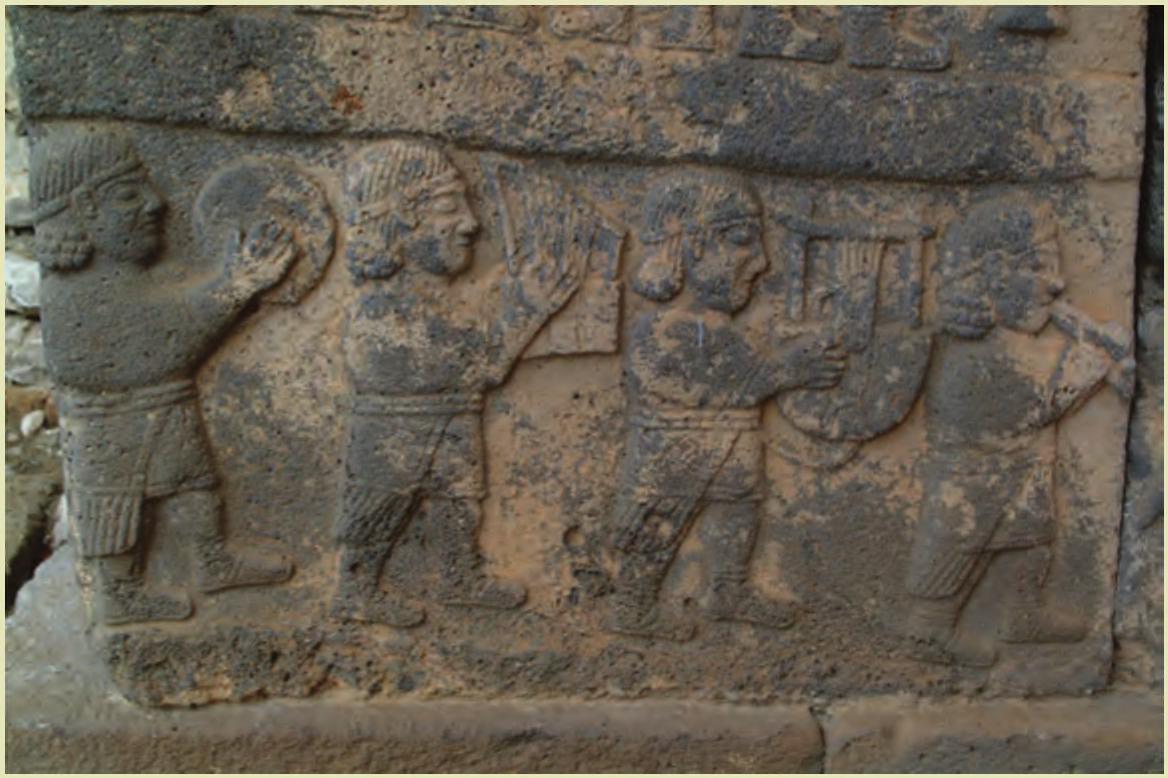
Music was a significant part
of life in the ancient Near
East. The Bible mentions
several instruments, five of
which are listed in 1 Chron
icles 15:28 (several more are
mentioned in Ps. 150:3 – 5;
Dan. 3:5).
Baker Photo Archive
c. 1900 b.c.
Jacob and his
family live in
Canaan
c. 1400 b.c.
The Israelites
conquer the
Promised Land
c. 1050 b.c.
Saul becomes king
of Israel
1010 b.c.
David’s reign
begins in Hebron
997 b.c.
The ark is brought
to Jerusalem
c. 990 b.c.
David wars against
the Ammonites
c. 972 b.c.
David stores up
materials for the
temple
970 b.c.
David dies and
Solomon becomes
king
930 b.c.
Solomon dies
and the kingdom
divides
Original illustrations
End of source page 665