PRINTED PAGE 609NKJV · STUDY EDITION
2 Kings 17:25 | 609
Assyria Resettles Samaria
24 p Then the king of Assyria brought
people from Babylon, Cuthah, q Ava, Ha
math, and from Sepharvaim, and placed
them in the cities of Samaria instead
of the children of Israel; and they took
possession of Samaria and dwelt in its
cities. 25 And it was so, at the beginning
24 p Ezra 4:2, 10
q 2 Kin. 18:34
17:24 The king of Assyria was probably Sargon II (722–705 b.c.),
although the practice described here was continued by later kings
as well. Such a mixing of populations would break down ethnic dis
Asshur
Ur
Haran
Gozan
Carchemish
Damascus
Hamath
Aleppo
Samaria
Jerusalem
Memphis
Nineveh
Babylon
Susa
Achmetha
Tadmor
Erech
Tiphsah
Rezeph
Nippur
Arvad
Byblos
Dur Sharrukin
Calah
Arrapkha
Eu
ph
ra
tes
R
.
Nil
e R.
Ti
g
r
i
s
R.
H
a
b
o
r R
.
Jordan R.
Ar
axe
s
R
.
Red
Sea
Persian
Gulf
Caspian
Sea
Sea
Black
Lake Van
Lake Urmia
GIMIRRAI
(GOMER)
URARTU
(ARARAT)
MEDIA
A R A B I A N
D E S E RT
M e d i t e r r a n e a n
S e a
Mt. Ararat
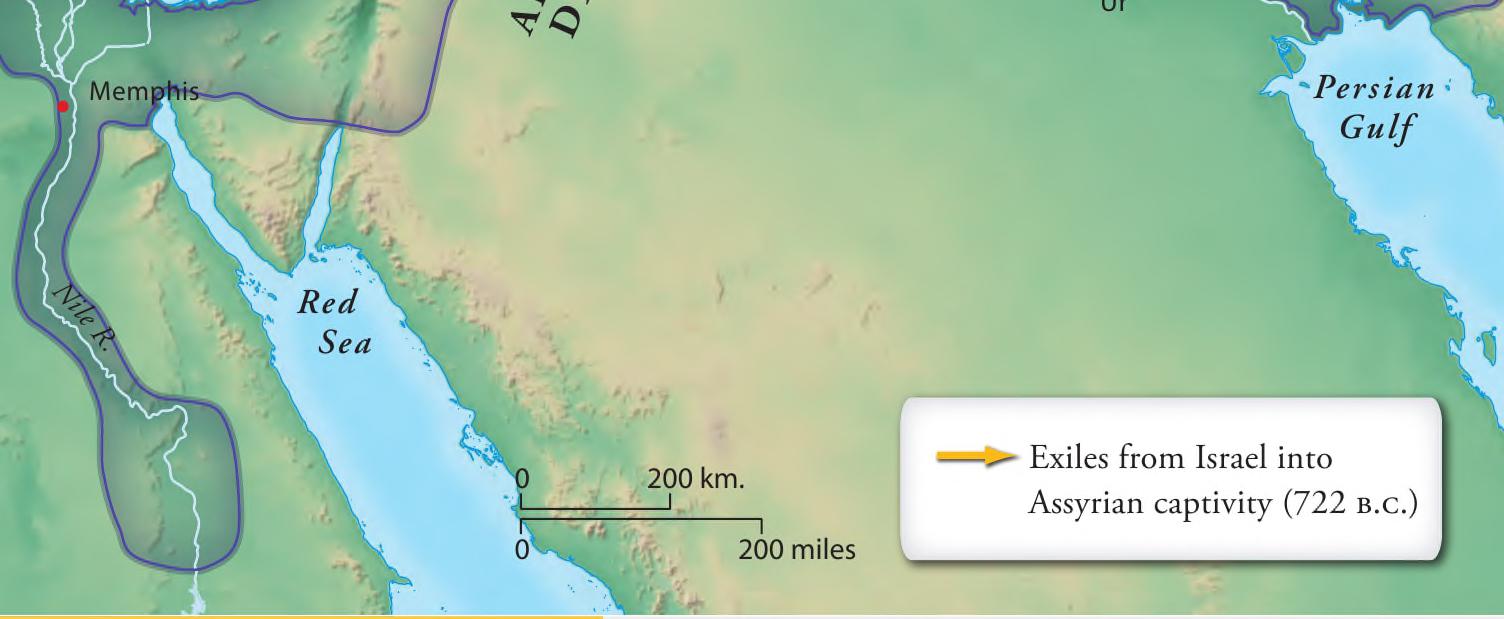
Exiles from Israel into
Assyrian captivity (722 b.c.)
0
200 miles
0
200 km.
The mass deportation policy of the Assyrians was a companion piece to the brutal and calculated terror initiated by
Ashurnasirpal and followed by all his successors. It was intended to forestall revolts but, like all Draconian measures,
it merely spread misery and engendered hatred. In the end, it hastened the disintegration of the Assyrian Empire.
There is some evidence that Israel experienced its
first deportations under Tiglath-Pileser III (745–
727 b.c.), a cruelty repeated by Sargon II (721–705
b.c.) at the time of the fall of Samaria. The latter king’s
inscriptions boast of carrying away 27,290 inhab
itants of the city “as plunder.” According to 2 Kin.
17:6, they were sent to Assyria, to Halah, to Gozan on
the Habor River, and apparently to the eastern fron
tiers of the empire (to the towns of the Medes, most
probably somewhere in the vicinity of Ecbatana, the
modern Hamadan).
Exile of the Northern Kingdom
The sequel is provided by the inscriptions of Sargon: “The Arabs who
live far away in the desert, who know neither overseers nor officials,
and who had not yet brought their tribute to any king, I deported . . .
and settled them in Samaria.”
Much mythology has developed around the theme of the so-called
ten lost tribes of Israel. A close examination of Assyrian records reveals
that the deportations approximated only a limited percentage of the
population, usually consisting of noble families. Agricultural workers,
no doubt the majority, were deliberately left to care for the crops
(cf. the Babylonian practice, 2 Kin. 24:14; 25:12).
Original illustrations
End of source page 644