PRINTED PAGE 577NKJV · STUDY EDITION
2 Kings INTRODUCTION 577
political entanglements with Assyria, ultimately brought the northern kingdom
to its end in 722 b.c. Meanwhile, Jotham and his wicked son Ahaz were ruling the
southern kingdom of Judah. Ahaz was so evil that even the godly Isaiah had little
effect on the king’s spiritual condition. The Scriptures attribute Judah’s ultimate
demise to the idolatry of this king (2 Chr. 28:23).
The remainder of 2 Kings deals with the varying fortunes and spiritual pil
grimage of the southern kingdom, tracing Judah’s history from the righteous
Hezekiah (chs. 18–20) to the wicked sons of Josiah, under whom Jerusalem faced
three invasions and deportations, the last in 586 b.c. Thus Judah was increasingly
caught up in the complex international events that took place from the late eighth
to the early sixth century b.c.
Judah’s ability to maintain its identity in the midst of its powerful neighbors
was due on the one hand to God, who was faithful to His covenant with the house
of David, and on the other hand to the spiritual gains made during the reigns of its
two faithful kings, Hezekiah (729–699 b.c.) and Josiah (640–609 b.c.). However, the
forces of apostasy that had brought about the collapse of the northern kingdom
also took their toll in the southern kingdom. Judah was led away captive, and their
exile would last 70 years. Second Kings ends on this tragic note. Only the final
word of Jehoiachin’s release provides a ray of hope in the darkness of captivity
(25:27–30). The symbolic message is clear: the Lord would still fulfill His promise
to restore His people (see 1 Kin. 8:46–53).
Christ in the Scriptures
While Elijah pointed to Jesus but was a clearer forerunner of John the Baptist
(Matt. 11:14; 17:10; Luke 1:17), it is the younger man for whom Elijah prepared
the way, Elisha, who definitely reminds us of Jesus. When you stop and think
about it, the similarities are impressive. Elijah (like John the Baptist) lived apart
from people, and he stressed the law, judgment, and repentance. But Elisha, like
Jesus, lived among the people and emphasized grace, life, and hope (see 4:8–37;
6:14–23; 8:7–15; 19:16–21).
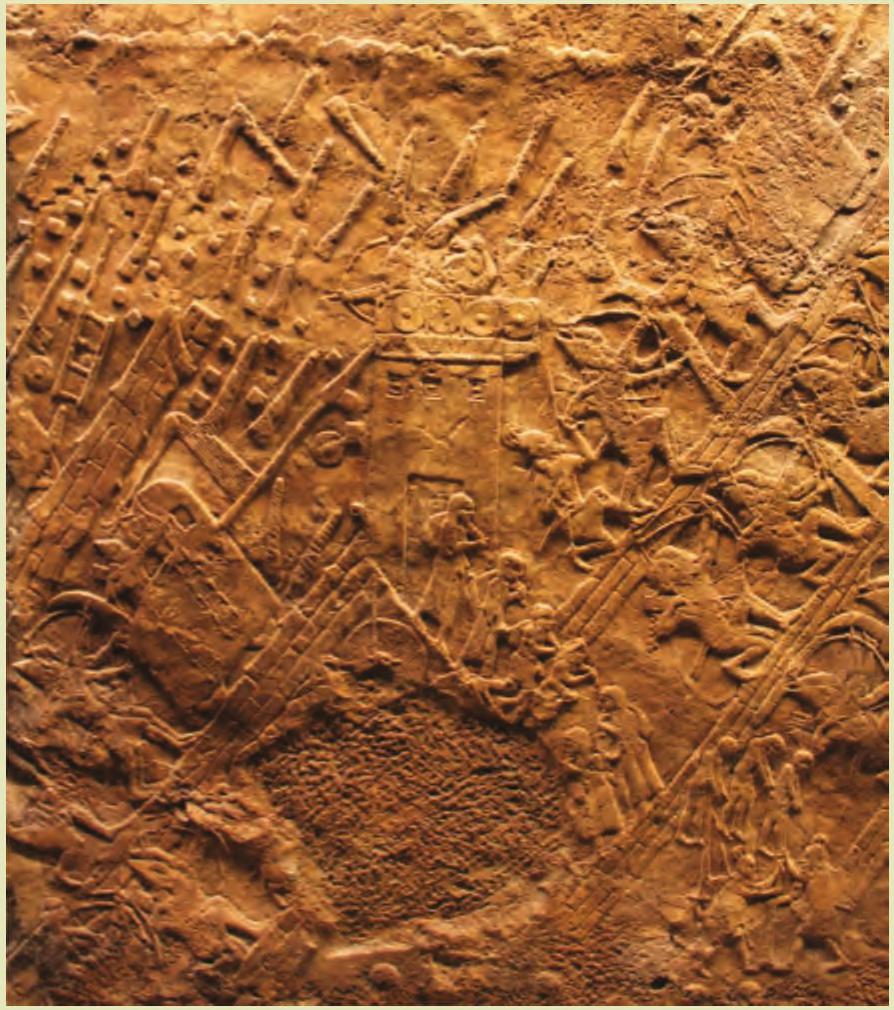
Wall relief depicting Assyrian king Sennacherib’s siege of
Lachish (2 Kin. 18:13, 14)
© 2013 by Zondervan
872 b.c.
Jehoshaphat
becomes king in
Judah
865 b.c.
Elijah begins to
prophesy against
Ahab in Israel
850 b.c.
Elijah is taken to
heaven; Elisha
prophesies
755 b.c.
Isaiah begins to
prophesy in Judah
736 b.c.
Ahaz begins to
reign in Judah
722 b.c.
Israel is taken
captive by the
Assyrians
697 b.c.
Manasseh begins
to reign in Judah
640 b.c.
Josiah’s reign
begins in Judah
624 b.c.
The Book of the
Law is found in
Jerusalem
612 b.c.
Assyria’s capital
Nineveh falls to
the Babylonians
586 b.c.
Judah is taken
captive by the
Babylonians
Original illustrations
End of source page 612