PRINTED PAGE 24NKJV · STUDY EDITION
24 | Genesis 12:3
most significant in the set. (2) God promised to bless Abram. The
blessing of God is His smile, the warmth of His pleasure (see 1:22,
28; 2:3; 9:1). The Lord’s promise of His personal blessing to Abram
and Sarai included the benefits of a long and healthy life (see 15:15;
especially 24:1), plus wealth and importance (see 13:2). (3) That one’s
name would live on long after one’s lifetime was a supreme honor
(6:4). Those who brought shame on themselves would be forgotten
(11:4). The name Abraham, by which we remember Abram (17:5), is
one of the most honored of all names in history. (4) be a blessing:
The phrase is a command. That is, Abram was under divine orders
to be a blessing to others. This he did whenever he told about the
living God before other nations and peoples (see v. 8). (5) those
who bless: Elements five and six form a poetic couplet. (6) him who
curses: Whereas God would bless the peoples who blessed Abram
or his descendants, His curse came upon the individual who cursed
Abram or his descendants. (7) all the families of the earth would
be blessed through them, the Jewish people who are descended
from Abram.
12:4 With the magnificent promise of the Lord as his sole motiva-
tion, Abram obeyed (see 17:23; 22:3). Lot went with him: Some have
imagined that Abram disobeyed God by taking Lot with him. How-
ever, the verse suggests that Lot made the decision. seventy-five
years old: The Bible rarely indicates a person’s age when events
occur, but it does so several times for Abram. As we will see, this
testifies to God’s mighty works in Abram’s life at his advanced age.
12:5 This is the first mention in the Bible of Canaan, the geograph-
ical stage for God’s acts of salvation. Canaan was populated with
peoples involved in gross idolatry (15:16). God promised this land
to Abram and Sarai.
12:6 passed through: This verb resembles the name Hebrew
(14:13). Here the Hebrew Abram was “passing through” the land,
crossing over to his destination. Shechem: This ancient site was in
the center of the land; later under Joshua’s leadership the people
would commemorate the Lord’s covenant there (Josh. 24:1). tree
of Moreh: A terebinth or ancient oak tree would serve as a lasting
marker for future generations to observe (see also 13:18; 18:1; 23:17).
The term Moreh means “The Teacher.” It is related to the term Torah,
which means “Instruction.” Here Abram began symbolically taking
possession of the land that would one day be the territory of the
Great Teacher and His instruction. The land was already occupied
by the Canaanites (see 13:7), but by God’s promise it would belong
to Abraham’s descendants.
12:7 the Lord appeared: This was the first time God appeared to
Abram in the land of Canaan, but certainly not the last (see 13:14–17).
p Gen. 13:15; 15:18; 17:8; Deut. 34:4; Ps. 105:9-12; Acts 7:5; Gal.
3:16 3 Lit. seed
3 f Gen. 24:35;
27:29; Ex. 23:22;
Num. 24:9 g Gen.
18:18; 22:18; 26:4;
28:14; Ps. 72:17;
Matt. 1:1; Luke 3:34;
Acts 3:25 ; [Gal.
3:8] h Is. 41:27
5 i Gen. 14:14 j Gen.
11:31 k Gen. 13:18
1 Lit. souls
6 l Heb. 11:9
m Deut. 11:30; Judg.
7:1 n Gen. 10:18, 19
2 Heb. Alon Moreh
7 o Gen. 17:1; 18:1
that they had gathered, and i the 1 peo
ple whom they had acquired j in Haran,
and they k departed to go to the land of
Canaan. So they came to the land of
Canaan. 6 Abram l passed through the
land to the place of Shechem, m as far as
2 the terebinth tree of Moreh. n And the
Canaanites were then in the land.
7 o Then the LORD appeared to Abram
and said, p “To your 3 descendants I will
3 f I will bless those who bless you,
And I will curse him who curses
you;
And in g you all the families of the
earth shall be h blessed.”
4 So Abram departed as the LORD had
spoken to him, and Lot went with him.
And Abram was seventy-five years old
when he departed from Haran. 5 Then
Abram took Sarai his wife and Lot his
brother’s son, and all their possessions
0
100 miles
0
100 km.
Ur
(Tell el-Maqayyar)
Mari
Salem
Shechem
Damascus
Emar
Tuttul
Haran
To Egy
pt
E
u
p
h
r
a
t
e
s
R
.
Balikh
R.
Ti
g
r
i
s R.
Abram’s migration route
Abram’s alternative migration route
Abram’s Travels
Original illustrations
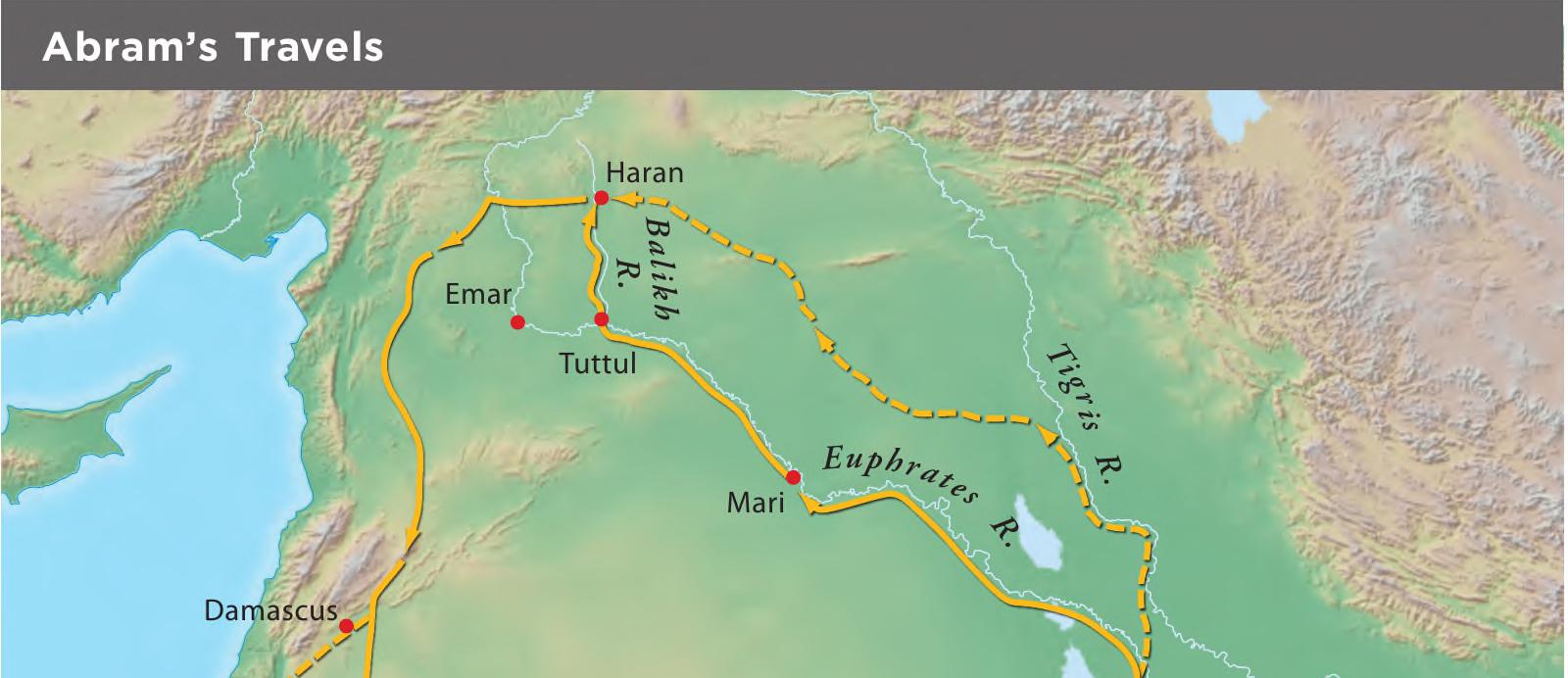
End of source page 59