PRINTED PAGE 554NKJV · STUDY EDITION
554 | 1 Kings 12:3
all Israel refers to representatives of the northern tribes who had
convened to consider the confirmation of Rehoboam as king of all
the land.
12:4 A system of forced labor had been imposed by Solomon to
accomplish and maintain his building projects (see 5:13–18). Because
this burdensome service was especially hateful to the northern
tribes, relief from it was a crucial issue.
12:6, 7 By elders is meant the chief government officials who had
advised Rehoboam’s father Solomon (see 4:1–19). Their advice was
to show moderation and temperance.
12:8, 9 The young men were men of Rehoboam’s generation
whom he had appointed to government office.
12:10, 11 little finger . . . father’s waist: The advice of Rehoboam’s
own advisors was that the system of forced labor should be inten
sified until its sting became like that of a scorpion. Scourges were
leather whips that could have more than one tail to which barbed
points or metal spikes were attached.
12:15 from the Lord: Even at this crucial time of national schism,
God was sovereignly working through human events to accomplish
His will, which had been made known through earlier prophecy
(11:29–39).
12:16 What share have we in David: The ancient rivalry felt by the
northern tribes now came to a peak in resentment against the tribe
of Judah and the house of David. Saul was from the tribe of Benja
min and had been regarded as “one of their own.” David, from the
south, had seemed distant. Rehoboam’s insensitivity to the volatile
situation led to a division of the nation.
12:17 cities of Judah: The southern section also included the
2 c 1 Kin. 11:26
d 1 Kin. 11:40
4 e 1 Sam. 8:11-18;
1 Kin. 4:7; 5:13-15
1 hard
7 f 2 Chr. 10:7; [Prov.
15:1]
11 2 Scourges with
points or barbs, lit.
scorpions
13 3 harshly
14 4 Lit. scorpions
15 g Deut. 2:30;
Judg. 14:4; 1 Kin.
12:24; 2 Chr. 10:15
h 1 Kin. 11:11, 29, 31
16 i 2 Sam. 20:1
17 j 1 Kin. 11:13, 36;
2 Chr. 11:14-17
the people 3 roughly, and rejected the
advice which the elders had given him;
14 and he spoke to them according to the
advice of the young men, saying, “My
father made your yoke heavy, but I will
add to your yoke; my father chastised you
with whips, but I will chastise you with
4 scourges!” 15 So the king did not listen
to the people; for g the turn of events was
from the LORD, that He might fulfill His
word, which the LORD had h spoken by
Ahijah the Shilonite to Jeroboam the son
of Nebat.
16 Now when all Israel saw that the
king did not listen to them, the people
answered the king, saying:
i“ What share have we in David?
We have no inheritance in the son of
Jesse.
To your tents, O Israel!
Now, see to your own house,
O David!”
So Israel departed to their tents. 17 But
Rehoboam reigned over j the children of
Israel who dwelt in the cities of Judah.
happened, when c Jeroboam the son of
Nebat heard it (he was still in d Egypt,
for he had fled from the presence of
King Solomon and had been dwelling in
Egypt), 3 that they sent and called him.
Then Jeroboam and the whole assembly
of Israel came and spoke to Rehoboam,
saying, 4 “Your father made our e yoke
1 heavy; now therefore, lighten the bur
densome service of your father, and his
heavy yoke which he put on us, and we
will serve you.”
5 So he said to them, “Depart for three
days, then come back to me.” And the
people departed.
6 Then King Rehoboam consulted the
elders who stood before his father Sol
omon while he still lived, and he said,
“How do you advise me to answer these
people?”
7 And they spoke to him, saying, f “If
you will be a servant to these people
today, and serve them, and answer them,
and speak good words to them, then they
will be your servants forever.”
8 But he rejected the advice which the
elders had given him, and consulted the
young men who had grown up with him,
who stood before him. 9 And he said to
them, “What advice do you give? How
should we answer this people who have
spoken to me, saying, ‘Lighten the yoke
which your father put on us’?”
10 Then the young men who had grown
up with him spoke to him, saying, “Thus
you should speak to this people who have
spoken to you, saying, ‘Your father made
our yoke heavy, but you make it lighter
on us’—thus you shall say to them: ‘My
little finger shall be thicker than my fa
ther’s waist! 11 And now, whereas my fa
ther put a heavy yoke on you, I will add
to your yoke; my father chastised you
with whips, but I will chastise you with
2 scourges!’ ”
12 So Jeroboam and all the people came
to Rehoboam the third day, as the king
had directed, saying, “Come back to me
the third day.” 13 Then the king answered
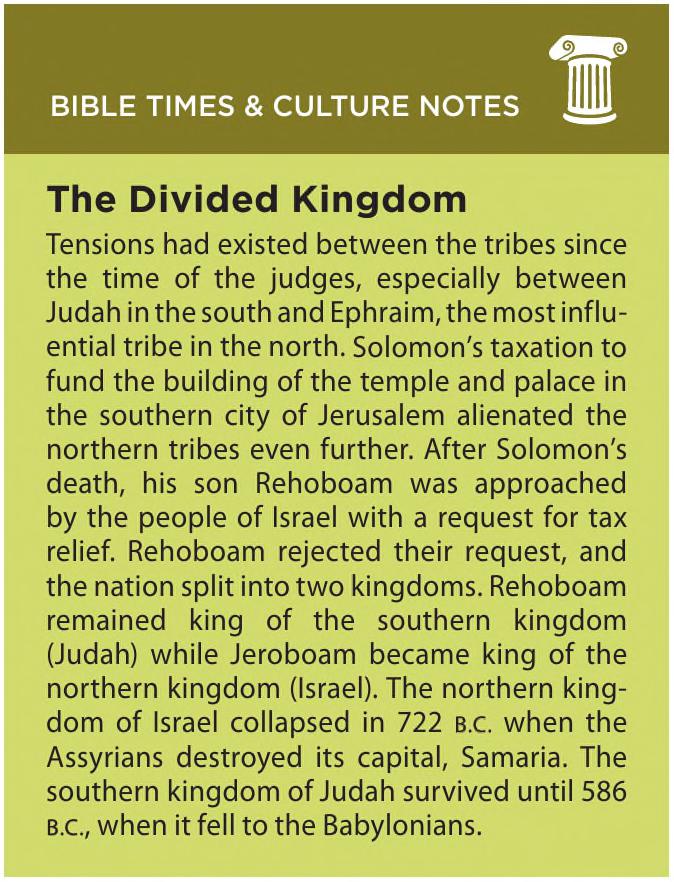
Bible Times & Culture Notes
The Divided Kingdom
Tensions had existed between the tribes since
the time of the judges, especially between
Judah in the south and Ephraim, the most influ
ential tribe in the north. Solomon’s taxation to
fund the building of the temple and palace in
the southern city of Jerusalem alienated the
northern tribes even further. After Solomon’s
death, his son Rehoboam was approached
by the people of Israel with a request for tax
relief. Rehoboam rejected their request, and
the nation split into two kingdoms. Rehoboam
remained king of the southern kingdom
(Judah) while Jeroboam became king of the
northern kingdom (Israel). The northern king
dom of Israel collapsed in 722 b.c. when the
Assyrians destroyed its capital, Samaria. The
southern kingdom of Judah survived until 586
b.c., when it fell to the Babylonians.
Original illustrations
End of source page 589