PRINTED PAGE 539NKJV · STUDY EDITION
1 Kings 6:20 | 539
6:11 word of the Lord: This message to Solomon might have come
by means of a prophet. On other occasions, Solomon had more
personal encounters with the Lord (3:5; 9:2; 11:11).
6:12, 13 The most important work of Solomon was certainly the
building of the temple. God promised to bless Solomon and his
work if he faithfully obeyed His commands.
6:19 The ark of the covenant of the Lord (Deut. 10:8; Josh. 3:11)
is so named because it housed the two stone tablets of the cov
enant—the Ten Commandments (Deut. 10:1–5). The ark symbolized
the presence of the sovereign God in the midst of His people (8:10,
11; Josh. 3:13).
6:20 the inner sanctuary: The Most Holy Place was a cube of 30
feet. with pure gold: The amount of gold is given as six hundred
talents, or about 23 tons, in 2 Chr. 3:8.
12 i 1 Kin. 2:4; 9:4
j [2 Sam. 7:13; 1 Chr.
22:10] 3 Lit. house
4 promise
13 k Ex. 25:8; Lev.
26:11; [2 Cor. 6:16;
Rev. 21:3] l [Deut.
31:6]
16 m Ex. 26:33; Lev.
16:2; 1 Kin. 8:6;
2 Chr. 3:8; Ezek.
45:3; Heb. 9:3
19 5 The Most Holy
Place
of cypress. 16 Then he built the twenty-
cubit room at the rear of the temple,
from floor to ceiling, with cedar boards;
he built it inside as the inner sanctuary,
as the m Most Holy Place. 17 And in front
of it the temple sanctuary was forty cu
bits long. 18 The inside of the temple was
cedar, carved with ornamental buds and
open flowers. All was cedar; there was no
stone to be seen.
19 And he prepared the 5 inner sanctu
ary inside the temple, to set the ark of the
covenant of the LORD there. 20 The inner
sanctuary was twenty cubits long, twenty
cubits wide, and twenty cubits high. He
overlaid it with pure gold, and overlaid
11 Then the word of the LORD came
to Solomon, saying: 12 “Concerning this
3 temple which you are building, i if you
walk in My statutes, execute My judg
ments, keep all My commandments, and
walk in them, then I will perform My
4 word with you, j which I spoke to your
father David. 13 And k I will dwell among
the children of Israel, and will not l for
sake My people Israel.”
14 So Solomon built the temple and fin
ished it. 15 And he built the inside walls
of the temple with cedar boards; from the
floor of the temple to the ceiling he pan
eled the inside with wood; and he cov
ered the floor of the temple with planks
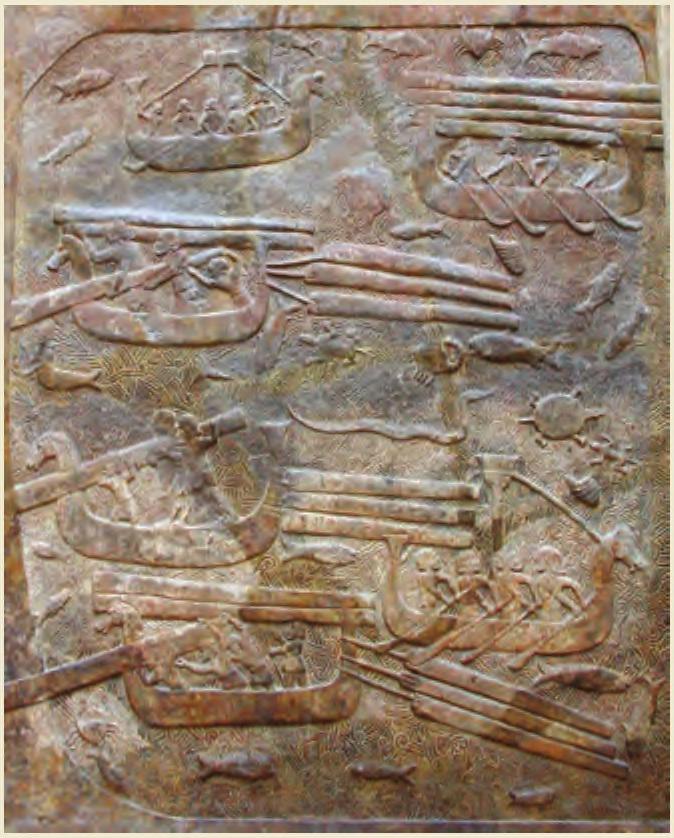
One register from the Frieze of the Transportation
of Timber, Neo-Assyrian period, c. 713–706 b.c.
Cedar logs from Lebanon were likely floated in a
similar manner for Solomon’s temple.
Kim Walton, courtesy of the Louvre
Sparing No Expense
Whenever modern-day churches draw up plans and budgets for buildings in which to worship, they face an age-old
tension: What is appropriate for a worship center in terms of size, materials, beauty, and expense? For Solomon, there
seems to have been only one answer to that question as he proposed to build God’s temple: Spare no expense! Consider
the costliness of Solomon’s temple:
• It was made of the most precious of building materials, many of them imported: cedar (5:6), quarried stone (5:15–18),
gold (6:20–22), olive wood (6:23–28, 31–33), cypress (6:34), and bronze (7:13–47).
• The project employed 30,000 laborers (5:13), 150,000 stonemasons and haulers (5:15), and 3,300 supervisors (5:16).
• The temple was paneled with cedar, some of which was
ornately carved (6:9, 15–18).
• Its floors and walls were overlaid with gold (6:20–22).
• It was furnished with items of finely crafted wood and gold
(6:23–35; 7:48–50).
• So much bronze was used that its weight (and therefore cost)
was not determined (7:45–47).
• The work continued nonstop for seven years (6:37–38).
Was Solomon justified in incurring such an expense? The ques
tion is not easily answered.
On the one hand, the project contributed to a number of prob
lems of Solomon’s reign: heavy taxation, a growing underclass of
foreigners, and the depletion of the forests of Lebanon. The temple
was not the sole cause of these troubles (9:15–19), but it was built
with a policy of “only the best” that seemed to typify the Solomonic
kingdom.
On the other hand, Solomon apparently recognized that
architecture is not neutral; it makes a statement. The temple was
a remarkable work of art, built to the glory of God (8:12, 13). God
apparently approved of Solomon’s achievement, for He blessed the
sanctuary with His presence (8:10, 11).
Yet even as the construction went forward, the Lord reminded
His builder that what mattered was not a house of cedar and gold,
but the keeping of the Law (6:11–13). Perhaps that is the most impor
tant architectural principle of all when it comes to houses of worship:
It is not the size, beauty, or expense of the structure, but the sincere
devotion and obedience of those who worship in the structure. After
all, the Lord does not dwell only in sanctuaries built by people, but in
the people themselves (8:27; Acts 7:48; 17:24; 1 Cor. 6:19, 20).
Original illustrations
End of source page 574