PRINTED PAGE 22NKJV · STUDY EDITION
22 | Genesis 11:8
11:8 the Lord scattered them: There are three great judgments
on sinful humanity in the first section of Genesis (chs. 1–11). The
first is the expulsion from Eden (ch. 3); the second is the Flood (chs.
6–9), and the third is the scattering of the people from Babel (see
Luke 1:51).
11:9 There is a pun in the name Babel that no Hebrew reader would
miss. The verb for confuse sounds similar to the name of the city.
The principal city of ancient paganism (Babylon) is merely a site of
confusion because there the Lord confused the language. Babel
(and Babylon) serves as a name and symbol in the Bible for activities
directed against God by the nations of the earth (see Rev. 17).
11:10 Genealogy (or family histories) is found in ten significant pas-
sages in the Book of Genesis (see the list at 2:4). The Jewish nation
came from Shem. Hence, the accounts that follow make much of
him and his family.
11:10–25 The pattern in this genealogy is similar to that in ch. 5;
but here only the first three elements are given: (1) name “A” lived
“x” years; (2) name “A” begot name “B”; (3) name “A” then lived “y”
years. As does ch. 5, the list leaves out some names, focusing on
major figures in the line from Noah to Abraham. “B” may be a remote
descendant rather than the immediate child of “A” (5:20). Thus the
genealogy shows that Abraham was a descendant of Noah through
Shem, just as Noah was a descendant of Adam through Seth. Note
also that while the people listed in ch. 11 lived very long lives, they
lived progressively shorter lives, from the 600 years of Shem (vv. 10,
11) to the 148 years of Nahor (vv. 24, 25). Note also the absence of a
total for the time from Shem to Abram (vv. 26–30); it must have been
at least several thousand years, but we do not know exactly how long.
11:26 Terah: At long last we come to the family of Terah and the
births of Abram, Nahor, and Haran. Years later, Abram would be
renamed Abraham (see 17:5), and would become the father of Isaac
(21:1–5). He was the progenitor of the Hebrew people from which
the Promised Deliverer, Jesus, comes.
11:27 The term genealogy (or family histories) is found in ten sig-
nificant passages in Genesis (see the list at 2:4). Abram, Nahor, and
Haran: These three sons of Terah would be expected to carry on his
name (but see 11:31). Haran begot Lot: Lot is a nephew of Abram; he
figures prominently in the upcoming account (see 12:4, 5; 13:1–13).
11:28 The untimely death of Haran leaves his son Lot to carry on his
name and to establish his destiny. For generations, scholars have
believed Ur of the Chaldeans to be the famous Ur located near
the ancient delta in the Persian Gulf where the Tigris and Euphrates
Rivers flow together. More recently, some scholars have noted the
tablets at Ebla that speak of an Ur in the region of north Syria and
suggest that this is the city of Haran’s death.
11:29 Sarai means “Princess,” implying a person of noble birth.
Sarah (as she is later called; see 17:15) has the same meaning. The
name Milcah is related to the verb that would be translated “to
reign” and means “Queen.” daughter of Haran: Evidently, Nahor
married his niece. We learn later that Sarai was Abram’s half sister.
8 k Gen. 11:4; Deut.
32:8; Ps. 92:9;
[Luke 1:51] l Gen.
10:25, 32
9 m 1 Cor. 14:23
3 Lit. Confusion,
Babylon
10 n Gen. 10:22-25;
1 Chr. 1:17
12 o Luke 3:35
16 p 1 Chr. 1:19
q Luke 3:35
20 r Luke 3:35
24 s Gen. 11:31;
Josh. 24:2; Luke
3:34
26 t Josh. 24:2;
1 Chr. 1:26
4 Abraham, Gen.
17:5
27 u Gen. 11:31; 17:5
five hundred years, and begot sons and
daughters.
12 Arphaxad lived thirty-five years,
o and begot Salah. 13 After he begot Salah,
Arphaxad lived four hundred and three
years, and begot sons and daughters.
14 Salah lived thirty years, and begot
Eber. 15 After he begot Eber, Salah lived
four hundred and three years, and begot
sons and daughters.
16 p Eber lived thirty-four years, and
begot q Peleg. 17 After he begot Peleg, Eber
lived four hundred and thirty years, and
begot sons and daughters.
18 Peleg lived thirty years, and begot
Reu. 19 After he begot Reu, Peleg lived
two hundred and nine years, and begot
sons and daughters.
20 Reu lived thirty-two years, and begot
r Serug. 21 After he begot Serug, Reu lived
two hundred and seven years, and begot
sons and daughters.
22 Serug lived thirty years, and begot
Nahor. 23 After he begot Nahor, Serug
lived two hundred years, and begot sons
and daughters.
24 Nahor lived twenty-nine years, and
begot s Terah. 25 After he begot Terah,
Nahor lived one hundred and nineteen
years, and begot sons and daughters.
26 Now Terah lived seventy years, and
t begot 4 Abram, Nahor, and Haran.
Terah’s Descendants
27 This is the genealogy of Terah: Terah
begot u Abram, Nahor, and Haran. Haran
begot Lot. 28 And Haran died before his
father Terah in his native land, in Ur of
the Chaldeans. 29 Then Abram and Nahor
took wives: the name of Abram’s wife
language, that they may not understand
one another’s speech.” 8 So k the LORD
scattered them abroad from there l over
the face of all the earth, and they ceased
building the city. 9 Therefore its name is
called 3 Babel, m because there the LORD
confused the language of all the earth;
and from there the LORD scattered them
abroad over the face of all the earth.
Shem’s Descendants
10 n This is the genealogy of Shem:
Shem was one hundred years old, and
begot Arphaxad two years after the flood.
11 After he begot Arphaxad, Shem lived
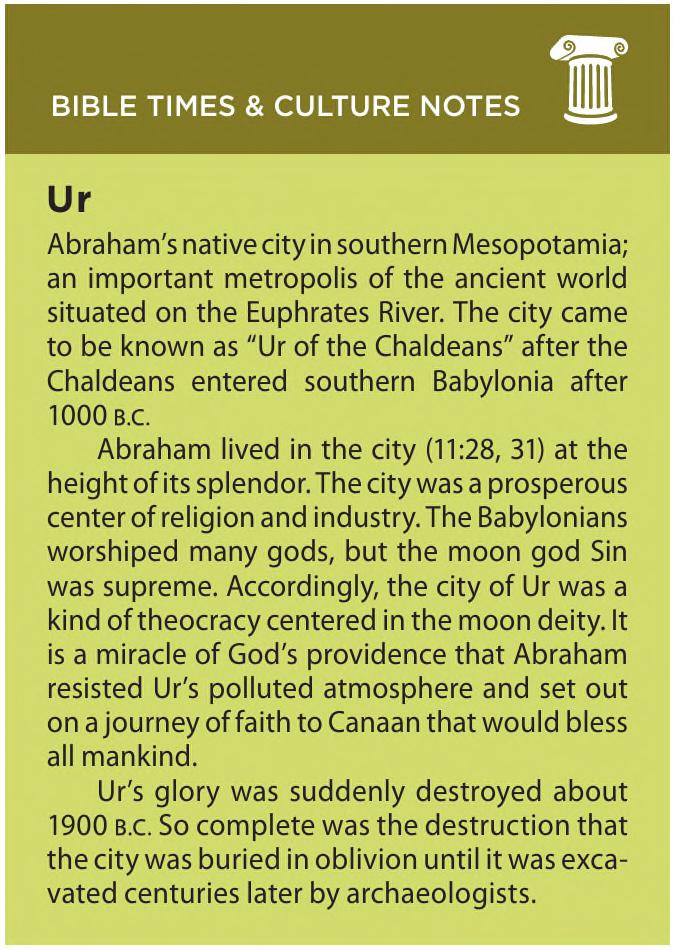
Bible Times & Culture Notes
Ur
Abraham’s native city in southern Mesopotamia;
an important metropolis of the ancient world
situated on the Euphrates River. The city came
to be known as “Ur of the Chaldeans” after the
Chaldeans entered southern Babylonia after
1000 b.c.
Abraham lived in the city (11:28, 31) at the
height of its splendor. The city was a prosperous
center of religion and industry. The Babylonians
worshiped many gods, but the moon god Sin
was supreme. Accordingly, the city of Ur was a
kind of theocracy centered in the moon deity. It
is a miracle of God’s providence that Abraham
resisted Ur’s polluted atmosphere and set out
on a journey of faith to Canaan that would bless
all mankind.
Ur’s glory was suddenly destroyed about
1900 b.c. So complete was the destruction that
the city was buried in oblivion until it was exca-
vated centuries later by archaeologists.
Original illustrations
End of source page 57