PRINTED PAGE 532NKJV · STUDY EDITION
532 | 1 Kings 2:5
Israel “would not lack a man,” but there would come a time when the
promised Ruler would not be on an earthly throne (Hos. 3:4). God’s
prophets predict that the heir of the throne of David will yet reign
over a repentant, regathered, and restored Israel (see Jer. 33:19–26;
Ezek. 34:22–31) in fulfillment of the promises contained in the Abra
hamic, Davidic, and New covenants (Ezek. 37:21–28; Mic. 7:18–20).
The NT reveals that all this will be realized in Jesus Christ, the Savior
King (Acts 3:25, 26; 15:16, 17; Gal. 3:26–29; Rev. 3:21), who is David’s
Heir in the ultimate sense (Acts 2:22–36).
2:5–9 David’s parting advice singled out some problems that had
not been solved. One concerned Joab. The bold, headstrong Joab
had murdered two generals (2 Sam. 3:27; 20:10) and David’s son
Absalom (2 Sam. 18:14); he also had joined Adonijah’s ill-fated
conspiracy (1:7, 19). Another problem concerned Shimei, who had
treated the king shamefully on a previous occasion (2 Sam. 16:5–13;
19:16–23). gray hair: Both Joab and Shimei had lived a long time
without requital for their wicked deeds. The aged king knew that
these men would likely continue to be a problem to Solomon even
as they had been to him.
2:7 David also included directions of kindness for the household of
Barzillai, who had stood by him throughout the period associated
with Absalom’s rebellion (2 Sam. 17:27–29; 19:31–39). To eat at the
king’s table carried with it not only distinct honor, but royal favor
(see 2 Sam. 9:7; 2 Kin. 25:29). It meant that the royal household would
make provision for this family in perpetuity.
2:10 There is a so-called tomb of David today on Mt. Zion in Jeru
salem marking approximately where he might have been buried.
4 g 2 Kin. 20:3 h 2 Sam. 7:12, 13; 1 Kin. 8:25 5 i 2 Sam. 3:39;
18:5, 12, 14 j 2 Sam. 3:27; 1 Kin. 2:32 k 2 Sam. 20:10 6 l 1 Kin.
2:9; Prov. 20:26 7 m 2 Sam. 19:31-39 n 2 Sam. 9:7, 10; 19:28
o 2 Sam. 17:17-29 8 p 2 Sam. 16:5-13 q 2 Sam. 19:18 r 2 Sam.
19:23 9 s Ex. 20:7; Job 9:28 t Gen. 42:38; 44:31 10 u 1 Kin.
1:21; Acts 2:29; 13:36 v 2 Sam. 5:7; 1 Kin. 3:1 2 Died and joined
his ancestors 11 w 2 Sam. 5:4, 5; 1 Chr. 3:4; 29:26, 27
12 x 1 Kin. 1:46; 1 Chr. 29:23
sons take heed to their way, to g walk be
fore Me in truth with all their heart and
with all their soul,’ He said, h ‘you shall
not lack a man on the throne of Israel.’
5 “Moreover you know also what Joab
the son of Zeruiah i did to me, and what
he did to the two commanders of the
armies of Israel, to j Abner the son of Ner
and k Amasa the son of Jether, whom he
killed. And he shed the blood of war in
peacetime, and put the blood of war on
his belt that was around his waist, and on
his sandals that were on his feet. 6 There
fore do l according to your wisdom, and
do not let his gray hair go down to the
grave in peace.
7 “But show kindness to the sons of
m Barzillai the Gileadite, and let them be
among those who n eat at your table, for
so o they came to me when I fled from
Absalom your brother.
8 “And see, you have with you p Shimei
the son of Gera, a Benjamite from Ba
hurim, who cursed me with a malicious
curse in the day when I went to Maha
naim. But q he came down to meet me at
the Jordan, and r I swore to him by the
LORD, saying, ‘I will not put you to death
with the sword.’ 9 Now therefore, s do not
hold him guiltless, for you are a wise man
and know what you ought to do to him;
but t bring his gray hair down to the grave
with blood.”
Death of David
10 So u David 2 rested with his fathers,
and was buried in v the City of David.
11 The period that David w reigned over
Israel was forty years; seven years he
reigned in Hebron, and in Jerusalem he
reigned thirty-three years. 12 x Then Sol
Temple
King’s
Gardens?
S
il
oa
m t
unnel
Royal
palace?
Jebusite tunnel
and pool
King’s Pool?
Pool of
Siloam
En Rogel
K i d r o n
V a l l e y
Gihon
spring
K i
d r
o n
Va
l l
e y
M o u n t o f
O l i v e s
MOUNT MORIAH
(Temple Mount)
Royal
palace?
0
250 m.
0
500 ft.
City walls at the time
of the Canaanites,
Jebusites, and David
Additions at the time
of Solomon
Ophel area
Water systems
Solomon’s Jerusalem
c. 950 b.c.
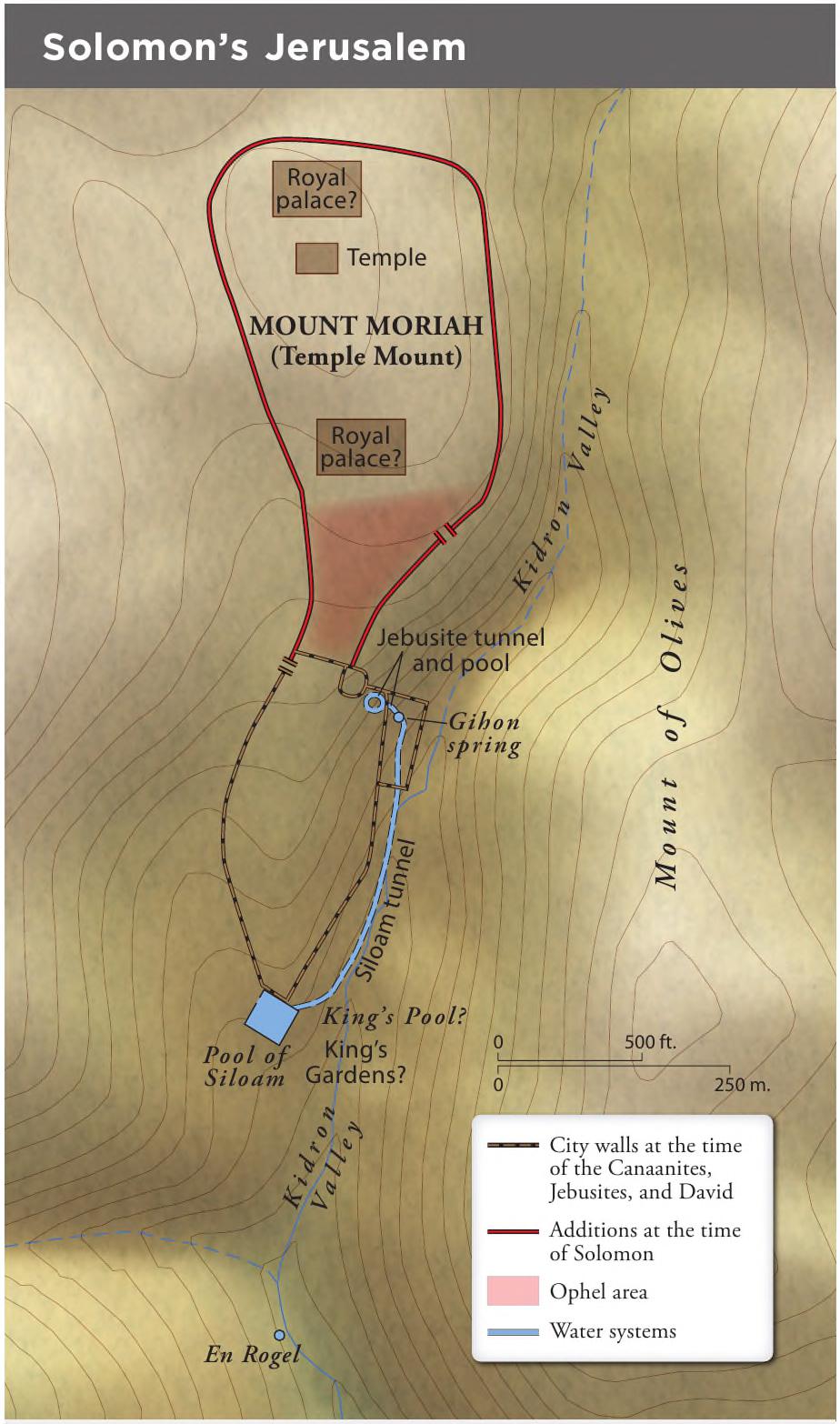
Solomon extended the city northward from the original site
and there built his magnificent temple.
His royal residence was nearby, but its exact location is
unknown.
Original illustrations
End of source page 567