PRINTED PAGE 529NKJV · STUDY EDITION
1 Kings 1:13 | 529
1:1—2:11 This section places Solomon’s reign in the context of
the provisions of the Davidic covenant (2 Sam. 7). The narrator
emphasizes that Solomon’s accession to the throne was the Lord’s
sovereign will.
1:1–3 David was about 70 years old at the time of his death (2 Sam.
5:4; 1 Chr. 29:26–28), and the long years of warfare had doubtless
ly taken their physical toll. warm: Using a healthy person’s body
warmth to care for a sick person is a medical procedure noted by
the second-century Greek physician Galen and the Jewish historian
Josephus.
1:5 The name of David’s fourth son, Adonijah, means “The Lord
Is My Lord” (2 Sam. 3:2–4). Amnon and Absalom, David’s first and
third sons, both experienced violent deaths (2 Sam. 13:28, 29; 18:14).
Chileab, his second son, apparently died at an early age. I will be
king: Adonijah, the oldest surviving son, might have assumed
that he would inherit the crown even though Solomon had been
designated as successor (1:13, 17, 30; 2:15; 1 Chr. 22:9, 10). Adoni
jah evidently knew of the intended royal succession, because he
deliberately avoided inviting those who would support the king’s
choice (vv. 8, 10). Adonijah thus exalted himself against God’s will.
1:6 rebuked: While David had been a most capable leader and a
man of deep spiritual sensitivity, he had not exercised proper paren
tal discipline of his children (2 Sam. 13:21–39; 14:18–24).
1:7 In gaining important allies to support his quest for the crown,
Adonijah sought the assistance of Joab, David’s general, and Abi-
athar, the high priest.
1:8 Zadok was descended from the priestly line of Eleazar (2 Sam.
8:17). Benaiah served as the commander of the king’s bodyguard
and was considered one of David’s mighty men (2 Sam. 23:20–23).
The prophet Nathan had long been David’s confidant, spiritual
advisor, and conscience (2 Sam. 12:1–25). Shimei is probably the
man who later became Solomon’s district governor (4:18); he should
not be confused with David’s foolish enemy, Shimei the son of Gera
(see 2:8; 2 Sam. 19:18–23).
1:9 Zoheleth means “Serpent.” Perhaps this was the shape of
an outcropping of rock that was a well-known rendezvous point.
Adonijah’s ceremonial meal was held at En Rogel near the inter
section of the Hinnom and Kidron valleys, a place well situated for
Adonijah’s purposes. En Rogel had positive associations with David
(2 Sam. 17:17).
1:11 It is a mark of David’s integrity that Nathan, who had confront
ed him with his terrible sin, was still welcome in the royal household
(2 Sam. 12:1–15). Nathan went to Bathsheba because she would not
want to see Adonijah displace her son Solomon as heir to the throne.
As David’s wife, Bathsheba had immediate access to him, and she
also had considerable influence in civil and social matters (15:10–13;
19:1–3; 21:5–15, 25). If Adonijah became king she and Solomon could
probably expect to die in a royal purge of all potential claimants
to the throne (compare 15:29; 16:11; 2 Kin. 9:30–37; 10:1–17; 11:1).
1:12–27 Nathan and Bathsheba planned together (v. 14) how Na
than could confirm Bathsheba’s report to the king. Nathan knew
of David’s solemn oath to Bathsheba (vv. 13, 30; see Lev. 19:12), but
CHAPTER 1
1 a 1 Chr. 23:1
1 Seventy years
2 2 Or serve
3 b 1 Kin. 2:17
c Josh. 19:18; 1 Sam.
28:4
5 d 2 Sam. 3:4
e 2 Sam. 15:1 3 The
fourth son 4 Lit.
reign
6 f 2 Sam. 3:3, 4;
1 Chr. 3:2 5 Lit.
pained
7 g 1 Chr. 11:6
h 2 Sam. 20:25
i 1 Kin. 2:22, 28
8 j 1 Kin. 2:35
k 1 Kin. 2:25; 2 Sam.
8:18 l 2 Sam.
12:1 m 1 Kin. 4:18
n 2 Sam. 23:8
9 o Josh. 15:7; 18:16;
2 Sam. 17:17 6 Lit.
Serpent 7 A spring
south of Jerusalem
in the Kidron Valley
10 p 2 Sam. 12:24
11 q 2 Sam. 3:4
Adonijah Presumes to Be King
N
ow King David was a old, 1 ad
vanced in years; and they put
covers on him, but he could
not get warm. 2 Therefore
his servants said to him, “Let a young
woman, a virgin, be sought for our lord
the king, and let her 2 stand before the
king, and let her care for him; and let
her lie in your bosom, that our lord the
king may be warm.” 3 So they sought for
a lovely young woman throughout all the
territory of Israel, and found b Abishag
the c Shunammite, and brought her to the
king. 4 The young woman was very love
ly; and she cared for the king, and served
him; but the king did not know her.
5 Then d Adonijah the 3 son of Haggith
exalted himself, saying, “I will 4 be king”;
and e he prepared for himself chariots
and horsemen, and fifty men to run be
fore him. 6 (And his father had not 5 re
buked him at any time by saying, “Why
have you done so?” He was also very
good-looking. f His mother had borne
him after Absalom.) 7 Then he conferred
with g Joab the son of Zeruiah and with
h Abiathar the priest, and i they followed
and helped Adonijah. 8 But j Zadok the
priest, k Benaiah the son of Jehoiada, l Na
than the prophet, m Shimei, Rei, and n the
mighty men who belonged to David were
not with Adonijah.
9 And Adonijah sacrificed sheep and
oxen and fattened cattle by the stone of
6 Zoheleth, which is by o En Rogel; 7 he
also invited all his brothers, the king’s
sons, and all the men of Judah, the king’s
servants. 10 But he did not invite Nathan
the prophet, Benaiah, the mighty men, or
p Solomon his brother.
11 So Nathan spoke to Bathsheba the
mother of Solomon, saying, “Have you
not heard that Adonijah the son of q Hag
gith has become king, and David our lord
does not know it? 12 Come, please, let me
now give you advice, that you may save
your own life and the life of your son Sol
omon. 13 Go immediately to King David
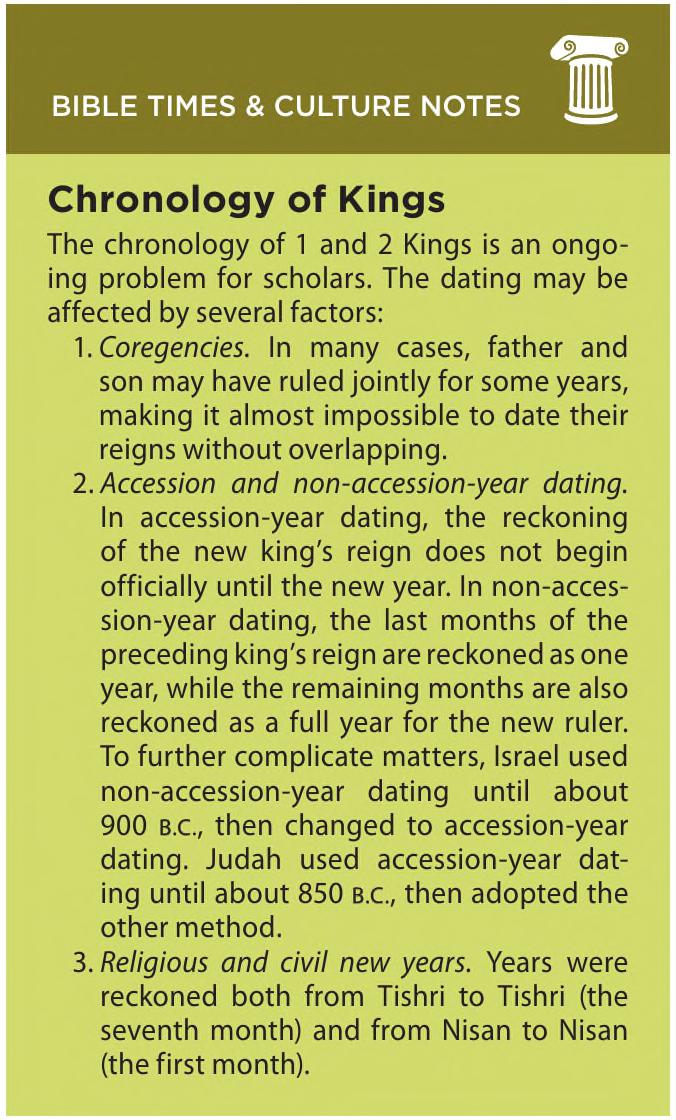
Bible Times & Culture Notes
Chronology of Kings
The chronology of 1 and 2 Kings is an ongo
ing problem for scholars. The dating may be
affected by several factors:
1. Coregencies. In many cases, father and
son may have ruled jointly for some years,
making it almost impossible to date their
reigns without overlapping.
2. Accession and non-accession-year dating.
In accession-year dating, the reckoning
of the new king’s reign does not begin
officially until the new year. In non-acces
sion-year dating, the last months of the
preceding king’s reign are reckoned as one
year, while the remaining months are also
reckoned as a full year for the new ruler.
To further complicate matters, Israel used
non-accession-year dating until about
900 b.c., then changed to accession-year
dating. Judah used accession-year dat
ing until about 850 b.c., then adopted the
other method.
3. Religious and civil new years. Years were
reckoned both from Tishri to Tishri (the
seventh month) and from Nisan to Nisan
(the first month).
Original illustrations
End of source page 564