PRINTED PAGE 527NKJV · STUDY EDITION
1 Kings INTRODUCTION 527
impetus for the author to gather up his sources and write an account of Israel’s
faithfulness to the covenant from the days of David until his own time.
To compose a work covering nearly four hundred years, the author of the
Book of Kings would need excellent source material. Three sources are specifically
named: (1) The Book of the Acts of Solomon (11:41), which detailed the events of
the Solomonic era; (2) The Book of the Chronicles of the Kings of Israel (cited 17
times in 14:19—15:31), which were the court records of the northern kingdom;
and (3) The Book of the Chronicles of the Kings of Judah (mentioned 15 times in
1 Kin. 14:29—2 Kin. 24:5), which were court records of the southern kingdom. Fur
thermore, the author might have had biographical accounts of David (1:1—2:11),
Elijah, and Elisha (1 Kin. 16:29—2 Kin. 9:37), and access to the Book of Isaiah (com
pare Is. 36–39 to 2 Kin. 18:13—20:19). Such material was preserved in priestly and
prophetic centers in both the northern and southern kingdoms.
Historical Content The author of 1 and 2 Kings was heir to a long history
of God’s dealing with His people. In the Books of Kings, the narrator presents a
selected rehearsal of the events of the nation covering the period from the death
of King David in the early tenth century b.c. to the fall of Jerusalem around 586 b.c.
The author’s focus is on the spiritual successes and failures in Israel’s history.
First Kings begins this narrative with a detailed account of the great Solomonic
era (971–930 b.c.; chs. 1–11). The narrative highlights Solomon’s godly wisdom
(1 Kin. 3; 4), his building projects, the temple and palace complex (1 Kin. 5–8),
and then Solomon’s spiritual failures toward the end of his reign. After Solomon’s
demise, the book addresses the division of the kingdom into a northern kingdom
(Israel), made up of ten tribes under Jeroboam I, and a southern kingdom, cen
tered in Judah under Solomon’s son Rehoboam as king (12:1–24). Thereafter, the
different fortunes of the two kingdoms are traced in terms of the blessings and
punishments that come as a result of the people’s obedience or disobedience
to God’s law. The sorry picture of Israel’s growing apostasy is sketched up to the
accession of Ahaziah in the northern kingdom (853–852 b.c.) and the reign of
Jehoshaphat in the south (872–847 b.c.). During this period, the two kingdoms
had to face the rising imperialism of Assyria, particularly during the reigns of the
Assyrian kings, Ashurnasirpal II (883–859 b.c.) and Shalmaneser III (859–824 b.c.).
Thus the narrative of 1 Kings stretches from the high prosperity of the Sol
omonic kingdom in the tenth century b.c. to the insecurity of the mid-ninth cen
tury b.c. During this period, the internal spiritual weakness of the two Israelite
kingdoms that would one day spell their defeat was beginning to take shape.
The book covers an era of dramatic change.
Purpose The author’s purpose in writing 1 and 2 Kings was not primarily to pro
vide historical information. Instead, the author wanted to evaluate Israel’s spiritual
odyssey that resulted in God’s chastisement (2 Kin. 17:7–23; 24:18–20). As a result,
the author devotes considerable attention to evaluating the kings according to
the way they responded to the responsibilities detailed in the Mosaic and Davidic
covenants. The author notes specifically those who handled such responsibilities
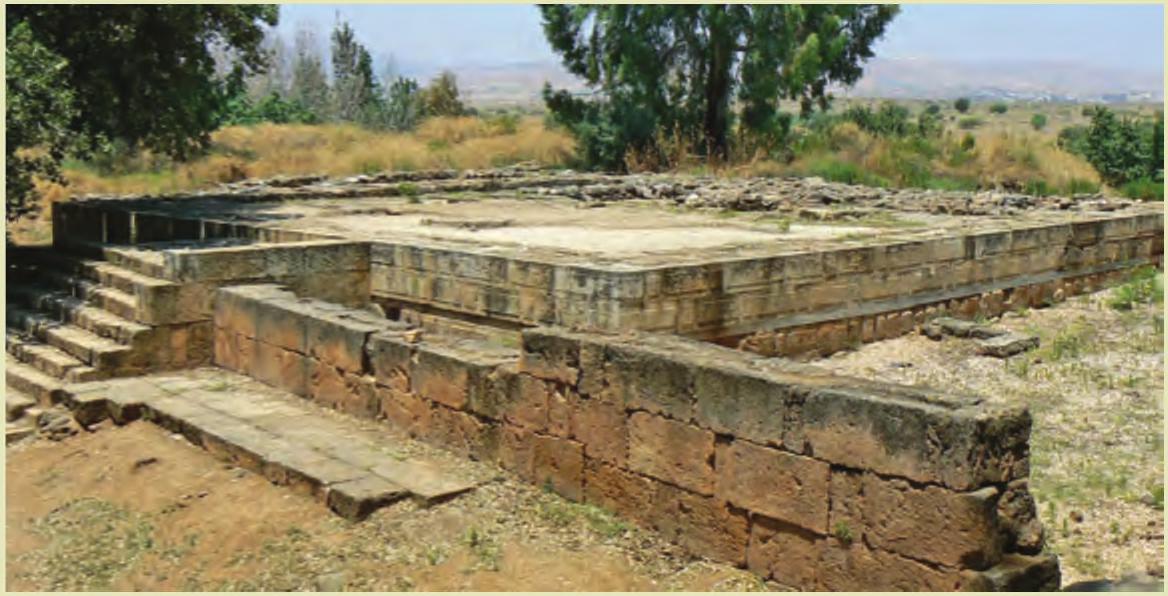
The high place at Dan,
where Jeroboam set up one
of the golden calves (1 Kin.
12:29)
Kim Walton
1003 b.c.
David becomes
king over all Israel
988 b.c.
Solomon is born
970 b.c.
David dies and
Solomon becomes
king
930 b.c.
Solomon dies;
Jeroboam reigns
in Israel and
Rehoboam reigns
in Judah
910 b.c.
Asa becomes king
in Judah
909 b.c.
Baasha becomes
king in Israel
874 b.c.
Ahab becomes
king in Israel
872 b.c.
Jehoshaphat
becomes king in
Judah
865 b.c.
Elijah begins to
prophesy against
Ahab
Original illustrations
End of source page 562