PRINTED PAGE 20NKJV · STUDY EDITION
20 | Genesis 10:2
a few mysteries. For one thing, the mention of names moves from
individuals to peoples to cities. Second, the point of view is from a
later date, when the people of Israel had as their geographical center
the land of Canaan. While the words imply universal humanity, they
omit a global perspective. Finally, the chapters give no clear sense
of time: they span many thousands of years.
10:1 Genealogy (or family histories) is found in ten significant pas-
sages in Genesis (see the list at 2:4). The names of the sons of Noah
were first given in 5:32 (see 6:10; 7:13; 9:18).
10:2 The listing of the sons of Japheth is more brief than the others.
Among the persons and peoples mentioned is Javan (vv. 2, 4), an
ancient name for the Greek people. It may be that many of Japheth’s
descendants migrated to Europe.
10:5 The migrations of the peoples to different lands would have
come after the events of 11:1–9 (the Tower of Babel).
10:6 Ham’s family included more than just his son Canaan (see 9:25).
Cush, Mizraim, Put, and Canaan are Ham’s four sons. Cush is the
ancient name for Ethiopia; Mizraim is a name for Egypt. The sons of
Cush are given in vv. 7–12, the sons of Mizraim in vv. 13, 14, and the
sons of Canaan in vv. 15–19. This section does not list the sons of Put.
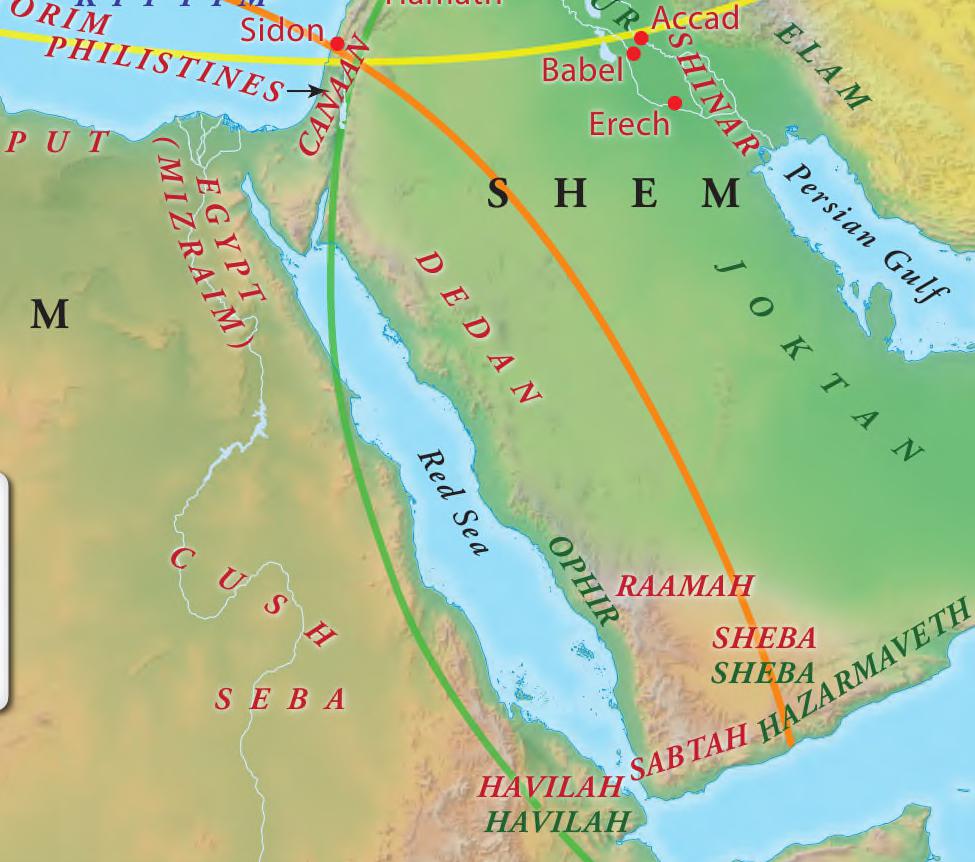
10:7–11 The sons of Cush include the infamous Nimrod (vv. 9–12).
The description of him as a mighty hunter before the Lord sug-
gests great arrogance. Like Lamech the descendant of Cain (4:19–24),
his infamy was proverbial. His territory was in the lands of the east,
the fabled ancient cities of Mesopotamia; these include Babel,
Erech, Accad, and Calneh (v. 10). The term Accad (or Akkad) supplies
the name of the language of ancient Babylon and Assyria, Akkadian.
The prophet Micah would later use the name Nimrod to describe
the region of Assyria, which would come under God’s judgment
(see Mic. 5:5, 6).
2 b 1 Chr. 1:5-7
3 1 Diphath, 1 Chr. 1:6
4 2 Sam. Rodanim
and 1 Chr. 1:7
5 c Gen. 11:8; Ps.
72:10; Jer. 2:10; 25:22
6 d 1 Chr. 1:8-16
3 Or Phut
8 e Mic. 5:6
9 f Jer. 16:16; Mic. 7:2
g Gen. 21:20
10 h Mic. 5:6 i Gen.
11:9
11 j Gen. 25:18;
2 Kin. 19:36; Mic. 5:6
were Seba, Havilah, Sabtah, Raamah, and
Sabtechah; and the sons of Raamah were
Sheba and Dedan.
8 Cush begot e Nimrod; he began to be
a mighty one on the earth. 9 He was a
mighty f hunter g before the LORD; there-
fore it is said, “Like Nimrod the mighty
hunter before the LORD.” 10 h And the
beginning of his kingdom was i Babel,
Erech, Accad, and Calneh, in the land
of Shinar. 11 From that land he went j to
Assyria and built Nineveh, Rehoboth Ir,
2 b The sons of Japheth were Gomer,
Magog, Madai, Javan, Tubal, Meshech,
and Tiras. 3 The sons of Gomer were Ash-
kenaz, 1 Riphath, and Togarmah. 4 The
sons of Javan were Elishah, Tarshish,
Kittim, and 2 Dodanim. 5 From these c the
coastland peoples of the Gentiles were
separated into their lands, everyone ac-
cording to his language, according to
their families, into their nations.
6 d The sons of Ham were Cush, Mizraim,
3 Put, and Canaan. 7 The sons of Cush
0
300 miles
0
300 km.
Nineveh
Hamath
Arvad
Sidon
Calah
Babel
Erech
Accad
Black Sea
Caspian
Sea
Persian Gulf
Aegean
Sea
Red Sea
M e d
i t e r
r a n
e a n
S e
a
P U T
D E D A N
CANAAN
HAVILAH
RAAMAH
SHEBA
SABTAH
S E B A
C
U
S
H
C
A
P
H
T
O
R
I
M
S
H
I
N
A
R
E
G
Y
P
T
PH I
L I S
TI N
E S
(
M
I
Z
R
A
I
M
)
OPHIR
HAZARMAVETH
A R A M
L
U
D
J
O
K
T
A
N
A S
S H
U R
E
L
A
M
HAVILAH
SHEBA
ARPHAXAD
K I T T I M
ELISHAH
TUBAL
T I R A S
TARSHISH
M
E
S
H
E
C
H
D
O
D
A N
I M
J
A
V
A
N
T
O
G
A
R
M
A
H
M
A
D
A
I
M A G O GG O M E R
A S H K E N A Z
H
A
M
S
H
E
M
J
A
P
H
E
T
H
Mt.
Ararat
Descendants of Japheth
Descendants of Ham
Descendants of Shem
PUT
ARAM
TUBAL
map_01_10_nations
66.6% = ~6” width
Table of Nations
Original illustrations
End of source page 55