PRINTED PAGE 491NKJV · STUDY EDITION
2 Samuel 6:15 | 491
CHAPTER 6
2 a 1 Chr. 13:5,
6 b Ex. 25:22;
1 Sam. 4:4; Ps. 80:1
1 Baalah, Kirjath
Jearim, Josh. 15:9;
1 Chr. 13:6 2 LXX,
Tg., Vg. omit by the
Name; many Heb.
mss., Syr. there
3 c 1 Sam. 26:1
3 LXX adds with
the ark
4 d 1 Sam. 7:1; 1 Chr.
13:7
5 e 1 Sam. 18:6, 7
6 f 1 Chr. 13:9
g Num. 4:15, 19, 20
4 held it
7 5 Or irreverence
8 6 Lit. Outburst
Against Uzzah
9 h Deut. 9:19; Ps.
119:120; Luke 5:8
10 i 2 Sam. 5:7
j 1 Chr. 13:13; 26:4-8
11 k 1 Chr. 13:14
l Gen. 30:27; 39:5
12 m 1 Chr.
15:25–16:3
13 n Num. 4:15;
Josh. 3:3; 1 Sam.
6:15; 2 Sam. 15:24;
1 Chr. 15:2, 15
o 1 Kin. 8:5
14 p Ps. 30:11; 149:3
q 1 Sam. 2:18, 28
7 whirled about
15 r 1 Chr. 15:28
12 Now it was told King David, saying,
“The LORD has blessed the house of Obed-
Edom and all that belongs to him, because
of the ark of God.” m So David went and
brought up the ark of God from the house
of Obed-Edom to the City of David with
gladness. 13 And so it was, when n those
bearing the ark of the LORD had gone six
paces, that he sacrificed o oxen and fatted
sheep. 14 Then David p danced 7 before the
LORD with all his might; and David was
wearing q a linen ephod. 15 r So David and
all the house of Israel brought up the ark
of the LORD with shouting and with the
sound of the trumpet.
a David arose and went with all the people
who were with him from 1 Baale Judah to
bring up from there the ark of God, whose
name is called 2 by the Name, the LORD of
Hosts, b who dwells between the cherubim.
3 So they set the ark of God on a new cart,
and brought it out of the house of Abina
dab, which was on c the hill; and Uzzah
and Ahio, the sons of Abinadab, drove
the new 3 cart. 4 And they brought it out
of d the house of Abinadab, which was on
the hill, accompanying the ark of God;
and Ahio went before the ark. 5 Then Da
vid and all the house of Israel e played mu
sic before the LORD on all kinds of instru
ments of fir wood, on harps, on stringed
instruments, on tambourines, on sis
trums, and on cymbals.
6 And when they came to f Nachon’s
threshing floor, Uzzah put out his g hand
to the ark of God and 4 took hold of it,
for the oxen stumbled. 7 Then the anger
of the LORD was aroused against Uzzah,
and God struck him there for his 5 er
ror; and he died there by the ark of God.
8 And David became angry because of
the LORD’s outbreak against Uzzah; and
he called the name of the place 6 Perez
Uzzah to this day.
9 h David was afraid of the LORD that
day; and he said, “How can the ark of
the LORD come to me?” 10 So David would
not move the ark of the LORD with him
into the i City of David; but David took
it aside into the house of Obed-Edom the
j Gittite. 11 k The ark of the LORD remained
in the house of Obed-Edom the Gittite
three months. And the LORD l blessed
Obed-Edom and all his household.
God is revealed in Ex. 3:13–15, where the context reveals that the
Lord is the mighty God of the patriarchs who intervenes on behalf
of His people. At times the Name of God is accompanied by the
designation “of Hosts” (5:10), referring to the angelic armies of the
universe (see 1 Kin. 22:19; Luke 2:13) as well as the armies of Israel
(1 Sam. 17:45). Cherubim are angelic beings generally regarded as
guardians of God’s holiness (see Gen. 3:24; Ex. 25:22; Ps. 80:1; 99:1).
God revealed Himself to Moses from between the two cherubim
mounted at opposite ends of the mercy seat over the ark of the
covenant (Ex. 25:22; Num. 7:89).
6:3 they set the ark of God on a new cart: The law was specific
that the ark was to be carried by the sons of Kohath, not by a cart or
any other vehicle (see Ex. 25:14, 15; Num. 3:30, 31). David was doing
what the Philistines had done (1 Sam. 6:7, 8). The ark had been taken
to the house of Abinadab after its recovery from the Philistines
(see 1 Sam. 7:1, 2). The sons of Abinadab should probably be
understood in a broader sense as “the descendants of Abinadab.”
6:5 Played literally means they “made merry” with dancing and
music (v. 21). The worshipers had a variety of string, wind, and per-
cussion instruments. Sistrums refers to Egyptian instruments con-
sisting of rings hanging loosely on metal rods that make a rattling
sound when shaken.
6:6 A threshing floor was a place for processing grain, separating
kernels from the chaff (Ruth 3:2). In order to steady the ark when it
seemed as though it would fall, Uzzah put out his hand.
6:7 Although Uzzah’s violation was unintentional, his error cost him
his life. God had warned His people that not even the Levites could
touch the holy objects of the tabernacle; the death penalty had
been specified for violators (Num. 4:15).
6:8 David became angry—not at himself for the carelessness
that resulted in this calamity, but at God. He named the place of the
tragedy Perez Uzzah, recalling what had happened.
6:9 David was afraid of the Lord: The tragedy of Uzzah rekindled
a necessary “fear of God” in the heart of David. Properly understood
(see Eccl. 12:13, 14), the fear of the Lord is essential to the pursuit of
obedience and holiness.
6:10 Obed-Edom was a Levite of the family of Korah, and later one
of the doorkeepers for the ark (see 1 Chr. 15:18, 24; 26:4–8). He was
called the Gittite because he was from the Levitical city of Gath
Rimmon (see Josh. 21:24).
6:13 This time the ark was carried (see Ex. 25:14, 15), rather than
transported by cart. Some interpreters think that the procession
was halted and sacrifices were offered every six paces. It is also
possible that the sacrifices were offered only once after the ark
bearers had advanced the first six paces, thus consecrating the
solemn procession.
6:14 The Hebrew word translated danced literally means “whirled.”
The linen ephod was a short, sleeveless garment worn by priests
(see 1 Sam. 2:18). David wore it to honor the Lord in view of his priest-
ly activities that day (v. 13).
6:15 Shouting was an expression of celebration and triumph (see
Is. 44:23). The trumpet refers to the ram’s horn or the shofar (2:28).
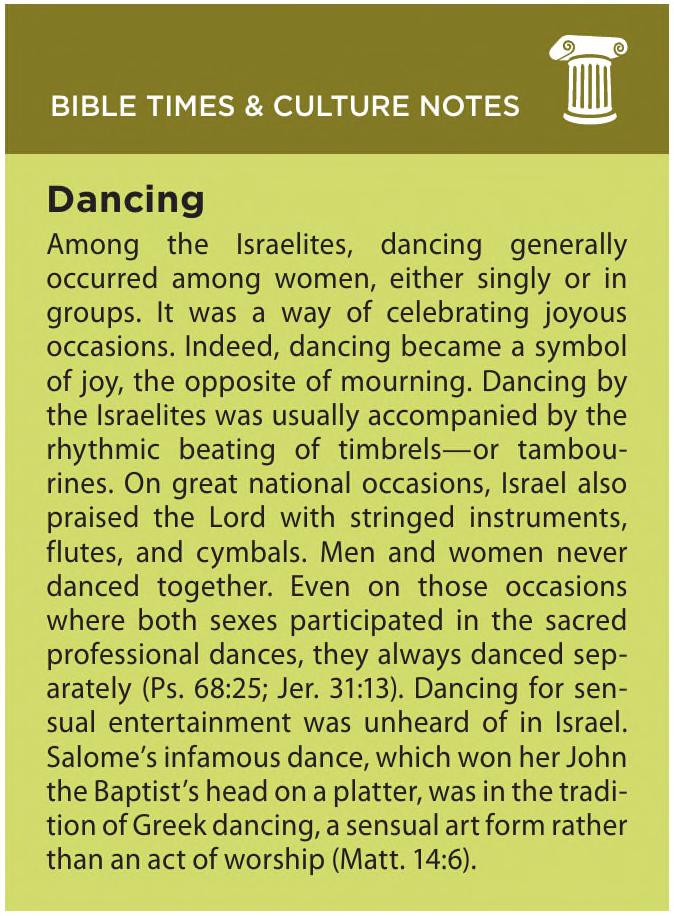
Bible Times & Culture Notes
Dancing
Among the Israelites, dancing generally
occurred among women, either singly or in
groups. It was a way of celebrating joyous
occasions. Indeed, dancing became a symbol
of joy, the opposite of mourning. Dancing by
the Israelites was usually accompanied by the
rhythmic beating of timbrels—or tambou-
rines. On great national occasions, Israel also
praised the Lord with stringed instruments,
flutes, and cymbals. Men and women never
danced together. Even on those occasions
where both sexes participated in the sacred
professional dances, they always danced sep-
arately (Ps. 68:25; Jer. 31:13). Dancing for sen-
sual entertainment was unheard of in Israel.
Salome’s infamous dance, which won her John
the Baptist’s head on a platter, was in the tradi-
tion of Greek dancing, a sensual art form rather
than an act of worship (Matt. 14:6).
Original illustrations
End of source page 526