PRINTED PAGE 490NKJV · STUDY EDITION
490 | 2 Samuel 5:13
5 idols 22 e 1 Chr. 14:13 23 f 2 Sam. 5:19 24 g 2 Kin. 7:6;
1 Chr. 14:15 h Judg. 4:14 25 i 1 Chr. 14:16 j Josh. 16:10 6 So
with MT, Tg., Vg.; LXX Gibeon
13 v [Deut. 17:17];
1 Chr. 3:9
14 w 1 Chr. 3:5-8
x 2 Sam. 12:24
2 Shimea, 1 Chr. 3:5
15 3 Elishama,
1 Chr. 3:6
17 y 1 Chr. 11:16
z 2 Sam. 23:14
18 a Gen. 14:5; Josh.
15:8; 1 Chr. 11:15;
Is. 17:5
19 b 1 Sam. 23:2;
2 Sam. 2:1
20 c 1 Chr. 14:11; Is.
28:21 4 Lit. Master
of Breakthroughs
21 d Deut. 7:5, 25
search for David. And David heard of it
z and went down to the stronghold. 18 The
Philistines also went and deployed them
selves in a the Valley of Rephaim. 19 So Da
vid b inquired of the LORD, saying, “Shall
I go up against the Philistines? Will You
deliver them into my hand?”
And the LORD said to David, “Go up,
for I will doubtless deliver the Philistines
into your hand.”
20 So David went to c Baal Perazim, and
David defeated them there; and he said,
“The LORD has broken through my ene
mies before me, like a breakthrough of
water.” Therefore he called the name of
that place 4 Baal Perazim. 21 And they left
their 5 images there, and David and his
men d carried them away.
22 e Then the Philistines went up once
again and deployed themselves in the
Valley of Rephaim. 23 Therefore f David
inquired of the LORD, and He said, “You
shall not go up; circle around behind
them, and come upon them in front of the
mulberry trees. 24 And it shall be, when
you g hear the sound of marching in the
tops of the mulberry trees, then you shall
advance quickly. For then h the LORD will
go out before you to strike the camp of
the Philistines.” 25 And David did so, as
the LORD commanded him; and he drove
back the Philistines from i Geba 6 as far
as j Gezer.
The Ark Brought to Jerusalem
6
Again David gathered all the choice
men of Israel, thirty thousand. 2 And
13 And v David took more concubines
and wives from Jerusalem, after he had
come from Hebron. Also more sons and
daughters were born to David. 14 Now
w these are the names of those who were
born to him in Jerusalem: 2 Shammua,
Shobab, Nathan, x Solomon, 15 Ibhar, 3 Eli
shua, Nepheg, Japhia, 16 Elishama, Elia
da, and Eliphelet.
The Philistines Defeated
17 y Now when the Philistines heard
that they had anointed David king over
Israel, all the Philistines went up to
economic interests, for he could profit from trade with Israel. The
house that Hiram had built for David must have been sumptuous
for the place and time. Most buildings in Israel were made of stone.
The use of cedar wood added elegance to David’s palace. Certainly
he spoke of his home with reasonable pride (7:2).
5:13 These marriages reflect David’s involvement in international
treaties and alliances which were sealed with the marriage of a king’s
daughter to the other participant in the treaty. Concubines, wives
who did not have the legal rights of a true wife, were part of a royal
harem. The status of kings in ancient times was often measured in
part by the size of their harems. Yet for Israel’s kings, there had been
a warning from God against acquiring many wives (Deut. 17:17).
5:14 Shammua is known as Shimea in 1 Chr. 3:5. Shammua, Shobab,
Nathan, and Solomon were David’s sons by Bathsheba (1 Chr. 3:5),
the wife of Uriah. David planned Uriah’s death so that he could marry
Bathsheba (ch. 11). The child born of David and Bathsheba’s affair
died in infancy (12:15–23).
5:15, 16 The lists in 1 Chr. 3:5–9 and 14:4, 5 record two additional
sons, Nogah and another Eliphelet (Elpelet in 1 Chr. 14:4).
5:17 The Hebrew word translated stronghold means “mountain
fortress,” suggesting a fortress other than Jerusalem. Therefore, it
is possible that these attacks took place between the time when
David was anointed over all Israel (v. 4) and when he captured Je-
rusalem (vv. 6–10).
5:18 The Valley of Rephaim, or “Valley of the Giants” (21:15–22),
extends southwest from Jerusalem toward the coastal plain. The
significance of the valley as a strategic approach to Jerusalem is
evidenced by the fact that the Philistines made a second attempt
to capture the city from this route (v. 22).
5:19 As was his custom, David inquired of the Lord before engag-
ing the Philistines in battle (see 2:1; 1 Sam. 23:2; 30:8). In matters of
warfare, David was not presumptuous. He wished to know the will
of God in choosing his battles and their timing.
5:21 The idol images which the Philistines had taken into battle to
assure them of victory were captured and carried away by David’s
men. This looting would have been regarded by the Philistines as a
defeat of their gods by the God of Israel. According to 1 Chr. 14:12,
David and his men burned the idols.
5:25 The Geba mentioned here is not the Geba of 1 Sam. 13:3,
which was 6 miles north of Jerusalem. This Geba was most likely
located south, in the Valley of Rephaim. Gezer was about 20 miles
northwest of Jerusalem.
6:1 The thirty thousand men were not all the men of Israel capable
of bearing arms, but the best of them.
6:2 Baale Judah, meaning “Masters of Judah,” was also called
Baalah and Kirjath Jearim (Josh. 15:9; 1 Chr. 13:6). It was a city on
the border of Judah and Benjamin, about 10 miles northwest of
Jerusalem. the Name, the Lord of Hosts: The personal name of
Bible Times & Culture Notes
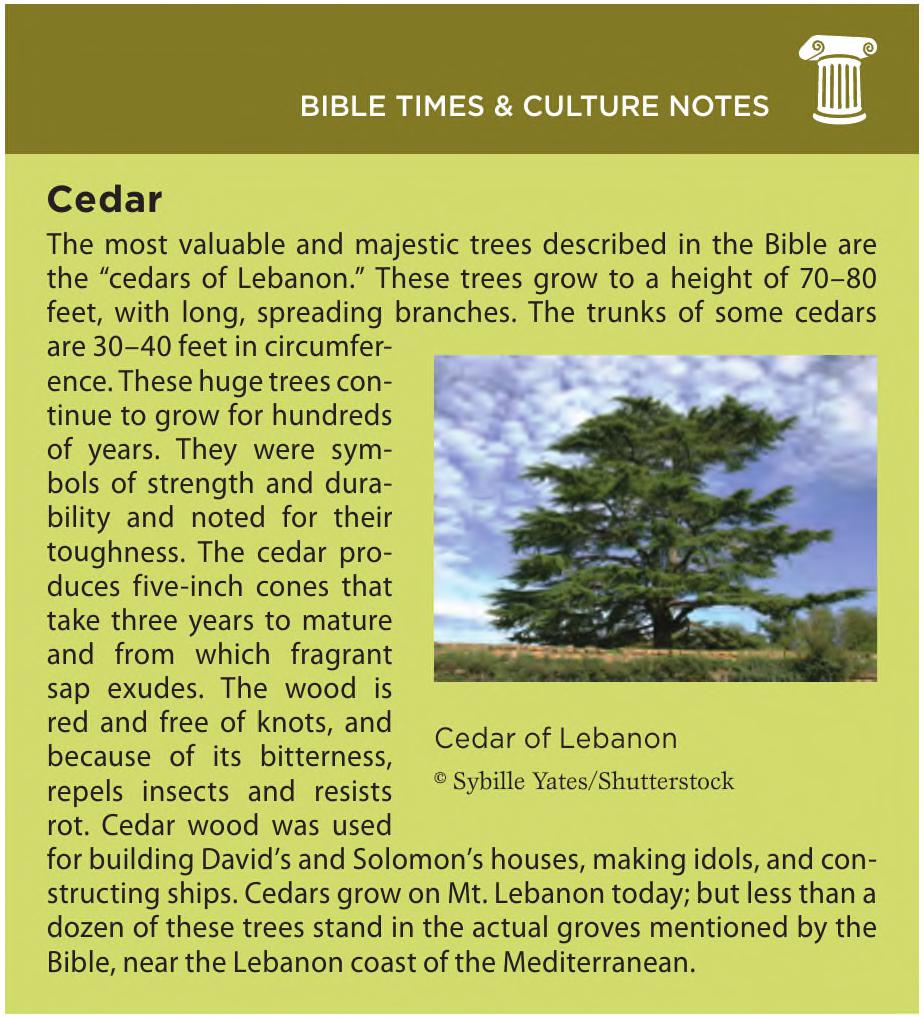
Cedar
The most valuable and majestic trees described in the Bible are
the “cedars of Lebanon.” These trees grow to a height of 70–80
feet, with long, spreading branches. The trunks of some cedars
are 30–40 feet in circumfer-
ence. These huge trees con-
tinue to grow for hundreds
of years. They were sym-
bols of strength and dura-
bility and noted for their
toughness. The cedar pro-
duces five-inch cones that
take three years to mature
and from which fragrant
sap exudes. The wood is
red and free of knots, and
because of its bitterness,
repels insects and resists
rot. Cedar wood was used
for building David’s and Solomon’s houses, making idols, and con-
structing ships. Cedars grow on Mt. Lebanon today; but less than a
dozen of these trees stand in the actual groves mentioned by the
Bible, near the Lebanon coast of the Mediterranean.
Cedar of Lebanon
© Sybille Yates/Shutterstock
Original illustrations
End of source page 525