PRINTED PAGE 489NKJV · STUDY EDITION
2 Samuel 5:12 | 489
7 m 2 Sam. 6:12, 16;
1 Kin. 2:10; 8:1; 9:24
8 n 1 Chr. 11:6-9
9 o 2 Sam. 5:7; 1 Kin.
9:15, 24 1 Lit. The
Landfill
10 p 1 Sam. 17:45
q 1 Sam. 18:12, 28
11 r 1 Kin. 5:1-18
s 1 Chr. 14:1
12 t Num. 24:7 u Is.
45:4
9 Then David dwelt in the stronghold,
and called it o the City of David. And Da
vid built all around from 1 the Millo and
inward. 10 So David went on and became
great, and p the LORD God of hosts was
with q him.
11 Then r Hiram s king of Tyre sent mes
sengers to David, and cedar trees, and
carpenters and masons. And they built
David a house. 12 So David knew that the
LORD had established him as king over Is
rael, and that He had t exalted His king
dom u for the sake of His people Israel.
itants of the land, who spoke to David,
saying, “You shall not come in here; but
the blind and the lame will repel you,”
thinking, “David cannot come in here.”
7 Nevertheless David took the stronghold
of Zion m (that is, the City of David).
8 Now David said on that day, “Who
ever climbs up by way of the water shaft
and defeats the Jebusites (the lame and
the blind, who are hated by David’s soul),
n he shall be chief and captain.” Therefore
they say, “The blind and the lame shall
not come into the house.”
because of its righteous king Melchizedek (Gen. 14:18–20). Mt. Mori-
ah—where Abraham had prepared to offer Isaac—was also located
at Jerusalem (Gen. 22:2).
5:6 The Jebusites were one of the Canaanite tribes living in the
Promised Land (Gen. 10:16–18). Jerusalem was on a hill just south of
Mt. Moriah, with steep cliffs on all sides except the north, making it
a natural fortress. The defenders felt able to boast that the blind
and the lame would be enough to defeat David.
5:7 Jerusalem is referred to as the stronghold of Zion. The word
Zion originally applied to the Jebusite stronghold, which became
the City of David after its capture. As the city expanded to the
north, encompassing Mt. Moriah, the temple mount came to be
called Zion (Ps. 78:68, 69). Eventually the term was used as a syn-
onym for Jerusalem (Is. 40:9).
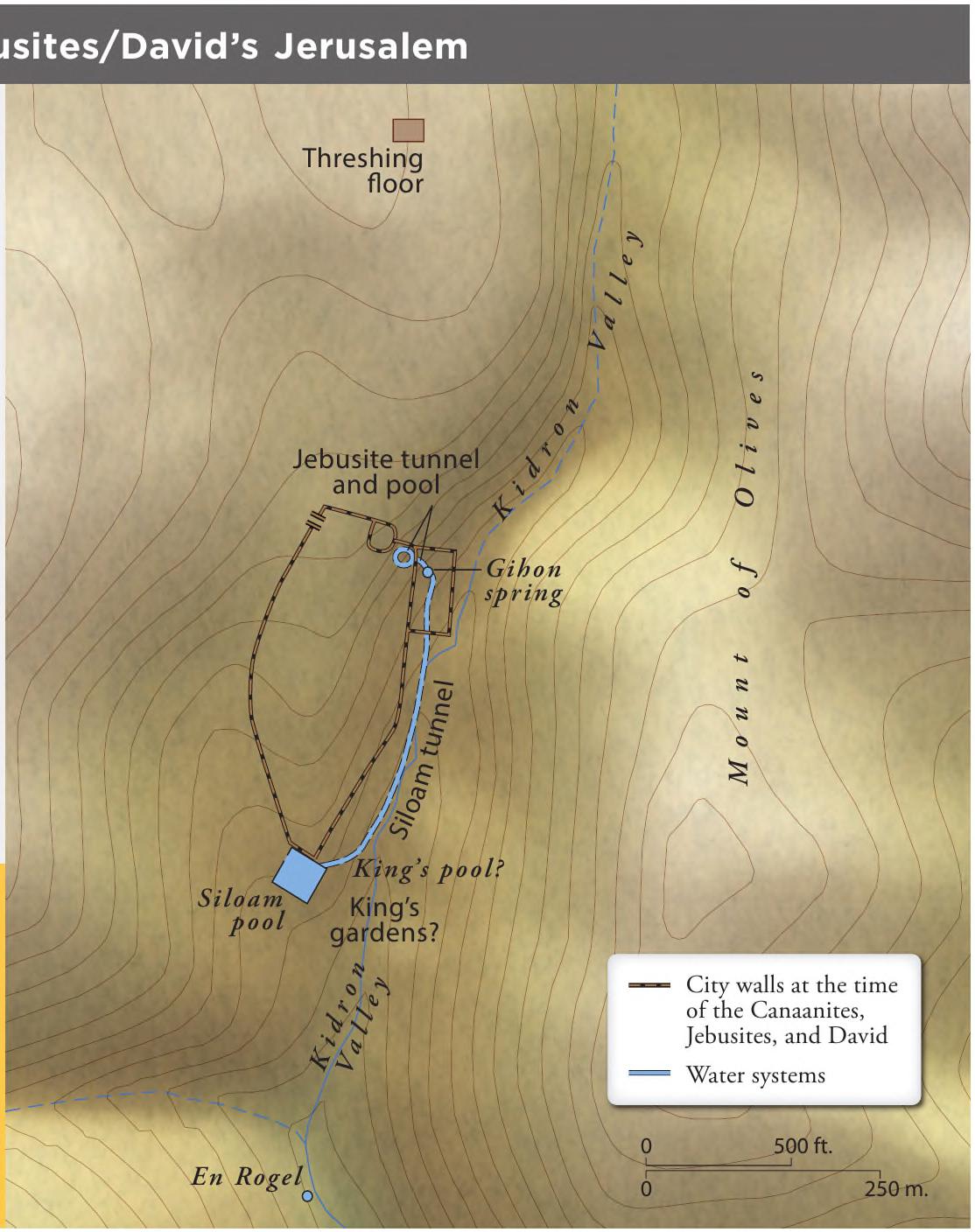
5:8 The water shaft extended about 230 feet up from the Gihon
spring to the top of the hill where the Jebusite fortress was situat-
ed (2 Chr. 32:30). The tunnel gave the city a secure water supply in
the event of a siege. The phrase the lame and the blind became
something of a taunt, which David turned first into a challenge, and
then into a victory song.
5:9 The term City of David is used in Luke 2:11 to refer to Bethle-
hem, the city of David’s birth. Here the term refers to Zion, the city
from which he ruled Israel.
5:10 God of hosts may also be translated “God of Armies” (6:2). The
hosts are the armies of angels that are at the Lord’s command (v. 24).
5:11, 12 Tyre, located on the Mediterranean coast north of Isra-
el, was a Phoenician city noted for its commerce, craftsmen, and
wealth. Hiram’s kindness toward David was probably prompted by
Threshing
floor
King’s
gardens?
S
il
oa
m tun
nel
Jebusite tunnel
and pool
King’s pool?
Gihon
spring
Siloam
pool
En Rogel
K i d r o n
V a l l e y
K i
d r
o n
V a
l l
e y
M o u n t
o f O l i
v e s
0
250 m.
0
500 ft.
City walls at the time
of the Canaanites,
Jebusites, and David
Water systems
Substantial historical evidence,
both biblical and extra-biblical,
places the temple of Solomon
on the holy spot where King
David built an altar to the Lord.
David had purchased the land
from Araunah the Jebusite,
who was using the exposed
bedrock as a threshing floor
(2 Sam. 24:18–25). Tradition
claims a much older sancti-
ty for the site, associating it
with the altar of Abraham on
Mount Moriah (Gen. 22:1–19;
2 Chr. 3:1). The writer of Gen-
esis equates Moriah with “the
Mount of the Lord” (Gen.
22:14).
c. 1000 b.c.
Less than 11 acres in size, Jebus, a
Canaanite city, could well defend
itself against attack, with walls
atop steep canyons and shafts
reaching an underground water
source. David captured the strong-
hold c. 1000 b.c. and made it his
capital.
The City of the Jebusites/David’s Jerusalem
Original illustrations
End of source page 524