PRINTED PAGE 480NKJV · STUDY EDITION
480 2 Samuel INTRODUCTION
David’s conquests and alliances gave him control of territory from the border of Egypt to the Euphrates. This
was largely due to David’s strong military presence in comparison with the general weakness that characterized
Egypt and Mesopotamia at this time. For a brief period, Israel was as strong as any nation of the ancient world.
Theme The unifying theme of 2 Samuel is the establishment of the kingdom of Israel, progressing from a
diverse group of divided and warring tribes to a solidified kingdom under David. However the purpose for
recording these events was not merely to have an “official” record of David’s reign. Throughout the narrative,
there is a continuing interest in the rule of God over His people. The book emphasizes that it was God who
rejected Saul for his disobedience, chose David for the throne, and disciplined David for his pride. God was still
the true King of Israel.
The key to David’s successful reign was his relationship with the Lord. God had described him as a man after
His own heart (1 Sam. 13:14). In his youth, David had demonstrated his strong faith in God by challenging a giant
with only a few stones and his faith in God’s strength (1 Sam. 17:45–51). In his adulthood, he continued to rely
on God for guidance and strength (2:1; 5:19). Early in his reign, he demonstrated the importance of his religious
convictions to all Israel by bringing the ark of the covenant to Jerusalem in the midst of a lavish celebration
before the Lord (6:1–23). Following that, his eagerness to build a temple for the glory of the Lord was known to
all (7:1–3). With such actions and the numerous songs he wrote in praise of God, David led the Israelites back
to the true worship of God. Even when he sinned, he demonstrated to the people his repentant heart before
the living God (12:13–23; 24:17–25). In the final analysis, David’s religious leadership was the most significant
part of his reign.
Through all the triumphs and tragedies of David’s reign, God was acting in the national and personal events
of His people in order to accomplish His will. The Lord gave David a glimpse of His ultimate will in the promises
He gave him, commonly called the Davidic covenant (7:12–16). In this unconditional covenant, God promised
David an eternal dynasty, an eternal throne, and an eternal kingdom. Ultimately, a righteous King greater than
David was coming. He would be David’s son and would rule from David’s throne forever (Is. 9:7). This promised
King is Jesus (see Luke 1:31–33; John 1:49).
Christ in the Scriptures
In spite of his sins of adultery, murder, and deceit (chs. 11–24), David remains a man after God’s own heart. This
is seen in his response and faithful attitude toward God. Like Jesus, David characterizes his reign with justice,
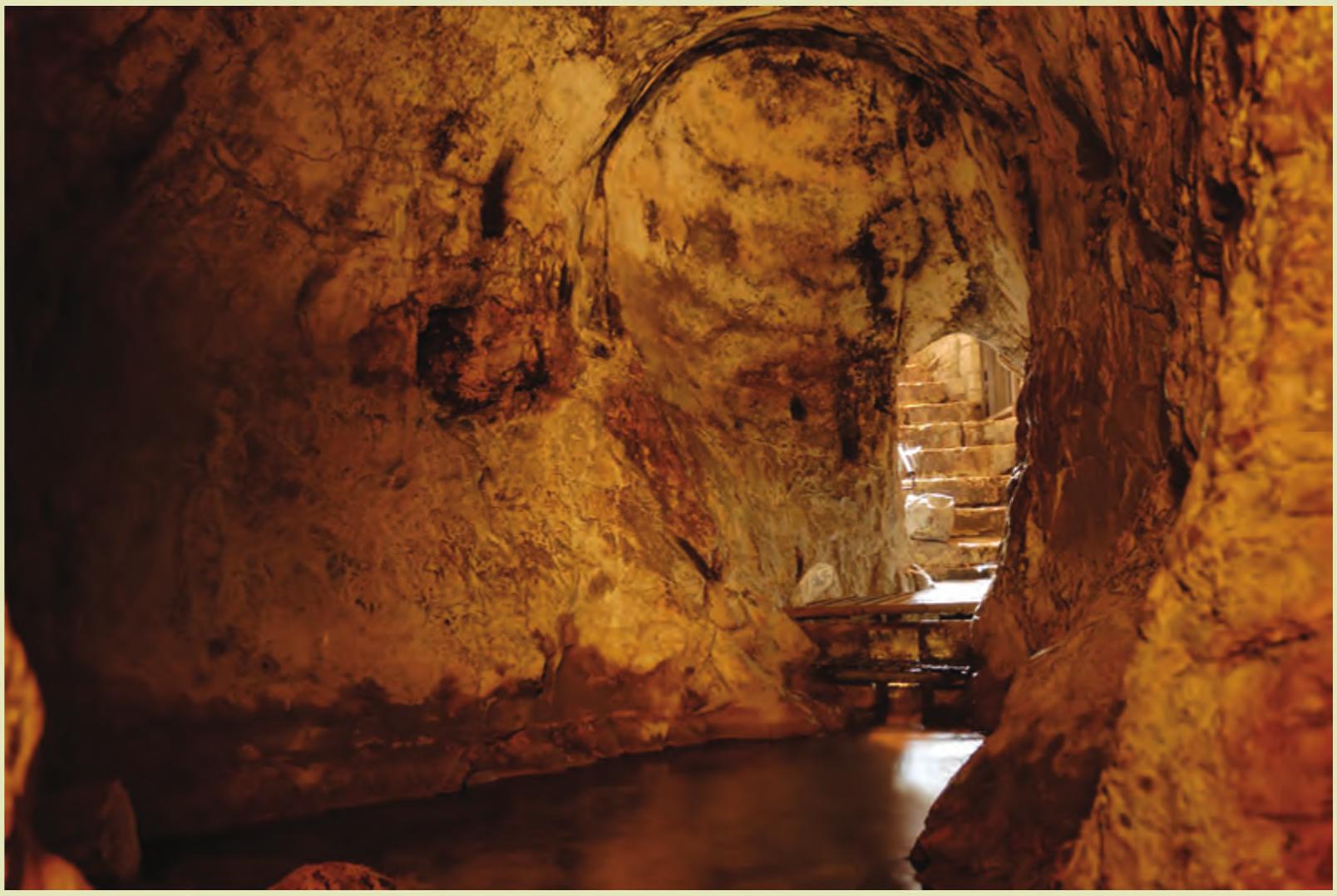
The Gihon spring (see 2 Sam. 5:8) provided a natural water source for ancient Jerusalem.
Todd Bolen/www.BiblePlaces.com
Original illustrations
End of source page 515