PRINTED PAGE 477NKJV · STUDY EDITION
1 Samuel 31:5 | 477
26 4 booty
27 u Josh. 19:8
v Josh. 15:48; 21:14
28 w Josh. 13:16
x 1 Chr. 27:27
y Josh. 15:50
29 z 1 Sam. 27:10
a Judg. 1:16; 1 Sam.
15:6; 27:10
30 b Num. 14:45;
21:3; Josh. 12:14;
15:30; 19:4; Judg.
1:17 5 Or Borashan
31 c Num. 13:22;
Josh. 14:13-15;
21:11-13; 2 Sam. 2:1
d 1 Sam. 23:22
CHAPTER 31
1 a 1 Chr. 10:1-12
b 1 Sam. 28:4
2 c 1 Sam. 14:49;
1 Chr. 8:33
3 d 2 Sam. 1:6 1 Lit.
found him
establish his relationships among the leaders of Judah after his stay
in Philistine territory.
30:27 Bethel is not the well-known city of Benjamin, but probably
the Bethel of Josh. 19:4. Ramoth of the South may be the same
city as Ramah of the South (Josh. 19:8), whose location is uncertain.
Jattir, a Levitical city (see Josh. 21:14) allotted to Judah (see Josh.
15:48), was about 13 miles southwest of Hebron.
30:28 Aroer was a village about 12 miles southeast of Beersheba.
The village of Siphmoth has not been identified. Eshtemoa was a
Levitical city (see Josh. 21:14) in the hill country of Judah.
30:29 Rachal is of uncertain location. The Jerahmeelites were
one of the clans of Judah (1 Chr. 2:9).
30:30 Hormah was where the Israelites were first defeated by
the Canaanites (Num. 14:45). The location of the city, allotted to
Judah (see Josh. 15:30) and to Simeon (see Josh. 19:4), is uncertain.
Chorashan and Athach are also of uncertain location.
30:31 Hebron, also known as Kirjath Arba (Gen. 23:2), was soon to
become David’s capital (see 2 Sam. 5:3). Hebron was captured by
Joshua and given to Caleb (Josh. 14:13). It was a Levitical city (Josh.
21:11) and a city of refuge (Josh. 20:7).
31:1 Mount Gilboa was a small mountain range in the eastern part
of the Jezreel valley.
31:2 Saul’s fourth son, Ishbosheth, was apparently not present at
this battle, since Abner promoted him to king after Saul’s death
(2 Sam. 2:8–10).
31:4 Saul took a sword and fell on it: This account of Saul’s death
is different from that given by the Amalekite in 2 Sam. 1:6–10. His
story was probably a fabrication intended to win David’s approval.
31:5 In a demonstration of loyalty, Saul’s armorbearer joined his
master in death.
sent some of the 4 spoil to the elders of Ju
dah, to his friends, saying, “Here is a pres
ent for you from the spoil of the enemies of
the LORD”— 27 to those who were in Bethel,
those who were in u Ramoth of the South,
those who were in v Jattir, 28 those who were
in w Aroer, those who were in x Siphmoth,
those who were in y Eshtemoa, 29 those who
were in Rachal, those who were in the cities
of z the Jerahmeelites, those who were in
the cities of the a Kenites, 30 those who were
in b Hormah, those who were in 5 Chor
ashan, those who were in Athach, 31 those
who were in c Hebron, and to all the places
where David himself and his men were
accustomed to d rove.
The Tragic End of Saul and His Sons
31
Now
a the Philistines fought
against Israel; and the men of Is
rael fled from before the Philistines, and
fell slain on Mount b Gilboa. 2 Then the
Philistines followed hard after Saul and
his sons. And the Philistines killed c Jon
athan, Abinadab, and Malchishua, Saul’s
sons. 3 d The battle became fierce against
Saul. The archers 1 hit him, and he was
severely wounded by the archers.
4 e Then Saul said to his armorbearer,
“Draw your sword, and thrust me
through with it, lest f these uncircum
cised men come and thrust me through
and 2 abuse me.”
But his armorbearer would not, g for he
was greatly afraid. Therefore Saul took
a sword and h fell on it. 5 And when his
armorbearer saw that Saul was dead, he
4 e Judg. 9:54; 1 Chr. 10:4 f Judg. 14:3; 1 Sam. 14:6; 17:26, 36
g 2 Sam. 1:14 h 2 Sam. 1:6, 10 2 torture
Bible Times & Culture Notes
Bow and Arrow
Bows were the most characteristic weapons of warfare in the
OT period, serving often as the decisive element in a battle.
Simple bows, composed of a piece of wood and string, did
not have much power or range, so the composite bow was
developed early in the history of the Middle East. The com-
posite bow was a combination of wood and animal horn. This
combination of materials provided the bow with the flexibil-
ity and strength needed for effective combat. The bow was
usually the first weapon fired in an open-field battle because
the archers of the hostile armies could send arrows long dis-
tances. When attacking a city, the archers of the attacking
army would try to pick city defenders off the walls. Archers
of the defending city would use their bows to try to keep the
army from getting close enough to break down the city’s
defenses.
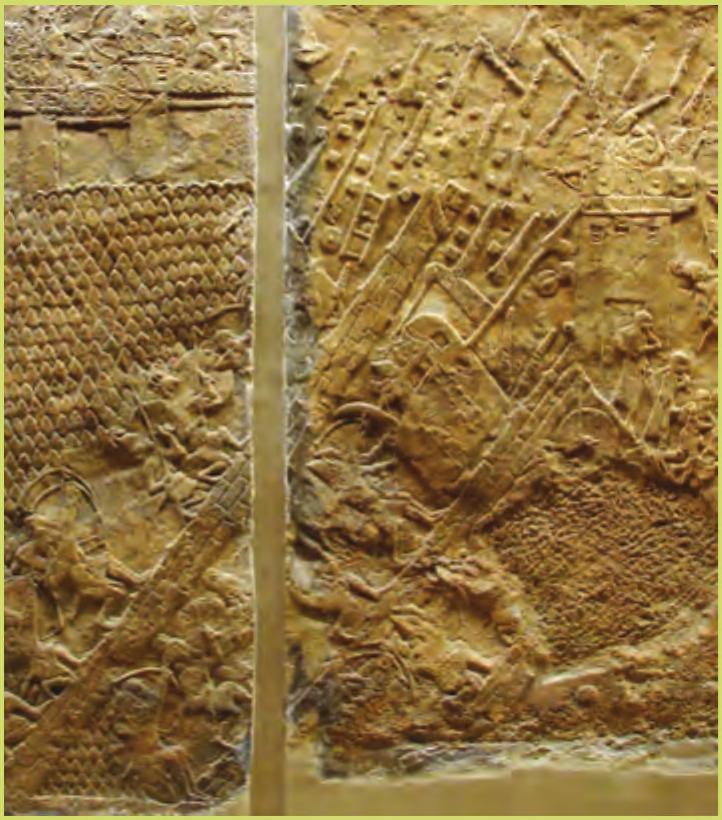
Archers on a Lachish relief. Note the one archer on the
top right defending the city from the tower and the
ones on the bottom left attacking the city.
Kim Walton, courtesy of the British Museum
Original illustrations
End of source page 512