PRINTED PAGE 452NKJV · STUDY EDITION
452 | 1 Samuel 15:33
7 But the LORD said to Samuel, k “Do
not look at his appearance or at his
physical stature, because I have 3 refused
him. l For 4 the LORD does not see as man
sees; for man m looks at the outward
appearance, but the LORD looks at the
n heart.”
8 So Jesse called Abinadab, and made
him pass before Samuel. And he said,
“Neither has the LORD chosen this one.”
9 Then Jesse made Shammah pass by.
And he said, “Neither has the LORD cho
sen this one.” 10 Thus Jesse made seven of
his sons pass before Samuel. And Samuel
said to Jesse, “The LORD has not chosen
And Agag said, “Surely the bitterness
of death is past.”
33 But Samuel said, h “As your sword
has made women childless, so shall your
mother be childless among women.” And
Samuel hacked Agag in pieces before the
LORD in Gilgal.
34 Then Samuel went to i Ramah, and
Saul went up to his house at j Gibeah of
Saul. 35 And k Samuel went no more to
see Saul until the day of his death. Nev
ertheless Samuel mourned for Saul, and
the LORD regretted that He had made Saul
king over Israel.
David Anointed King
16
Now the LORD said to Samuel,
a “How long will you mourn for
Saul, seeing I have rejected him from
reigning over Israel? b Fill your horn with
oil, and go; I am sending you to c Jesse the
Bethlehemite. For d I have 1 provided My
self a king among his sons.”
2 And Samuel said, “How can I go? If
Saul hears it, he will kill me.”
But the LORD said, “Take a heifer with
you, and say, e ‘I have come to sacrifice
to the LORD.’ 3 Then invite Jesse to the
sacrifice, and I will show you what you
shall do; you shall anoint for Me the one
I name to you.”
4 So Samuel did what the LORD said,
and went to Bethlehem. And the elders
of the town f trembled at his coming, and
said, g “Do you come peaceably?”
5 And he said, “Peaceably; I have come
to sacrifice to the LORD. h Sanctify 2 your
selves, and come with me to the sacri
fice.” Then he consecrated Jesse and his
sons, and invited them to the sacrifice.
6 So it was, when they came, that he
looked at i Eliab and j said, “Surely the
LORD’s anointed is before Him!”
“executed.” before the Lord: The execution was an expression of
divine judgment.
15:35 See evidently means “to give attention” or “to regard with
interest.” The point is that God was through with Saul as king, and
so was Samuel.
16:1—31:13 The next section records David’s rise to the throne.
David was known as a man after God’s heart (13:14). His faith was
so exemplary that centuries later God was pleased to be called
“the God of David” (2 Kin. 20:5; Is. 38:5). David contributed to the
worship of the Lord by planning the building of the temple (2 Chr.
28:11—29:2) and by writing many psalms (2 Sam. 23:1).
16:1 Fill your horn: The ram’s horn served as a vessel for the
anointing olive oil (10:1). Jesse the Bethlehemite was the son
(or descendant) of Obed, the son of Ruth and Boaz (Ruth 4:21, 22). I
have provided Myself a king: God made it clear to Samuel that
this king would be of His choosing.
16:2 Samuel’s concern for his life was not unwarranted in light of
Saul’s suspicious nature and spiritual degeneracy (18:11). A heifer is
a young cow. say, ‘I have come to sacrifice’: God did not instruct
Samuel to lie, but instead He provided a legitimate opportunity for
Samuel to visit with Jesse and his family. By performing the anoint-
ing in Bethlehem while officiating at a sacrifice, Samuel would avoid
arousing the suspicions of Saul.
16:4 Because Samuel’s visit was unexpected, the elders of the
town wondered if he had come to execute judgment (7:15, 16).
16:5 The Hebrew word for peaceably means “things as they ought
to be.” The word sanctify means “to set oneself apart” by means
of ceremonial washings and purifications (Ex. 19:10, 14, 22). he
consecrated Jesse and his sons: Apparently, Samuel personally
supervised the purification of the father and his sons.
16:6, 7 Eliab means “My God Is Father.” said: Samuel was probably
saying these things to himself. The appearance and stature of
Jesse’s oldest son, Eliab, commended him to leadership. But these
were the very things that had commended Saul (9:2). Instead of
looking at appearances, God searched the heart. Thus God gave
Samuel a new perspective. The state of a man’s heart was far more
significant than natural ability and physical appearance.
16:8, 9 Abinadab means “My Father Is Noble.” Shammah may
come from the word that means “He Hears.” The parade of sons
began with the oldest, in a typical patriarchal manner. The assump-
tion was that the firstborn would receive a higher rank than his
brothers. Yet often God’s way surprisingly reversed this expectation.
l Is. 55:8, 9 m 2 Cor. 10:7 n 1 Kin. 8:39 3 rejected 4 LXX For God
does not see as man sees; Tg. It is not by the appearance of a
man; Vg. Nor do I judge according to the looks of a man
33 h [Gen. 9:6];
Num. 14:45; Judg.
1:7; [Matt. 7:2]
34 i 1 Sam. 7:17
j 1 Sam. 11:4
35 k 1 Sam. 19:24
CHAPTER 16
1 a 1 Sam. 15:23, 35
b 1 Sam. 9:16; 10:1;
2 Kin. 9:1 c Ruth
4:18-22 d Ps. 78:70,
71; Acts 13:22 1 Lit.
seen
2 e 1 Sam. 9:12
4 f 1 Sam. 21:1
g 1 Kin. 2:13; 2 Kin.
9:22
5 h Gen. 35:2; Ex.
19:10 2 Consecrate
6 i 1 Sam. 17:13, 28
j 1 Kin. 12:26
7 k Ps. 147:10
Bible Times & Culture Notes
Anointing
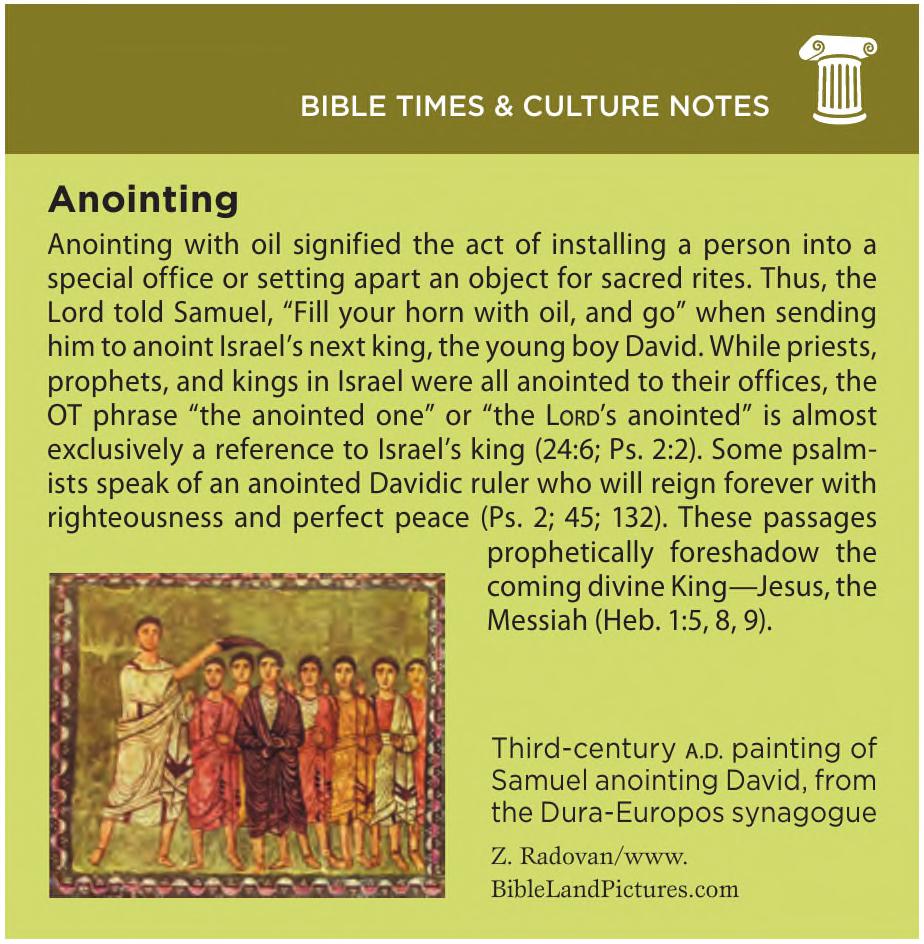
Anointing with oil signified the act of installing a person into a
special office or setting apart an object for sacred rites. Thus, the
Lord told Samuel, “Fill your horn with oil, and go” when sending
him to anoint Israel’s next king, the young boy David. While priests,
prophets, and kings in Israel were all anointed to their offices, the
OT phrase “the anointed one” or “the Lord’s anointed” is almost
exclusively a reference to Israel’s king (24:6; Ps. 2:2). Some psalm-
ists speak of an anointed Davidic ruler who will reign forever with
righteousness and perfect peace (Ps. 2; 45; 132). These passages
prophetically foreshadow the
coming divine King—Jesus, the
Messiah (Heb. 1:5, 8, 9).
Third-century a.d. painting of
Samuel anointing David, from
the Dura-Europos synagogue
Z. Radovan/www.
BibleLandPictures.com
Original illustrations
End of source page 487