PRINTED PAGE 438NKJV · STUDY EDITION
438 | 1 Samuel 7:4
afraid of the Philistines. 8 So the children
of Israel said to Samuel, o “Do not cease
to cry out to the LORD our God for us,
that He may save us from the hand of the
Philistines.”
9 And Samuel took a p suckling lamb
and offered it as a whole burnt offering
to the LORD. Then q Samuel cried out to
the LORD for Israel, and the LORD an
swered him. 10 Now as Samuel was offer
ing up the burnt offering, the Philistines
drew near to battle against Israel. r But
the LORD thundered with a loud thun
der upon the Philistines that day, and so
confused them that they were overcome
before Israel. 11 And the men of Israel
went out of Mizpah and pursued the Phi
listines, and 3 drove them back as far as
below Beth Car. 12 Then Samuel s took a
stone and set it up between Mizpah and
Shen, and called its name 4 Ebenezer, say
ing, “Thus far the LORD has helped us.”
13 t So the Philistines were subdued,
and they u did not come anymore into
the territory of Israel. And the hand of
the LORD was against the Philistines all
the days of Samuel. 14 Then the cities
which the Philistines had taken from Is
rael were restored to Israel, from Ekron
to Gath; and Israel recovered its territory
from the hands of the Philistines. Also
there was peace between Israel and the
Amorites.
15 And Samuel v judged Israel all the
days of his life. 16 He went from year to
year on a circuit to Bethel, Gilgal, and
Mizpah, and judged Israel in all those
places. 17 But w he always returned to
with all your hearts, then e put away the
foreign gods and the f Ashtoreths 1 from
among you, and g prepare your hearts
for the LORD, and h serve Him only; and
He will deliver you from the hand of the
Philistines.” 4 So the children of Israel
put away the i Baals and the 2 Ashtoreths,
and served the LORD only.
5 And Samuel said, j “Gather all Israel
to Mizpah, and k I will pray to the LORD
for you.” 6 So they gathered together at
Mizpah, l drew water, and poured it out
before the LORD. And they m fasted that
day, and said there, n “We have sinned
against the LORD.” And Samuel judged
the children of Israel at Mizpah.
7 Now when the Philistines heard that
the children of Israel had gathered togeth
er at Mizpah, the lords of the Philistines
went up against Israel. And when the
children of Israel heard of it, they were
sexuality, and war. The rites connected with her worship usually
involved sacred prostitution. Sexual rituals in the Canaanite temples
were designed to prompt the gods to make the earth fertile.
7:4 the Baals: In ancient sculptures, Baal was depicted with a
horned helmet. In one hand he grasped a club or mace and in the
other a shaft of lightning or a spear with leaves. In some sculptures,
he stood on the back of a bull. The plurals Baals and Ashtoreths
refer either to the many images of these gods or to the various local
forms under which these gods were worshiped.
7:5 Samuel gathered the people for a prayer meeting at Mizpah,
about eight miles north of Jerusalem. The city was the capital of
Judah after the fall of Jerusalem (see 2 Kin. 25:22–25). I will pray:
Samuel, like his mother (1:10–16; 2:1–10), repeatedly exhibited a
commitment to prayer (8:6; 12:19, 23; Ps. 99:6; Jer. 15:1).
7:6 poured it out: The pouring of water was symbolic of repen-
tance (Ps. 62:8; Lam. 2:19). Samuel judged: Samuel acted as chief
magistrate, rendering decisions and settling disputes.
7:7 The Israelite gathering at Mizpah alerted the Philistines of a po-
tential uprising. They immediately organized an attack.
7:8 Do not cease to cry out to the Lord: The Israelites did not
want to engage in battle unless Samuel was praying for victory. In
contrast to the debacle at Aphek (ch. 4), the Israelites were no longer
depending on the ark as a magical talisman. They now wanted to
depend solely on the power of God through prayer.
7:9 a suckling lamb: According to Lev. 22:27, no animal could be
sacrificed until it was at least eight days old.
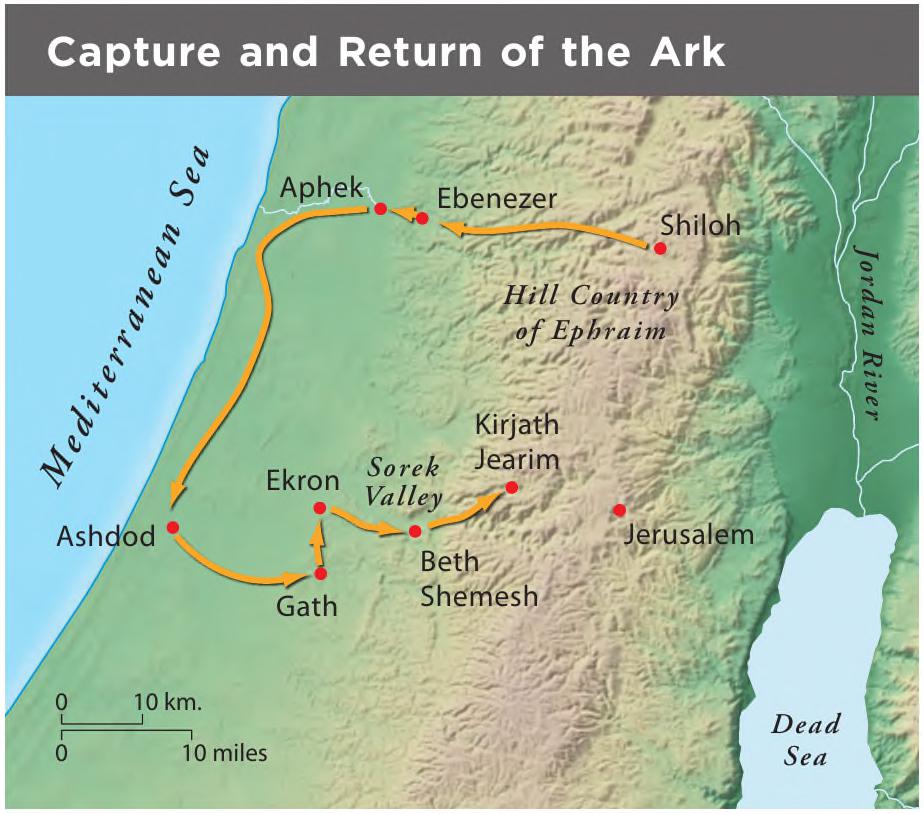
7:12, 13 To commemorate the victory and acknowledge the Lord’s
intervention, Samuel set up a memorial stone on the battlefield and
named it Ebenezer, meaning “Stone of Help.” Samuel followed
Joshua’s practice of commemorating the victories of God for His
people with stone markers (see Josh. 4). The victory at Ebenezer
was so decisive that the Philistines made no more attacks against
the Israelites during Samuel’s judgeship.
7:14 Ekron and Gath were Philistine cities near Israel (5:8, 10). The
frontier settlements which the Israelites had been forced to evac-
uate could now be taken again. Amorites may refer to the origi-
nal inhabitants of Canaan (see Gen. 15:16), or to the hill dwellers of
southern Canaan (see Num. 13:29; Josh. 10:5).
7:16 In addition to his religious duties as prophet, Samuel served as
a circuit judge. Bethel, the “House of God,” was where Jacob had
his famous dream (Gen. 28:10–22). Gilgal was where the Israelites
had first camped after crossing the Jordan River to conquer Canaan
(Josh. 4:19, 20). It was about one mile from Jericho.
7:17 Ramah was about five miles north of Jerusalem.
q 1 Sam. 12:18; Ps. 99:6; Jer. 15:1 10 r Josh. 10:10; 2 Sam.
22:14, 15; Ps. 18:13, 14 11 3 struck them down
12 s Gen. 28:18; 35:14; Josh. 4:9; 24:26 4 Lit. Stone of Help
13 t Judg. 13:1 u 1 Sam. 13:5 15 v 1 Sam. 12:11 17 w 1 Sam. 8:4
3 e Gen. 35:2;
Josh. 24:14, 23;
Judg. 10:16 f Judg.
2:13; 1 Sam. 31:10
g 2 Chr. 30:19; Job
11:13 h Deut. 6:13;
10:20; 13:4; Josh.
24:14; Matt. 4:10;
Luke 4:8 1 Images
of Canaanite
goddesses
4 i Judg. 2:11;
10:16 2 Images
of Canaanite
goddesses
5 j Judg. 10:17;
20:1; 1 Sam. 10:17
k 1 Sam. 12:17-19
6 l 2 Sam. 14:14
m Judg. 20:26; Neh.
9:1, 2; Dan. 9:3-5;
Joel 2:12 n Judg.
10:10; 1 Sam. 12:10;
1 Kin. 8:47; Ps. 106:6
8 o 1 Sam. 12:19-24;
Is. 37:4
9 p Lev. 22:27
Kirjath
Jearim
Beth
Shemesh
Gath
Jerusalem
Shiloh
Ebenezer
Aphek
Ashdod
Ekron
Hill Country
of Ephraim
Sorek
Valley
Dead
Sea
Jord
an River
Me d it
er ran
e an S
ea
0
10 miles
0
10 km.
Capture and Return of the Ark
Original illustrations
End of source page 473