PRINTED PAGE 431NKJV · STUDY EDITION
1 Samuel 2:23 | 431
wife, and say, “The LORD give you de
scendants from this woman for the 7 loan
that was k given to the LORD.” Then they
would go to their own home.
21 And the LORD l visited 8 Hannah, so
that she conceived and bore three sons
and two daughters. Meanwhile the child
Samuel m grew before the LORD.
Prophecy Against Eli’s Household
22 Now Eli was very old; and he heard
everything his sons did to all Israel, 9 and
how they lay with n the women who as
sembled at the door of the tabernacle of
meeting. 23 So he said to them, “Why do
you do such things? For I hear of your
may take as much as your heart desires,”
he would then answer him, “No, but you
must give it now; and if not, I will take
it by force.”
17 Therefore the sin of the young men
was very great e before the LORD, for men
f abhorred 6 the offering of the LORD.
Samuel’s Childhood Ministry
18 g But Samuel ministered before the
LORD, even as a child, h wearing a linen
ephod. 19 Moreover his mother used to
make him a little robe, and bring it to him
year by year when she i came up with
her husband to offer the yearly sacrifice.
20 And Eli j would bless Elkanah and his
2:17 abhorred: Eli’s sons dishonored God by doing their priestly
duties with irreverence and disrespect. Those who regularly handle
the things of God are sometimes in grave danger of carelessly and
presumptuously performing the sacred duties entrusted to them.
2:18 The linen ephod was a sleeveless garment that was worn by
priests, especially when officiating at the altar (see 2:28; 22:18; Ex.
28:6–14). Occasionally it was worn by others engaged in religious
ceremonies, such as David (2 Sam. 6:14), and here by Samuel.
2:19 The little robe made by Hannah is different from the ephod
mentioned in v. 18. It was probably a long outer garment like those
worn by people of rank or special status. The fact that Hannah made
such a robe indicated her love for her son, whom she could visit
only on rare occasions.
2:20 the loan that was given: The word loan here indicates a
complete giving up of the child to God (1:28).
2:21 visited Hannah: God came to Hannah to grant her request,
as He had to Sarah (Gen. 21:1). In His gracious condescension, He
comes near to His people to meet their needs (see Ruth 1:8). In other
circumstances, God’s visit may be for the purpose of judgment (see
Hos. 1:4).
2:23, 24 Eli’s protests seem weak in view of the enormity of his
sons’ sins.
17 e Gen. 6:11
f [Mal. 2:7-9]
6 despised
18 g 1 Sam. 2:11; 3:1
h Ex. 28:4
19 i 1 Sam. 1:3, 21
20 j Gen. 14:19
k 1 Sam. 1:11, 27,
28 7 gift
21 l Gen. 21:1
m Judg. 13:24;
1 Sam. 2:26; 3:19-
21; Luke 1:80; 2:40
8 attended to
22 n Ex. 38:8 9 So
with MT, Tg., Vg.;
DSS, LXX omit rest
of verse
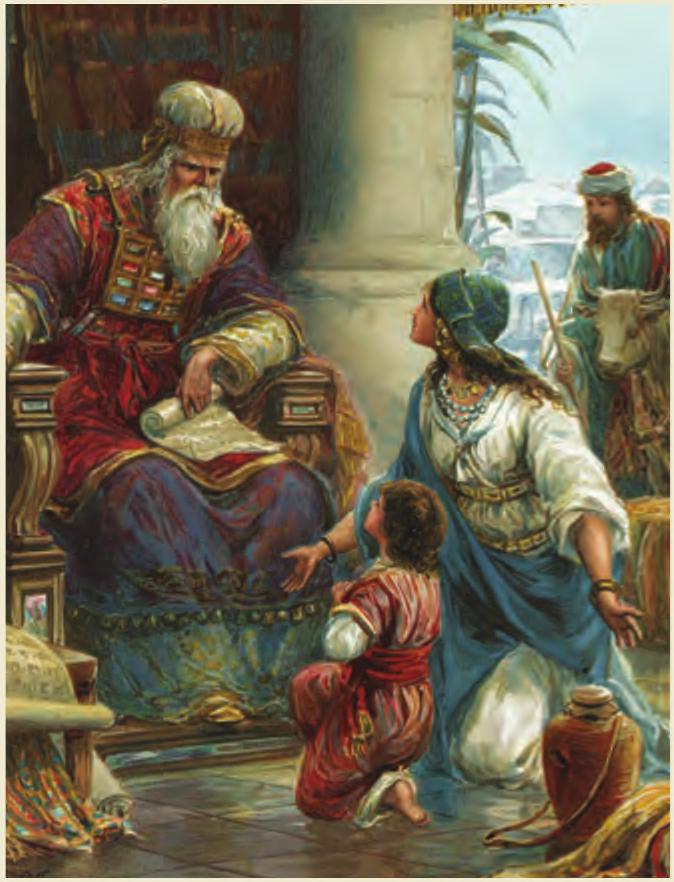
Hannah bringing Samuel to Eli
Hannah bringing Samuel to Eli, Dudley, Robert Ambrose/
Private Collection/© Look and Learn/The Bridgeman Art
Library
One Woman’s Devotion
Out of the materialism and ruthlessness of Israel during the period of the judges, Hannah emerged as a woman of faith.
From her home in the hills north of Jerusalem, she had traveled to Shiloh, the national place of worship. Her sadness of
heart and persistence in prayer contrasted sharply with the prevalent corruption in worship led by Eli’s sons (2:12–17).
Hannah’s personal life was one of despair in her childlessness
as she recoiled from Peninnah’s pestering reproaches. Her prayer
exhibited selflessness as she pled for a son whom she might present
to God for His use (1:11). Clearly, Hannah was loved and valued for
herself by her husband, Elkanah, but even the intensity of a devoted
husband’s love could not penetrate her inner disquiet nor overcome
her yearning for a child (1:8). The throbbing emotions of her despair
were so evident in Hannah’s prayers that the aged Eli accused her
of drunkenness. But beyond her prayers and tears, a vow erupted.
Hannah, in effect, made a pact with God; she pledged to give back
to Him the precious life He might give to her. God honored her bold
and decisive act.
Hannah’s faith was rewarded, and she named her son Samuel (in
Hebrew, “Name of God”) because she “asked for him from the Lord”
(1:20). According to custom, she probably nursed him several years,
giving time for her to convey to Samuel her own spirit of deep rev-
erence and piety and also to knit her heart with his through mater-
nal bonding. Nonetheless, she kept her word to the Lord. Into the
defiled worship center she placed her very young, impressionable
son. Although humanly it seemed to border on foolishness, this was
an act of saintly sacrifice. Her commitment was to God; her gift had
been pre-arranged with Him. With prophetic insight she planted the
next generation just as promised.
Samuel grew up to become the last judge, an outstanding and
gifted prophet, and the one who would anoint the first two kings of
Israel. Samuel was the pivotal spiritual leader who turned the nation
toward Yahweh. His mother Hannah played her part in this spiritual
awakening as she trusted God, leaving for all posterity an example
of determined devotion in her motherhood.
Original illustrations
End of source page 466