PRINTED PAGE 428NKJV · STUDY EDITION
428 | 1 Samuel 1:1
1:1 Ramathaim Zophim is another name for Ramah (v. 19), a village
about five miles north of Jerusalem. The mountains of Ephraim
refers to the hill country primarily occupied by the tribe of Ephraim.
Elkanah, whose Hebrew name means “God Has Created,” was a
Levite (1 Chr. 6:26, 34). He is referred to as an Ephraimite since he
lived in the territory of Ephraim.
1:3 yearly: God’s law called for the Israelites to attend three annual
pilgrim festivals in Jerusalem (Ex. 34:23; Deut. 16:16). The Lord of
hosts is a military designation referring to God as the One who
commands the angelic armies of heaven (1 Kin. 22:19; Luke 2:13; Rev.
19:14) and the armies of Israel (17:45). Shiloh, located about 20 miles
north of Jerusalem, was the religious center for the nation at this
time and the location of the tabernacle (Josh. 18:1). Eli, Hophni,
and Phinehas served as priests at Shiloh, officiating at the sacrifices
presented in the court of the tabernacle. Eli may mean “God Is High.”
Hophni means “Tadpole.” Phinehas may come from an Egyptian
word meaning “Black One.”
1:4, 5 The double portion was designed to compensate Hannah
for her lack of children and demonstrate Elkanah’s love for her. the
Lord had closed her womb: God is the One who provides the
ability to conceive children (see Gen. 33:5; Ps. 127:3).
1:6 Her rival refers to Peninnah, Elkanah’s other wife, who took
every occasion to flaunt her children before Hannah.
1:7 she went up: God’s law demanded that the men of Israel appear
before Him on three festival occasions. Many brought their families
with them, but it was not required that they do so. This verse shows
Hannah’s devotion to the Lord in that she also made annual treks
to Shiloh to worship God. she wept and did not eat: Peninnah’s
constant taunting drove Hannah to depression.
1:8 While Peninnah provoked Hannah, Elkanah sought to encourage
her. He suggested that his love for Hannah was a greater blessing
than having ten sons.
1:9 eating and drinking: The worship of God involved not only
the sacrifice of animals, but also lavish banquets of meat and wine.
Eli, Israel’s high priest and judge (4:18), was from the family of
Ithamar, Aaron’s fourth son (1 Kin. 2:27; 1 Chr. 24:1, 3). The last high
priest mentioned before him was Phinehas, the son of Eleazar (Judg.
20:28). It is not known why or how the office of high priest passed
from the house of Eleazar to that of Ithamar. The doorpost of the
tabernacle refers to the entrance of the place of worship, where
people would approach Eli for judicial rulings.
1:11 Within the context of her prayer, Hannah made a vow to God.
She promised that if God would give her a son, the child would
be given back to God. Levites customarily served from age 25 to
50 (Num. 4:3; 8:24–26). Yet Hannah dedicated her son for lifelong
service. The words no razor shall come upon his head refer to
the law of the Nazirite (Num. 6:2–6). The Nazirite vow involved a des-
ignated period of time (usually no more than a few weeks or months)
during which there was a commitment to refrain completely from
wine, from cutting the hair, and touching any dead body. Hannah
promised that her son would be a Nazirite for life.
1:12–14 Eli watched her mouth: From a distance, Eli was unable
CHAPTER 1
1 a Josh. 17:17, 18;
24:33 b 1 Chr. 6:27,
33-38 c Ruth 1:2
1 Eliel, 1 Chr. 6:34
2 Toah, 1 Chr. 6:34
2 d Deut. 21:15-17
3 e Ex. 34:14, 23;
Judg. 21:19; 1 Sam.
1:21; Luke 2:41
f Deut. 12:5-7; 16:16
g Josh. 18:1
4 h Deut. 12:17, 18
5 i Gen. 16:1; 30:1, 2
6 j Job 24:21
8 k Ruth 4:15
9 l 1 Sam. 3:3
3 palace or temple,
Heb. heykal
10 m Job 7:11 4 Lit.
wept greatly
11 n Gen. 28:20;
Num. 30:6-11 o Ps.
25:18 p Gen. 8:1
q Num. 6:5; Judg.
13:5
The Family of Elkanah
N
ow there was a certain man
of Ramathaim Zophim, of the
a mountains of Ephraim, and
his name was b Elkanah the son
of Jeroham, the son of 1 Elihu, the son of
2 Tohu, the son of Zuph, c an Ephraim
ite. 2 And he had d two wives: the name
of one was Hannah, and the name of the
other Peninnah. Peninnah had children,
but Hannah had no children. 3 This man
went up from his city e yearly f to worship
and sacrifice to the LORD of hosts in g Shi
loh. Also the two sons of Eli, Hophni and
Phinehas, the priests of the LORD, were
there. 4 And whenever the time came for
Elkanah to make an h offering, he would
give portions to Peninnah his wife and
to all her sons and daughters. 5 But to
Hannah he would give a double portion,
for he loved Hannah, i although the LORD
had closed her womb. 6 And her rival also
j provoked her severely, to make her mis
erable, because the LORD had closed her
womb. 7 So it was, year by year, when she
went up to the house of the LORD, that
she provoked her; therefore she wept and
did not eat.
Hannah’s Vow
8 Then Elkanah her husband said to
her, “Hannah, why do you weep? Why
do you not eat? And why is your heart
grieved? Am I not k better to you than ten
sons?”
9 So Hannah arose after they had fin
ished eating and drinking in Shiloh. Now
Eli the priest was sitting on the seat by
the doorpost of l the 3 tabernacle of the
LORD. 10 m And she was in bitterness of
soul, and prayed to the LORD and 4 wept
in anguish. 11 Then she n made a vow and
said, “O LORD of hosts, if You will indeed
o look on the affliction of Your maidser
vant and p remember me, and not forget
Your maidservant, but will give Your
maidservant a male child, then I will give
him to the LORD all the days of his life,
and q no razor shall come upon his head.”
12 And it happened, as she continued
praying before the LORD, that Eli watched
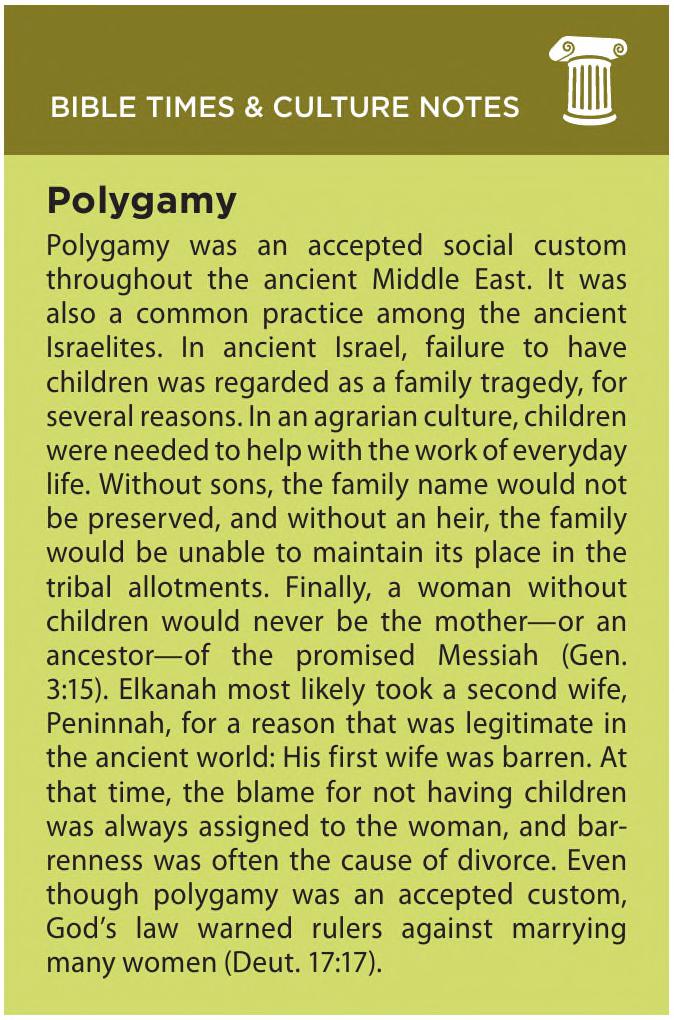
Bible Times & Culture Notes
Polygamy
Polygamy was an accepted social custom
throughout the ancient Middle East. It was
also a common practice among the ancient
Israelites. In ancient Israel, failure to have
children was regarded as a family tragedy, for
several reasons. In an agrarian culture, children
were needed to help with the work of everyday
life. Without sons, the family name would not
be preserved, and without an heir, the family
would be unable to maintain its place in the
tribal allotments. Finally, a woman without
children would never be the mother—or an
ancestor—of the promised Messiah (Gen.
3:15). Elkanah most likely took a second wife,
Peninnah, for a reason that was legitimate in
the ancient world: His first wife was barren. At
that time, the blame for not having children
was always assigned to the woman, and bar-
renness was often the cause of divorce. Even
though polygamy was an accepted custom,
God’s law warned rulers against marrying
many women (Deut. 17:17).
Original illustrations
End of source page 463