PRINTED PAGE 417NKJV · STUDY EDITION
Ruth INTRODUCTION 417
place in the community of faith. He blessed her with a child who would become the ancestor of King David
and later of the promised Messiah.
The second concept that the Book of Ruth emphasizes is redemption. God’s providential hand in redeem-
ing Ruth and Naomi from poverty is evident. He controlled circumstances so that Ruth and Boaz would meet,
and He prompted Boaz to fulfill the responsibilities of the “close relative” or the kinsman-redeemer (3:9). The
kinsman-redeemer was “the defender of family rights.” This individual was a close relative who had the financial
resources to rescue a poverty-stricken family member, stepping in to save that relative from slavery or from
having to sell the family’s ancestral land. In the story of Ruth, Boaz redeemed the land that Naomi was about to
sell. He also took on another of the kinsman-redeemer’s responsibilities—the obligation of providing an heir
for Ruth’s deceased husband, Mahlon. Dying without an heir was considered a tragedy in the ancient Middle
East. To rectify this situation, the brother of a deceased man was expected to marry the widow in order to
produce a child, who would be considered the heir of the deceased. This was called a levirate marriage. Boaz
willingly took on this duty, even though he was not the nearest relative (3:12, 13). He bought the land from
Naomi, married Ruth, and carried on the family name through the birth of their son. Through all these actions,
Boaz exemplified the compassion and love of a redeemer. His life is an illustration for us of the compassion of
Jesus, who is our Redeemer (Gal. 3:13).
Christ in the Scriptures
In this short book, the Hebrew word goel is used 13 times. It means “close relative” (3:9) and conveys the concept
of kinsman-redeemer. That’s exactly who Jesus turned out to be: the kinsman-redeemer for the human race,
one who became part of our “family” and who also became our advocate. According to ancient Hebrew law,
a person must fulfill certain requirements in order to qualify as a “kinsman-redeemer.” And the requirements
anticipate what Jesus Himself did for us.
For one thing, this kinsman-redeemer must be a relative of those he redeems (Deut. 25:5, 7–10; John 1:14;
Rom. 1:3; Phil. 2:5–8; Heb. 2:14, 15). This family member must also be able to pay the price of redemption (Ruth
2:1; 1 Pet. 1:18, 19) and be willing to redeem the individual who is about to be claimed by another (Ruth 3:11;
Matt. 20:28; John 10:15, 18; Heb. 10:7). One final requirement is that the kinsman-redeemer must himself be free
and not in debt. Because Jesus was sinless, He was free from the curse of sin. The kinsman-redeemer is a clear
picture of the role Jesus would play for us.
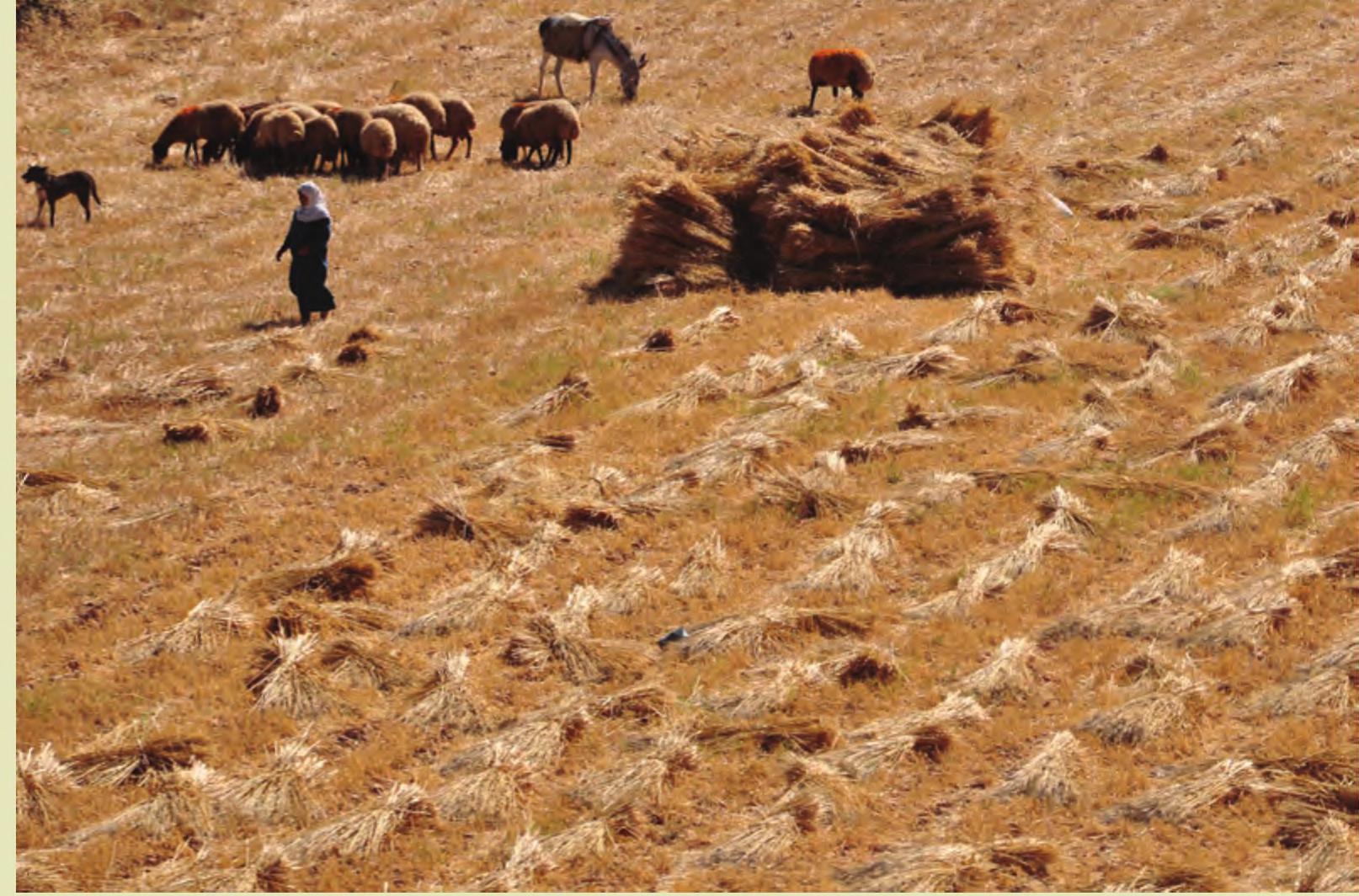
A wheat field being harvested in the hill country of Manasseh. Ruth met Boaz when he saw her gleaning leftover
grain from his fields (Ruth 2).
www.HolyLandPhotos.org
Original illustrations
End of source page 452