PRINTED PAGE 390NKJV · STUDY EDITION
390 | Judges 7:3
2 b Deut. 8:17; Is.
10:13
3 c Deut. 20:8
makes even more incredible the Israelites’ request that Gideon rule
over them because he had “delivered us from the hand of Midian”
(8:22, 23).
7:3 When Gideon allowed those who were fearful to leave, more
than two-thirds departed, leaving only ten thousand. Mosaic law
allowed military exemptions for several classes of people, includ-
ing those who had just built a home, those who had just planted a
vineyard, those engaged to be married, and those who were fearful
(Deut. 20:5–8).
7:4, 5 Gideon thinned his army even more by employing a strange
distinction, namely, how his men drank water from a brook. Some
commentators have suggested that the men who did not get down
on their knees were maintaining a higher degree of military readi-
ness by drinking out of their hands. However, they may be reading
too much into the account, for the text does not indicate any reason
for Gideon’s preference. The reference to the way a dog laps might
even be derogatory since dogs were despised creatures in the an-
cient world (1 Sam. 17:43; 2 Kin. 8:13; Matt. 7:6). If so, God’s role in
the victory becomes even more apparent, since the three hundred
who were left were the ones who did not even have the common
sense to drink in a normal fashion. God’s comment in v. 7 seems to
reinforce this suggestion.
people are still too many; bring them
down to the water, and I will test them
for you there. Then it will be, that of
whom I say to you, ‘This one shall go
with you,’ the same shall go with you;
and of whomever I say to you, ‘This one
shall not go with you,’ the same shall not
go.” 5 So he brought the people down to
the water. And the LORD said to Gid
eon, “Everyone who laps from the water
for Me to give the Midianites into their
hands, lest Israel b claim glory for itself
against Me, saying, ‘My own hand has
saved me.’ 3 Now therefore, proclaim in
the hearing of the people, saying, c ‘Who
ever is fearful and afraid, let him turn
and depart at once from Mount Gilead.’ ”
And twenty-two thousand of the people
returned, and ten thousand remained.
4 But the LORD said to Gideon, “The
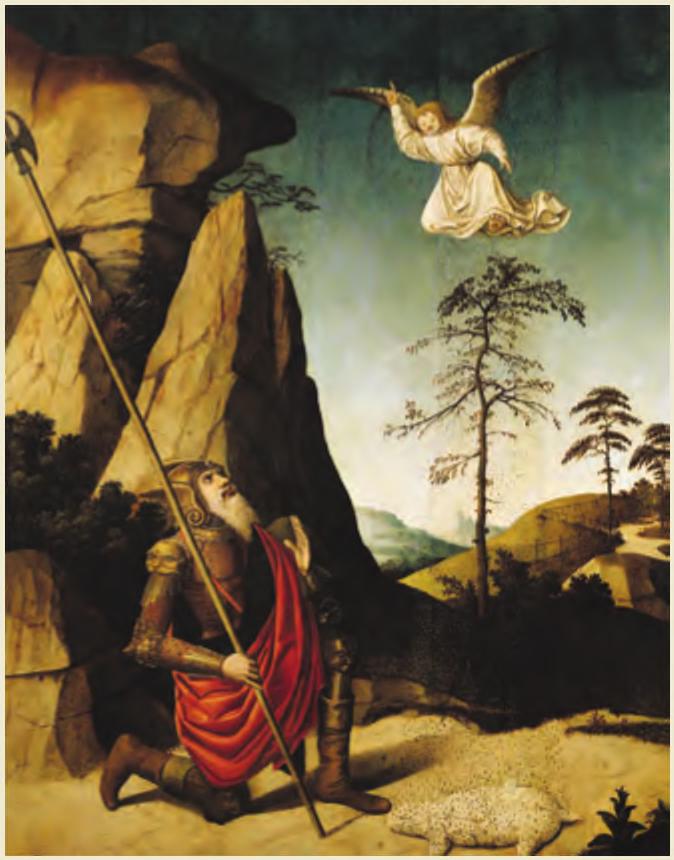
Gideon seeking God’s will with a piece of fleece
Gideon and the Fleece, c.1490, French School/Musee du
Petit Palais, Avignon, France/Giraudon/The Bridgeman
Art Library
Determining God’s Will
Christians believe that they should carefully obey God’s will. But how can we know what His will is? How should we go
about making decisions that honor the Lord?
The example of Gideon is frequently cited as a model for godly decision-making. Before acting, Gideon carefully
considered whether the Lord wanted him to rally an army and attack the Midianites. Twice he set out a fleece (a clump
of wool) to make sure of God’s intentions (6:36–40). On this basis, some have argued that before Christians make major
decisions with long-range consequences, they should “put out a fleece before the Lord,” seeking some tangible sign that
indicates His will with certainty.
Is that an appropriate way to know God’s will? In considering the question, it is important to note that this is the only
occasion in the Bible when God revealed His will through a fleece. It is also worth noting Gideon’s extreme hesitation,
doubt, and fear. The Lord had already told him what to do through the Angel of the Lord (6:11–16). In fact, the Angel had
already given Gideon a confirming sign (6:17–22).
In light of these facts, Gideon’s use of the fleece would appear
to demonstrate a lack of faith more than any zeal to be certain of
God’s will. Fortunately, God was very patient with him and granted
his request for a confirming sign. But it seems that using a fleece to
determine God’s will was the exception rather than the rule, and
thus does not serve as the best pattern for how we can depend on
God for guidance.
Is there a more reliable way? Yes, God has clearly and objec-
tively told us what He wants throughout the Bible. For example,
the Ten Commandments give straightforward instructions to guide
our behavior in numerous areas of life. Likewise, one of the New
Testament letters to the Thessalonians says plainly, “This is the will
of God” (1 Thess. 4:3). The passage then goes on to outline some of
God’s will in regard to sexuality.
Thus when it comes to making choices in life, God calls us to
clear thinking—thinking that is based on our relationship with Him
and our allegiance to His values, which are clearly spelled out in
Scripture. God has made us to be thinking, discerning, analytical
persons who assume responsibility for working our way through life
in accordance with His general plans and purposes. He challenges
us to learn all that we can about any situation, relationship, respon-
sibility, or opportunity that we have, weigh it in light of His precepts
and principles, and then act. As we act, we can take comfort from
the fact that He is at work within us, “both to will and to do for His
good pleasure” (Phil. 2:13).
Original illustrations
End of source page 425