PRINTED PAGE 378NKJV · STUDY EDITION
378 | Judges 1:11
11 m Josh. 15:15
12 n Josh. 15:16, 17
13 o Judg. 3:9
14 p Josh. 15:18,
19 3 LXX, Vg. he
urged her
15 q Gen. 33:11
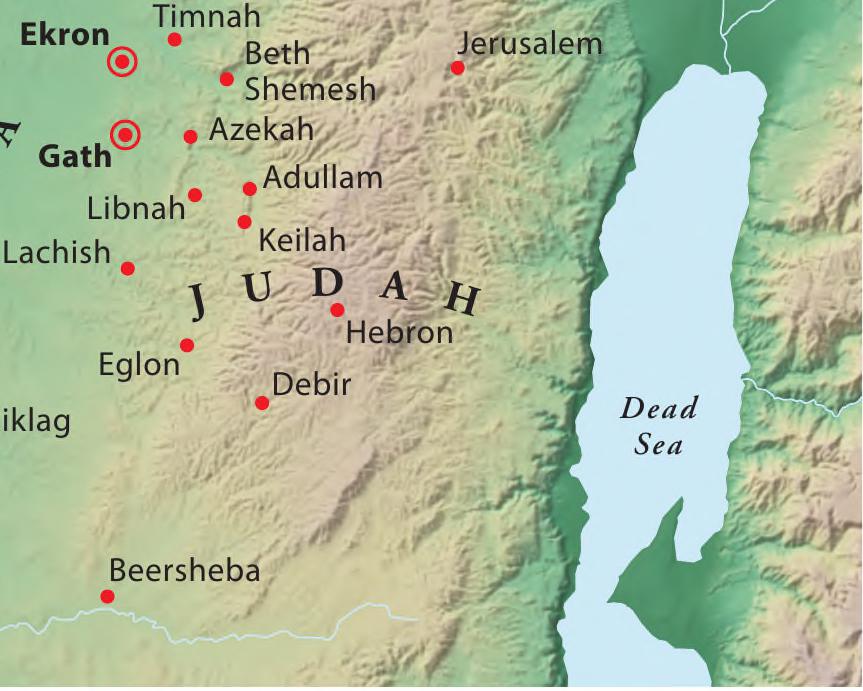
four cities. Hebron, about 20 miles southwest of Jerusalem, was
where Abraham settled and built an altar (Gen. 13:18). they killed
Sheshai, Ahiman, and Talmai: Caleb drove these three men out
of Hebron (v. 20; Josh. 15:14).
1:11 Debir was the next city captured by the Israelites. Its former
name Kirjath Sepher means “City of the Book”; it may have been
an administrative center where records were kept. However, the
modern archaeological site, Tell Beit Mirsim, has not yielded any
great library or records. Nevertheless, archaeologists have uncov-
ered a strongly fortified city, which was destroyed close to 1200 b.c.
1:14, 15 As a dowry, Caleb’s daughter asked for springs of water in
addition to the land he had given her. Land without fresh water was
almost worthless, so her request was an astute one.
his daughter Achsah as wife. 14 p Now it
happened, when she came to him, that
3 she urged him to ask her father for a
field. And she dismounted from her don
key, and Caleb said to her, “What do you
wish?” 15 So she said to him, q “Give me a
blessing; since you have given me land in
the South, give me also springs of water.”
And Caleb gave her the upper springs
and the lower springs.
Arba.) And they killed Sheshai, Ahiman,
and Talmai.
11 m From there they went against the
inhabitants of Debir. (The name of Debir
was formerly Kirjath Sepher.)
12 n Then Caleb said, “Whoever attacks
Kirjath Sepher and takes it, to him I
will give my daughter Achsah as wife.”
13 And Othniel the son of Kenaz, o Caleb’s
younger brother, took it; so he gave him
0
10 miles
0
10 km.
Joppa
Timnah
Beersheba
Jerusalem
Gerar
Ziklag
Aphek
Debir
Eglon
Hebron
Gezer
Lod
Azekah
Adullam
Lachish
Aijalon
Beth
Shemesh
Tel Qasile
Libnah
Keilah
Gibbethon
Ashdod
Ashkelon
Gaza
Ekron
Gath
Dead
Sea
P H I
L I S
T I A
J
U
D
A
H
M e d i t
e r r a
n e a
n
S e a
Gaza, Ashkelon, Ashdod, Ekron, and Gath comprise a list of
familiar biblical names. Each of these cities was a commer-
cial emporium with important connections both north (as
far as Mesopotamia) and south (as far as Egypt) by way of the
coastal highway that served as one of the major highways of
the ancient world. Also the ships of Phoenicia, Cyprus, Crete,
and the Aegean called at Philistia’s seaports. Among these
seaports was a place today called Tel Qasile on the Yarkon
River (the “Brook Kanah” of Josh. 16:8; 17:9) just north of mod-
ern Tel Aviv. A Philistine temple has been found at Tel Qasile.
The Philistine plain itself was an arid, loam-covered lowland
between the Mediterranean Sea and the foothills of the
Judahite plateau on the east. To the south lay a stretch of
undulating sand dunes adjacent to the sea. No area in bibli-
cal history was more frequently contested than the western
foothills, lying on the border between Judah and Philistia.
Originally a part of Judah’s tribal allotment, the coastal area
was never totally wrested away from the Philistines. Beth
Shemesh, Timnah, Azekah, and Ziklag were among the towns
coveted by both Israelites and Philistines, and they figure in
the stories of Samson, Goliath, and David. The area to the
north of Philistia, the plain of Sharon, was also contested at
various periods. During Saul’s reign the Philistines even held
Beth Shean and the Valley of Jezreel. Later, from about the
time of Baasha on, a long border war was conducted by the
Israelites at Gibbethon.
Five Cities of the Philistines
Original illustrations
End of source page 413