PRINTED PAGE 377NKJV · STUDY EDITION
Judges 1:10 | 377
1:1—2:5 The introductory passage of Judges shows continuing mil-
itary activity (1:1–26), which indicates that all military conquests had
not been completed during Joshua’s day. It then explicitly details
the incomplete conquests of several tribes (1:27–36). That Israel had
disobeyed God’s directions for conquest is evident in 2:1–5, where
the Angel of the Lord makes such an accusation. In sharp contrast
to the peaceful and unified picture of Israel at the end of the Book of
Joshua, the breakdown of Israelite society is already evident.
1:1–21 Judges begins with a record of conquests in southern
Palestine. The tribe of Judah assumed leadership and allied with
Simeon in campaigns against the Canaanites who had not been
driven out of their respective territories. They fought a series of suc-
cessful campaigns, “going up” against Bezek and Jerusalem, “going
down” against Hebron, Debir, and Zephath, and concluding with
an invasion of Philistine territory. They had mixed success against
the Canaanites, but their successes (vv. 4–18, 20) outweighed their
failures (vv. 19, 21).
1:1 Now after the death of Joshua it came to pass that: Judges
begins as the Book of Joshua does, with reference to the death of
the previous leader—Moses in Josh. 1:1, Joshua here. Yet no new
leader was commissioned to lead Israel after Joshua; rather, the tribe
of Judah was designated to lead in the fight against the Canaanites
(1:1–4). The choice of Judah was the first hint that Jacob’s prediction
for Judah (Gen. 49:8–12) was coming to pass. The prophecy would
come to fruition with the establishment of the monarchy under
David and his descendants; David was from the tribe of Judah.
1:3 History bound the tribes of Judah and Simeon together. They
were both descended from the same mother (Gen. 29:33, 35), and
Simeon had inherited land in Judah’s territory (Josh. 19:1, 9). Theirs
was a natural alliance.
1:4 the Canaanites and the Perizzites: See Josh. 3:10. The site
of the battle of Bezek between Israelites and Canaanites is un-
known. Many scholars believe that it took place near present-day
Khirbet Bezqa, about three miles northeast of Gezer, northwest of
Jerusalem. However, 1 Sam. 11:8–11 mentions a town called Bezek
northeast of Shechem in the territory of Manasseh, where Saul took
a census of the people. Considering that Judah was leading a cam-
paign on behalf of all Israel (vv. 1, 2), a battle in Manasseh’s territory
is quite possible. Later, Judah spearheaded a campaign in its own
territory (vv. 8–19).
1:6, 7 Adoni-Bezek: The name of this minor king means “Lord of
Bezek.” To cut off his thumbs and big toes would prevent Adoni-
Bezek from ever engaging in battle again, since a thumb was need-
ed to hold a sword and the big toes were necessary for running. The
practice of mutilating vanquished enemies is recorded in ancient
sources found in Mesopotamia and Greece and was practiced by
Adoni-Bezek himself. As a result of his wounds, however, Adoni-
Bezek died.
1:8, 9 After the battle at Bezek, Judah pressed the campaign against
the Canaanites elsewhere in Jerusalem and the mountains, the
southland, and the lowland. Jerusalem was captured and burned,
but not settled. Verse 21 states that Benjamin did not drive out the
Jebusites from the city. For more on this differing account, see Josh.
15:63. The complete conquest and settlement of Jerusalem was not
accomplished until David’s day (2 Sam. 5:6–10).
1:10–15 The capture of Hebron and Debir appears as a new con-
quest, but these victories had already been recounted in Josh. 15.
This passage is probably a reference to the earlier victory (or else
the passage in Joshua is anticipating the victories to come). The
account in vv. 11–15 is taken almost verbatim from Josh. 15:15–19,
and it is the third account of Caleb’s inheritance (the other account
is found in Josh. 14:6–15).
1:10 The name Hebron means “Confederacy.” This city’s name was
formerly Kirjath Arba (literally “city of four”). Arba was also the
name of a leader of the Anakim (Josh. 14:15). From the names it
is conjectured that Hebron was originally a close-knit alliance of
CHAPTER 1
1 a Josh. 24:29
b Num. 27:21;
Judg. 20:18 c Josh.
17:12, 13
2 d Gen. 49:8, 9;
Rev. 5:5
3 e Josh. 19:1
f Judg. 1:17
4 g 1 Sam. 11:8
7 h Lev. 24:19;
1 Sam. 15:33;
[James 2:13]
8 i Josh. 15:63;
Judg. 1:21
9 j Josh. 10:36;
11:21; 15:13 1 Heb.
Negev, and so
throughout the
book
10 k Josh. 15:13-19
l Josh. 14:15
2 attacked
The Continuing Conquest of Canaan
N
ow after the a death of Joshua it
came to pass that the children
of Israel b asked the LORD, say
ing, “Who shall be first to go
up for us against the c Canaanites to fight
against them?”
2 And the LORD said, d “Judah shall go
up. Indeed I have delivered the land into
his hand.”
3 So Judah said to e Simeon his brother,
“Come up with me to my allotted territo
ry, that we may fight against the Canaan
ites; and f I will likewise go with you to
your allotted territory.” And Simeon
went with him. 4 Then Judah went up,
and the LORD delivered the Canaanites
and the Perizzites into their hand; and
they killed ten thousand men at g Bezek.
5 And they found Adoni-Bezek in Bezek,
and fought against him; and they defeat
ed the Canaanites and the Perizzites.
6 Then Adoni-Bezek fled, and they pur
sued him and caught him and cut off his
thumbs and big toes. 7 And Adoni-Bezek
said, “Seventy kings with their thumbs
and big toes cut off used to gather scraps
under my table; h as I have done, so God
has repaid me.” Then they brought him
to Jerusalem, and there he died.
8 Now i the children of Judah fought
against Jerusalem and took it; they struck
it with the edge of the sword and set the
city on fire. 9 j And afterward the chil
dren of Judah went down to fight against
the Canaanites who dwelt in the moun
tains, in the 1 South, and in the lowland.
10 Then Judah 2 went against the Canaan
ites who dwelt in k Hebron. (Now the
name of Hebron was formerly l Kirjath
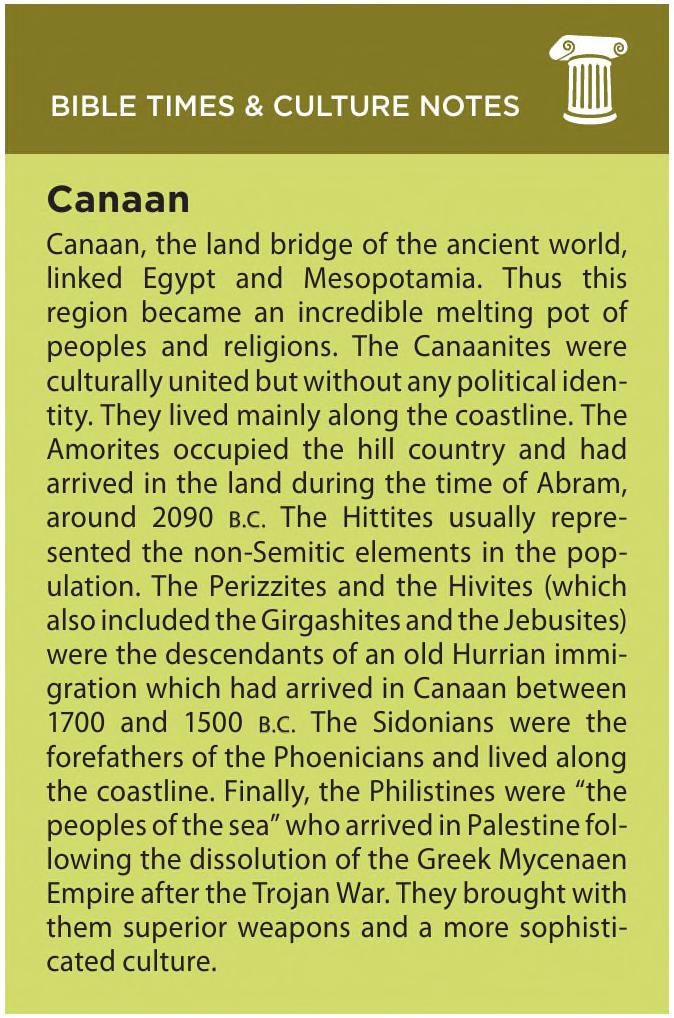
Bible Times & Culture Notes
Canaan
Canaan, the land bridge of the ancient world,
linked Egypt and Mesopotamia. Thus this
region became an incredible melting pot of
peoples and religions. The Canaanites were
culturally united but without any political iden-
tity. They lived mainly along the coastline. The
Amorites occupied the hill country and had
arrived in the land during the time of Abram,
around 2090 b.c. The Hittites usually repre-
sented the non-Semitic elements in the pop-
ulation. The Perizzites and the Hivites (which
also included the Girgashites and the Jebusites)
were the descendants of an old Hurrian immi-
gration which had arrived in Canaan between
1700 and 1500 b.c. The Sidonians were the
forefathers of the Phoenicians and lived along
the coastline. Finally, the Philistines were “the
peoples of the sea” who arrived in Palestine fol-
lowing the dissolution of the Greek Mycenaen
Empire after the Trojan War. They brought with
them superior weapons and a more sophisti-
cated culture.
Original illustrations
End of source page 412