PRINTED PAGE 355NKJV · STUDY EDITION
Joshua 12:8 | 355
h Deut. 3:11; Josh. 13:12 i Deut. 1:4 5 j Deut. 3:8 k Deut. 3:10;
Josh. 13:11; 1 Chr. 5:11 l Deut. 3:14; 1 Sam. 27:8 6 m Num.
21:24, 35 n Num. 32:29-33; Deut. 3:12; Josh. 13:8 7 o Josh.
11:17 p Gen. 14:6; 32:3; Deut. 2:1, 4 q Josh. 11:23 5 Lit. The Bald
Mountain 8 r Josh. 10:40; 11:16
20 a Deut. 20:16, 17
21 b Num. 13:22,
33; Deut. 1:28; 9:2;
Josh. 15:13, 14
22 c 1 Sam. 17:4
d Josh. 15:46;
1 Sam. 5:1; Is. 20:1
23 e Ex. 33:2; Num.
34:2-15 f Num.
26:53; Josh. 14; 15
g Deut. 12:9, 10;
25:19; [Heb. 4:8]
CHAPTER 12
1 a Num. 21:24
b Deut. 3:8
2 c Num. 21:24;
Deut. 2:24-27
3 d Deut. 3:17
e Josh. 13:20 f Deut.
3:17; 4:49 1 Sea of
Galilee 2 Lit. Sea of
the Plain, the Dead
Sea 3 Or Teman
4 Or Ashdoth Pisgah
4 g Num. 21:33;
Deut. 3:4, 10
God has reached out to so many in order to graciously make them
His children. See Rom. 9:14–24 concerning God’s hardening of Pha-
raoh’s heart.
11:21, 22 The destruction of the Anakim from the hill country was
especially significant. Their fearsome presence had caused the Isra-
elites to rebel against God’s command to enter Canaan many years
before (Num. 13:22, 28, 32, 33). But as this generation learned, their
size did not matter.
11:23 This verse ends this section (chs. 9–11). It is a transitional verse,
looking back to summarize the conquests and looking forward to
anticipate the inheritance of the land. The statement the land rest-
ed from war draws the first section of the book to a close. The next
section before the distribution of Israel’s inheritance is the list of
defeated Canaanite kings (ch. 12). The idea of rest for the entire na-
tion is found in such passages as Deut. 12:10; 25:19, and it is echoed
in the summarizing passages of Joshua, 21:44; 23:1.
12:1–6 The Israelites’ earlier conquests east of the Jordan are men-
tioned here, their victories over Sihon, king of Heshbon, and Og,
king of Bashan. The Israelites defeated them under Moses’ leader-
ship and took possession of their land at that time (Num. 21:21–35).
The detailed description of the territory they ruled makes more
impressive the victory Israel had won. Verse 6 confirms that this
indeed had been given as an inheritance to the two and one-half
tribes who settled there.
12:6, 7 The language of these verses makes it plain that Joshua
succeeded Moses in his various roles, first as conqueror and second
as giver of the land. The two men are described in the same way:
As conquerors, Joshua and the children of Israel (v. 7), follow
Moses . . . and the children of Israel (v. 6). As land-giver, Joshua
gave (v. 7), as Moses . . . had given (v. 6).
and the children of Israel had conquered;
and n Moses the servant of the LORD had
given it as a possession to the Reuben
ites, the Gadites, and half the tribe of
Manasseh.
The Kings Conquered by Joshua
7 And these are the kings of the coun
try o which Joshua and the children of Is
rael conquered on this side of the Jordan,
on the west, from Baal Gad in the Valley
of Lebanon as far as 5 Mount Halak and
the ascent to p Seir, which Joshua q gave to
the tribes of Israel as a possession accord
ing to their divisions, 8 r in the mountain
country, in the lowlands, in the Jordan
receive no mercy, but that He might de
stroy them, a as the LORD had commanded
Moses.
21 And at that time Joshua came and
cut off b the Anakim from the mountains:
from Hebron, from Debir, from Anab,
from all the mountains of Judah, and
from all the mountains of Israel; Joshua
utterly destroyed them with their cities.
22 None of the Anakim were left in the
land of the children of Israel; they re
mained only c in Gaza, in Gath, d and in
Ashdod.
23 So Joshua took the whole land, e ac
cording to all that the LORD had said to
Moses; and Joshua gave it as an inher
itance to Israel f according to their divi
sions by their tribes. Then the land g rest
ed from war.
The Kings Conquered by Moses
12
These are the kings of the land
whom the children of Israel defeat
ed, and whose land they possessed on the
other side of the Jordan toward the rising
of the sun, a from the River Arnon b to
Mount Hermon, and all the eastern Jor
dan plain: 2 One king was c Sihon king of
the Amorites, who dwelt in Heshbon and
ruled half of Gilead, from Aroer, which
is on the bank of the River Arnon, from
the middle of that river, even as far as the
River Jabbok, which is the border of the
Ammonites, 3 and d the eastern Jordan
plain from the 1 Sea of Chinneroth as far
as the 2 Sea of the Arabah (the Salt Sea),
e the road to Beth Jeshimoth, and 3 south
ward below f the 4 slopes of Pisgah. 4 g The
other king was Og king of Bashan and his
territory, who was of h the remnant of the
giants, i who dwelt at Ashtaroth and at
Edrei, 5 and reigned over j Mount Her
mon, k over Salcah, over all Bashan, l as
far as the border of the Geshurites and
the Maachathites, and over half of Gilead
to the border of Sihon king of Heshbon.
6 m These Moses the servant of the LORD
Bible Times & Culture Notes
Building a Fortress
Archaeologists have found that the Indo-Aryans (a group of
non-Semitic people originally from the plateau of Iran) exerted a
strong influence upon Palestine, introducing many new weapons
and tools. They brought horse-drawn chariots, the composite bow,
and new types of city fortifications. They outfitted nearly every
major city from central Syria to the Nile Delta with a defensive wall
called a glacis. The glacis contained alternating layers of pounded
earth, clay, and gravel, covered with plaster. It sloped down from
the rock city walls to a dry moat below. Perhaps it was designed
to frustrate cavalrymen and battering rams. The Indo-Aryan cities
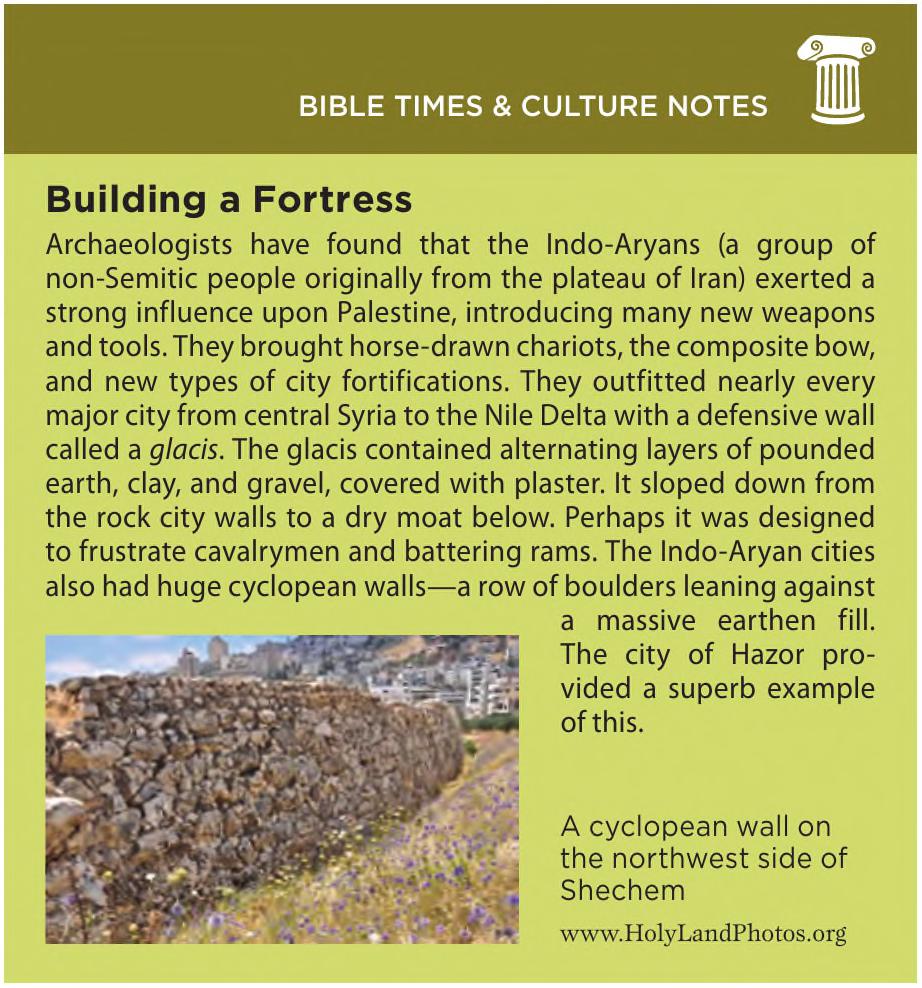
also had huge cyclopean walls—a row of boulders leaning against
a massive earthen fill.
The city of Hazor pro-
vided a superb example
of this.
A cyclopean wall on
the northwest side of
Shechem
www.HolyLandPhotos.org
Original illustrations
End of source page 390