PRINTED PAGE 353NKJV · STUDY EDITION
Joshua 11:12 | 353
f Deut. 7:1; Judg. 3:3, 5; 1 Kin. 9:20 g Josh. 11:17; 13:5, 11 h Gen.
31:49 4 i Gen. 22:17; 32:12; Judg. 7:12; 1 Sam. 13:5 5 1 Lit.
assembled by appointment 6 j Josh. 10:8 k 2 Sam. 8:4
8 l Gen. 49:13 m Josh. 13:6 2 Heb. Sidon Rabbah 3 Heb.
Misrephoth Maim, lit. Burnings of Water 11 n Deut. 20:16
o Josh. 10:40
2 c Num. 34:11
d Josh. 17:11; Judg.
1:27; 1 Kin. 4:11
3 e Josh. 9:1
11:3 The inclusion of the Jebusite, that is, the inhabitants of Jeru-
salem, is striking because Jerusalem was south of Jericho. Evidently,
the Canaanites so feared the Israelite threat that they sought help
from far and wide. Mount Hermon in the land of Mizpah was in
the far north, the highest point in northern Palestine. Mizpah was a
name of several cities in Israel’s history, including one near Lachish
(15:38), one in Benjamin in the south (18:26), and another one in
Gilead east of the Jordan (Judg. 10:17).
11:4 Horses at this time were for pulling chariots. These vehicles
accompanied the infantry and carried a rider with a bow or a sup-
ply of spears. The Canaanite armies did not use mounted warriors.
These armies came well-armed to fight the Israelites, but it did not
matter. God still defeated them (vv. 6–9). Only in the battles of Jeri-
cho and Ai did the Israelites initiate the action. Here, as in the other
battles described in Joshua, the enemy—usually well-armed and
in great numbers—attacked the Israelites. God limited the size of
the Israelite army so that the Israelites would not trust their military
power. Similarly, the instructions for a king in Deut. 17:14–20 explicit-
ly state that the king was not to “multiply horses for himself” (17:16);
that is, not to depend on his military might, but rather on God.
11:6 God promised to deliver Israel’s enemies into their hands by
tomorrow about this time. This is especially significant in light of
the impressive numbers arrayed against Israel. These are the same
words used many years later by Elisha to predict the escape of Sa-
maria from a siege imposed by the Syrians (2 Kin. 7:1). In both cases
God’s promise came true.
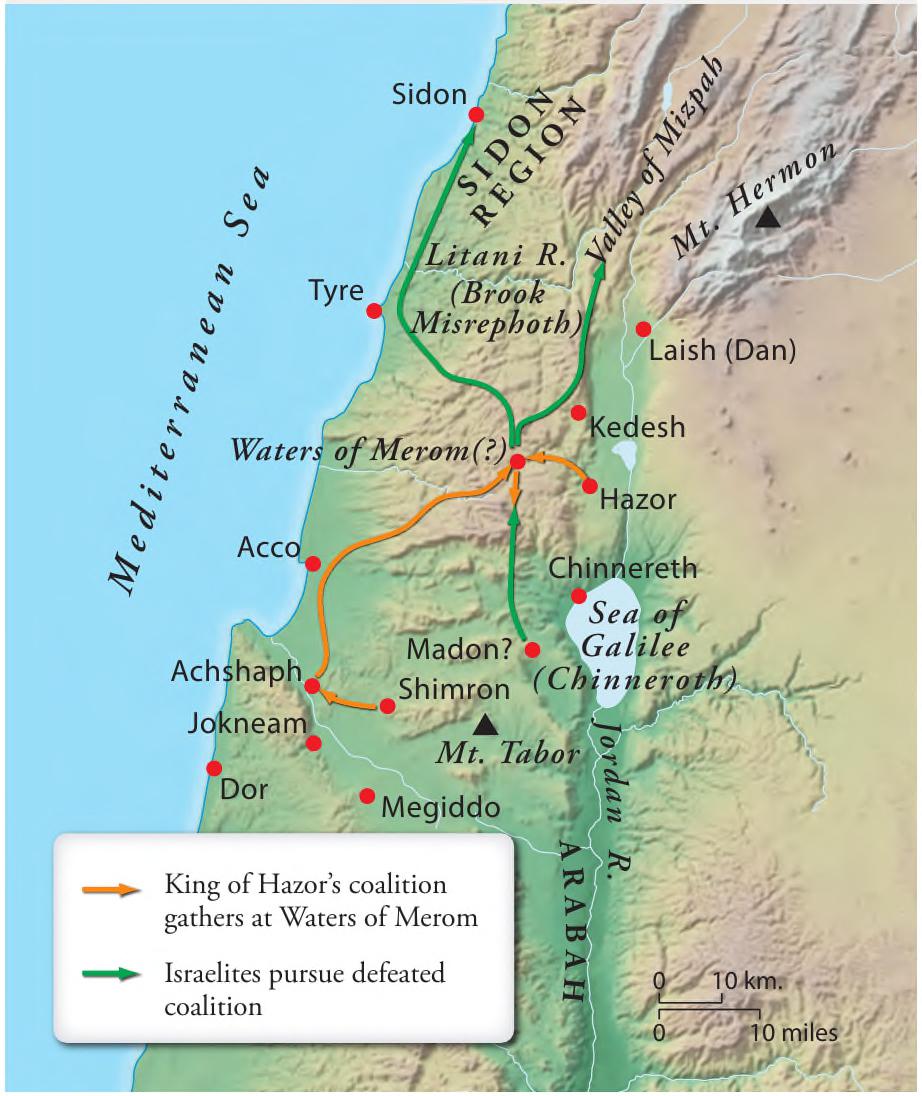
11:8 Greater Sidon was a Phoenician city on the Mediterranean
coast, and the Brook Misrephoth was south of it. The defeat of
the Canaanites described here shows them fleeing in all directions
in a total rout.
11:9 as the Lord had told him: Joshua was careful to do exactly
as instructed (see v. 6).
11:10 Hazor was formerly the head: This is probably why Joshua
struck at Hazor first, and why the text details its destruction. Excava-
tion of Hazor has shown several destructions in the Late Bronze Age,
one from about 1400 b.c. that could easily be attributed to Joshua.
11:11 Jericho and Ai were the only other cities burned. Most of the
cities of Canaan were taken without being destroyed; their armies
were defeated on the battlefield. In this way, most of the cities could
be inhabited by Israel without rebuilding.
the Perizzite, the Jebusite in the moun
tains, f and the Hivite below g Hermon h in
the land of Mizpah. 4 So they went out,
they and all their armies with them, as
many people i as the sand that is on the
seashore in multitude, with very many
horses and chariots. 5 And when all these
kings had 1 met together, they came and
camped together at the waters of Merom
to fight against Israel.
6 But the LORD said to Joshua, j “Do not
be afraid because of them, for tomorrow
about this time I will deliver all of them
slain before Israel. You shall k hamstring
their horses and burn their chariots with
fire.” 7 So Joshua and all the people of war
with him came against them suddenly by
the waters of Merom, and they attacked
them. 8 And the LORD delivered them into
the hand of Israel, who defeated them and
chased them to 2 Greater l Sidon, to the
3 Brook m Misrephoth, and to the Valley
of Mizpah eastward; they attacked them
until they left none of them remaining.
9 So Joshua did to them as the LORD had
told him: he hamstrung their horses and
burned their chariots with fire.
10 Joshua turned back at that time and
took Hazor, and struck its king with the
sword; for Hazor was formerly the head
of all those kingdoms. 11 And they struck
all the people who were in it with the
edge of the sword, n utterly destroying
them. There was none left o breathing.
Then he burned Hazor with fire.
12 So all the cities of those kings, and
all their kings, Joshua took and struck
with the edge of the sword. He utterly
plain south of c Chinneroth, in the low
land, and in the heights d of Dor on the
west, 3 to the Canaanites in the east and
in the west, the e Amorite, the Hittite,
0
10 miles
0
10 km.
Dor
Laish (Dan)
Acco
Madon?
Tyre
Sidon
Jokneam
Shimron
Achshaph
Megiddo
Chinnereth
Hazor
Kedesh
Mt. Tabor
Mt.
He
rm
o
n
Valley of Miz
pah
Sea of
Galilee
(Chinneroth)
Waters of Merom(?)
Jord
an
R
.
Litani R.
(Brook
Misrephoth)
M e d i t e r r a n e a n S
e
a
S I D O N
R E G I O N
A R
A B
A
H
King of Hazor’s coalition
gathers at Waters of Merom
Israelites pursue defeated
coalition
Late Bronze Age Hazor was burned by Joshua (Josh. 11:13).
Excavations have revealed three clearly datable destruction
layers, one of which may provide the strongest evidence yet
for a historically verifiable date for the conquest.
The excavator thought Joshua burned the latest level (c. 1230
b.c.), but others argue that it must actually have been the earli-
est of the three levels, c. 1400 b.c.
The Northern Campaign
Original illustrations
End of source page 388