PRINTED PAGE 351NKJV · STUDY EDITION
Joshua 10:27 | 351
21 y Ex. 11:7
1 criticized, lit.
sharpened his
tongue
24 z Ps. 107:40; Is.
26:5, 6; Mal. 4:3
25 a Deut. 31:6-8;
Josh. 1:9 b Deut.
3:21; 7:19 2 The
captains
26 c Josh. 8:29;
2 Sam. 21:9 3 The
kings
27 d Deut. 21:22, 23;
Josh. 8:29
10:24 Joshua told the captains to put their feet on the necks of
these kings as a clear declaration of victory. See Ps. 110:1: “I [will]
make Your enemies Your footstool”; and 1 Cor. 15:25–27, where God
places Jesus’ enemies “under His feet” (Ps. 8:6). Ancient sculptural
reliefs show Assyrian kings doing this to their vanquished enemies.
10:25 be strong and of good courage: Joshua encouraged the
people in the same terms God had used to encourage him (1:6, 9;
10:8). Now Joshua had the authority to give this exhortation to
others.
10:26 hanged them on five trees . . . until evening: Joshua did
to these five kings what he had earlier done to the king of Ai (8:29).
As before, he took the bodies down before sundown in accordance
with Mosaic legislation (8:29).
on the necks of these kings.” And they
drew near and z put their feet on their
necks. 25 Then Joshua said to 2 them,
a “Do not be afraid, nor be dismayed; be
strong and of good courage, for b thus the
LORD will do to all your enemies against
whom you fight.” 26 And afterward Josh
ua struck 3 them and killed them, and
hanged them on five trees; and they
c were hanging on the trees until eve
ning. 27 So it was at the time of the going
down of the sun that Joshua command
ed, and they d took them down from the
trees, cast them into the cave where they
had been hidden, and laid large stones
against the cave’s mouth, which remain
until this very day.
ies. 21 And all the people returned to the
camp, to Joshua at Makkedah, in peace.
y No one 1 moved his tongue against
any of the children of Israel.
22 Then Joshua said, “Open the mouth
of the cave, and bring out those five
kings to me from the cave.” 23 And they
did so, and brought out those five kings
to him from the cave: the king of Jeru
salem, the king of Hebron, the king of
Jarmuth, the king of Lachish, and the
king of Eglon.
24 So it was, when they brought out
those kings to Joshua, that Joshua called
for all the men of Israel, and said to the
captains of the men of war who went
with him, “Come near, put your feet
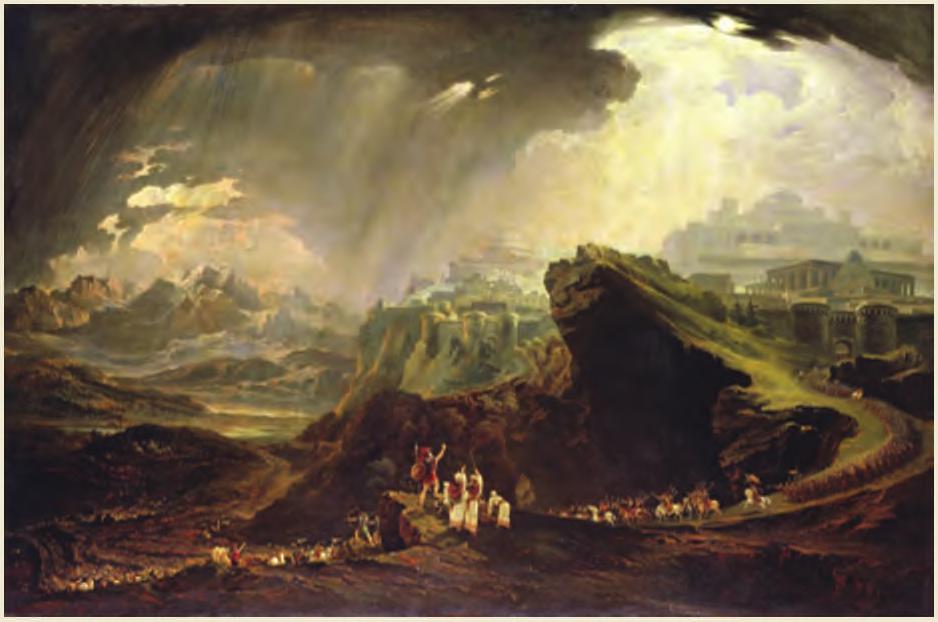
Joshua prays for the sun to stand still.
Joshua Commanding the Sun to Stand Still upon Gibeon, 1816, Martin, John/
Private Collection/Photo © Agnew’s, London, UK/The Bridgeman Art Library
Miracles
Open the Bible wherever you like and you will soon find the mention of an event that only God could do. These stories of
God’s intervention in nature occur without apology throughout the Bible. But the Bible usually gives the barest of details.
Sometimes the reader is left wondering exactly what happened.
The account of Israel’s victory over the five kings of the Amorites is a perfect example. Joshua 10:13 says that in response
to Joshua’s prayer, “the sun stood still, and the moon stopped.” This miraculous event played a key role in Israel’s victory
that day. Even accepting this as a miracle, which the narrative surely bids us to do, leaves some questions unanswered.
We know that the sun does not move around the earth, so it was not the sun that literally stopped, but what took place
that day? And how did it help Israel?
Some take the text to mean that God stopped the earth’s rotation. “The sun stood still” means that the position of
the sun in the sky remained constant. Since the sun’s position is determined by the earth’s rotation, the earth’s rotation
must have stopped. This delay gave the Israelites the daylight they needed to finish routing their enemies rather than
letting them escape.
Others suggest that God caused an unusual refraction of light in the earth’s atmosphere that caused the sun to remain
visible for a very lengthy period of time. The sun appeared to stop, but without any change in the rate of the earth’s rotation.
Again, this gave Israel time to finish their rout.
Others reinterpret the miracle. The verb
translated “stand [stood] still” in verses 12,
13 can also be translated “cease, stop.” Some
scholars therefore say that Joshua was asking
that the sun stop shining, not that it stop mov-
ing. The long night’s march, largely uphill and
with full battle gear, left his troops tired. Joshua
asked God to stop the sun from beating down
on his troops before exhaustion overcame
them. Joshua was seeking a cooler day, not a
longer one.
Of course, we do not know exactly what
happened. What we know for sure is that God
intervened in the normal course of nature at
exactly the right moment to give the Israel-
ites victory over their enemies. As the writer
of Joshua points out, the greatest marvel lies
not in the occurrence of the miracle itself but
that “the Lord heeded the voice of a man”
(Josh. 10:14).
Original illustrations
End of source page 386