PRINTED PAGE 323NKJV · STUDY EDITION
Deuteronomy 31:16 | 323
31:7, 8 With encouraging and challenging words, Moses publicly
transferred his authority to Joshua (1:38; 31:14, 23; 32:44; 34:9). He
is the One who goes before you: Moses applied the promise
given to Israel (v. 6) to Joshua.
31:9 Moses wrote this law and delivered it: In accordance with
ancient Middle Eastern practices concerning international treaties,
Moses made provisions for the future reading of the law and instruc-
tion in it. The ark was called the ark of the covenant because it
was the depository for the tablets of the Law.
31:11, 12 you shall read this law: Specifically, the priests were
given the responsibility of reading the law and instructing the peo-
ple (Neh. 8:1–6; Mal. 2:4–9). men and women and little ones, and
the stranger: The Word of God was for all to hear.
31:14 The words the days approach must have brought a renewed
heaviness to Moses. He was ready to die, but his heart yearned to
see the Promised Land. I may inaugurate him: The Lord’s words
to Joshua are recorded in v. 23 (compare Num. 27:18–23).
31:15 The pillar of cloud was the symbol of the presence of God
during the wilderness journey (Ex. 13:21, 22).
31:16 The phrase rest with your fathers suggests that the body
of the person would be laid to rest in a tomb. After the flesh had de-
cayed, the bones would be placed with the bones of one’s ancestors.
Thus the person’s remains were “with his fathers.” But the phrase
may also refer to the intermediate state of the soul between death
and resurrection. The Lord predicted Israel’s future rebelliousness,
apostasy, and breach of the covenant. The expression play the
harlot speaks both of spiritual adultery and physical acts of sexual
immorality that were performed in association with the worship of
Baal and Asherah, the gods of Canaan (12:1–5).
7 n Num. 27:19;
Deut. 31:23; Josh.
1:6
8 o Ex. 13:21 p Deut.
31:6; Josh. 1:5;
1 Chr. 28:20; Heb.
13:5
9 q Deut. 17:18;
31:25, 26 r Num.
4:5, 6, 15; Deut.
10:8; 31:25, 26;
Josh. 3:3
10 s Deut. 15:1, 2
t Lev. 23:34; Deut.
16:13
11 u Deut. 16:16
v Deut. 12:5 w Josh.
8:34; 2 Kin. 23:2
12 x Deut. 4:10
13 y Deut. 11:2 z Ps.
78:6, 7
14 a Num. 27:13
b Num. 27:19; Deut.
3:28 1 commission
15 c Ex. 33:9
16 d Deut. 29:22
e Ex. 34:15; Deut.
4:25-28; Judg. 2:11,
12, 17 f Deut.
32:15 g Judg. 2:20
2 Die and join your
ancestors
in the tabernacle of meeting, that b I may
1 inaugurate him.”
So Moses and Joshua went and pre
sented themselves in the tabernacle of
meeting. 15 Now c the LORD appeared at
the tabernacle in a pillar of cloud, and
the pillar of cloud stood above the door
of the tabernacle.
16 And the LORD said to Moses: “Be
hold, you will 2 rest with your fathers;
and this people will d rise and e play the
harlot with the gods of the foreigners of
the land, where they go to be among them,
and they will f forsake Me and g break My
covenant which I have made with them.
7 Then Moses called Joshua and said to
him in the sight of all Israel, n “Be strong
and of good courage, for you must go
with this people to the land which the
LORD has sworn to their fathers to give
them, and you shall cause them to inherit
it. 8 And the LORD, o He is the One who
goes before you. p He will be with you, He
will not leave you nor forsake you; do not
fear nor be dismayed.”
The Law to Be Read Every Seven
Years
9 So Moses wrote this law q and deliv
ered it to the priests, the sons of Levi,
r who bore the ark of the covenant of the
LORD, and to all the elders of Israel. 10 And
Moses commanded them, saying: “At the
end of every seven years, at the appointed
time in the s year of release, t at the Feast
of Tabernacles, 11 when all Israel comes
to u appear before the LORD your God in
the v place which He chooses, w you shall
read this law before all Israel in their
hearing. 12 x Gather the people together,
men and women and little ones, and the
stranger who is within your gates, that
they may hear and that they may learn to
fear the LORD your God and carefully ob
serve all the words of this law, 13 and that
their children, y who have not known
it, z may hear and learn to fear the LORD
your God as long as you live in the land
which you cross the Jordan to possess.”
Prediction of Israel’s Rebellion
14 Then the LORD said to Moses, a “Be
hold, the days approach when you must
die; call Joshua, and present yourselves
feast
(Heb. chag) (16:10, 13; 31:10; Ex. 12:14) Strong’s #2282
The word feast, or “festival-gathering,” is related to the
verb that means “to make a pilgrimage” or “to keep a pil-
grim feast” (Ps. 84:5). The Hebrews were commanded to
observe three pilgrim feasts a year (16:16; Ex. 23:14). These
sacred feasts were celebrated by all people and were joy-
ous expressions of gratitude to God (2 Chr. 30:21). They
included processions, dancing, and the enjoyment of food
and drink (Lev. 23:40, 41; Judg. 21:19–21). God intended that
Israel’s religious feasts be worship events, a celebration of
the joy God had given them (Lev. 23:7, 21, 24, 36). The OT
prophets, however, condemned the feasts because the
Hebrews were desecrating these holy convocations with
sacrilegious behavior (Is. 1:12–15; Amos 5:21). Zechariah
prophesied of a time in the future when all nations would
keep the “pilgrim-feast” before the Lord (Zech. 14:16).
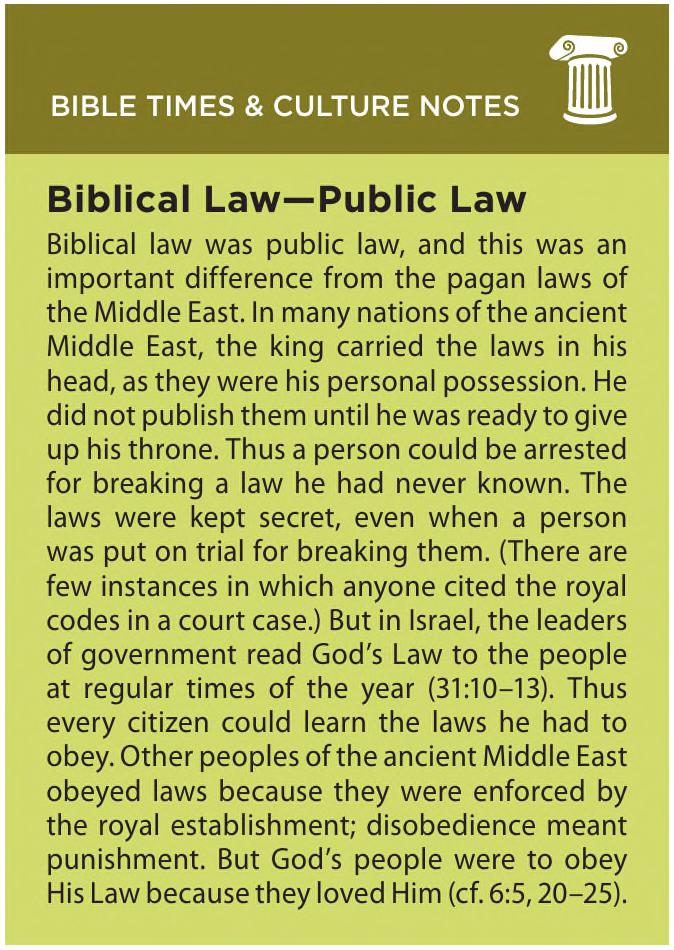
Bible Times & Culture Notes
Biblical Law—Public Law
Biblical law was public law, and this was an
important difference from the pagan laws of
the Middle East. In many nations of the ancient
Middle East, the king carried the laws in his
head, as they were his personal possession. He
did not publish them until he was ready to give
up his throne. Thus a person could be arrested
for breaking a law he had never known. The
laws were kept secret, even when a person
was put on trial for breaking them. (There are
few instances in which anyone cited the royal
codes in a court case.) But in Israel, the leaders
of government read God’s Law to the people
at regular times of the year (31:10–13). Thus
every citizen could learn the laws he had to
obey. Other peoples of the ancient Middle East
obeyed laws because they were enforced by
the royal establishment; disobedience meant
punishment. But God’s people were to obey
His Law because they loved Him (cf. 6:5, 20–25).
Original illustrations
End of source page 358