PRINTED PAGE 312NKJV · STUDY EDITION
312 | Deuteronomy 24:12
you from there; therefore I command you
to do this thing.
19 v “When you reap your harvest in
your field, and forget a sheaf in the
field, you shall not go back to get it; it
shall be for the stranger, the fatherless,
and the widow, that the LORD your God
may w bless you in all the work of your
hands. 20 When you beat your olive trees,
you shall not go over the boughs again;
it shall be for the stranger, the father
less, and the widow. 21 When you gath
er the grapes of your vineyard, you shall
not glean it afterward; it shall be for the
stranger, the fatherless, and the widow.
22 And you shall remember that you were
a slave in the land of Egypt; therefore I
command you to do this thing.
25
“If there is a a dispute between
men, and they come to 1 court,
that the judges may judge them, and they
b justify the righteous and condemn the
wicked, 2 then it shall be, if the wicked
man c deserves to be beaten, that the judge
will cause him to lie down d and be beat
en in his presence, according to his guilt,
with a certain number of blows. 3 e Forty
blows he may give him and no more, lest
and the man to whom you lend shall
bring the pledge out to you. 12 And if
the man is poor, you shall not 5 keep his
pledge overnight. 13 l You shall in any case
return the pledge to him again when the
sun goes down, that he may sleep in his
own garment and m bless you; and n it
shall be righteousness to you before the
LORD your God.
14 “You shall not o oppress a hired ser
vant who is poor and needy, whether one
of your brethren or one of the aliens who
is in your land within your gates. 15 Each
day p you shall give him his wages, and
not let the sun go down on it, for he is
poor and has set his heart on it; q lest he
cry out against you to the LORD, and it be
sin to you.
16 r “Fathers shall not be put to death
for their children, nor shall children be
put to death for their fathers; a person
shall be put to death for his own sin.
17 s “You shall not pervert justice due
the stranger or the fatherless, t nor take a
widow’s garment as a pledge. 18 But u you
shall remember that you were a slave in
Egypt, and the LORD your God redeemed
regulations protected the debtor’s privacy (vv. 10, 11) and ability to
provide for his family (vv. 12, 13).
24:14, 15 The following laws allowed property owners and labor-
ers to receive a due profit from their properties and their labor. At
the same time, both the owners and the laborers were to resist any
greedy actions that would prevent a reasonable provision for the
disadvantaged people in their communities. For instance, the poor
needed daily payment of wages for daily subsistence. To be able to
pay their wages and not do so was a sin against the Lord.
24:18, 19 The passage exhorts the Israelites to remember their
people’s own slavery in Egypt (v. 22). Just as God showed compas-
sion on them when they were oppressed (15:15), they were to show
compassion on those who were now disadvantaged. God may
bless: Ultimately, it is in one’s own best interest to have a concern
for the interest of others.
25:3 A rod was probably used for the beating (Ex. 21:20). Forty
blows: Later Jewish law restricted the number to 40 minus one
(2 Cor. 11:24) to make sure that the authorities remained within the
12 5 Lit. sleep with
his pledge
13 l Ex. 22:26; Ezek.
18:7 m Job 29:11;
2 Tim. 1:18 n Deut.
6:25; Ps. 106:31;
Dan. 4:27
14 o Lev. 19:13;
Deut. 15:7-18; [Prov.
14:31]; Amos 4:1;
[Mal. 3:5; 1 Tim.
5:18]
15 p Lev. 19:13; Jer.
22:13 q Ex. 22:23;
Deut. 15:9; Job
35:9; James 5:4
16 r 2 Kin. 14:6;
2 Chr. 25:4; Jer.
31:29, 30; Ezek.
18:20
17 s Ex. 23:6 t Ex.
22:26
18 u Deut. 24:22
19 v Lev. 19:9, 10
w Deut. 15:10; Ps.
41:1; Prov. 19:17
CHAPTER 25
1 a Deut. 17:8-13;
19:17; Ezek. 44:24
b Prov. 17:15 1 Lit.
the judgment
2 c Prov. 19:29; Luke
12:48 d Matt. 10:17
3 e 2 Cor. 11:24
Bible Times & Culture Notes
Farming
Practically every family in Israel owned a piece
of land, and many families farmed a small area
of their own. Outside the cities, most Israelites
lived in villages rather than on farms. Cultivated
land usually was outside the village, situated
near the water supply or on western or north-
ern slopes where rainfall was greatest. Crops
included wheat, barley, grapes, olives, and figs.
Farm animals lived in the houses with the fam-
ilies. All but the poorest owned at least one ox
or donkey as a work animal. Cattle, sheep, and
goats were common, providing milk products
as well as skins for clothes. Richer families and
royal estates employed farm managers and
workers (1 Chr. 27:25–31) and hired laborers for
special tasks, particularly at harvest time (Matt.
20:1–16). Frequent difficulties, such as hilly
ground, stony soil, and unpredictable rainfall,
did not make farming easy.
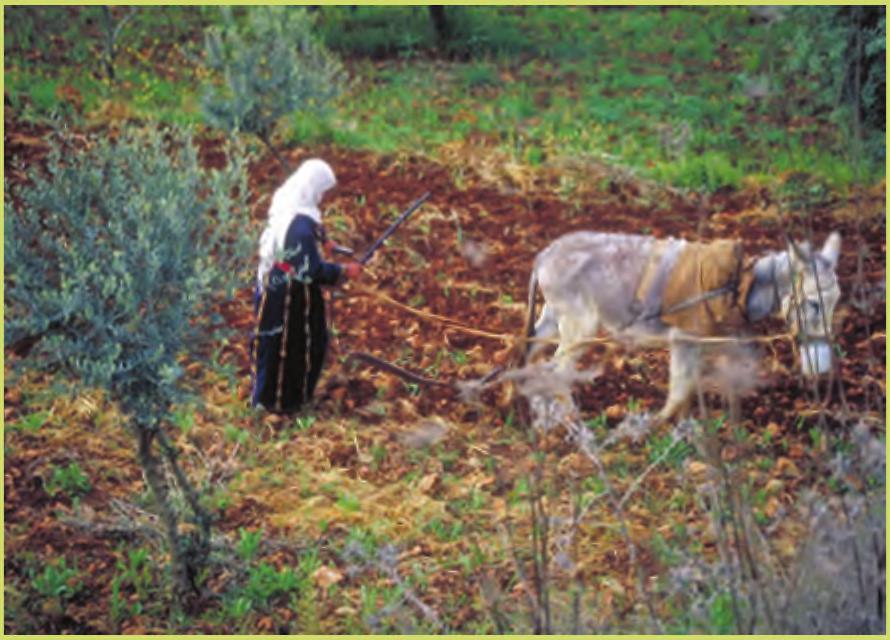
A bedouin woman using her donkey to plow a small plot of land
© 1995 by Phoenix Data Systems
Original illustrations
End of source page 347