PRINTED PAGE 273NKJV · STUDY EDITION
Deuteronomy INTRODUCTION 273
barren mountaintop of Ebal the curses for those who rejected God’s Law. On the
lush slopes of Gerizim, the rich blessings for those who obeyed God’s law would
be recited. With these instructions, Moses anticipated the renewal of the covenant
on the other side of the Jordan River. There, the people would gather for the grand
moment when they would renew the covenant once again, but this time as inhabi-
tants of the Promised Land (11:29, 30; 27:1–8, 12, 13; Josh. 8:30–35). After describing
this future covenantal renewal, Moses himself challenged the people to renew their
commitment to God (30:11–20).
Finally, the expectation of Moses’ imminent death explains why he gave the
book as a testimony to God’s law. The Lord had commanded him to leave the words
of the law as a testimony to Israel. In response, Moses wrote the words down, gave
them to the priests for safekeeping, and commanded the priests to read the word
of God every seven years. In this way, Moses not only prepared the new generation
for the coming conquest of the land, but also insured that every generation after
that would hear God’s laws (31:9–13).
Theme and Structure Moses’ emphasis on the covenant throughout Deuter-
onomy is remarkable. He testified to its importance by repeatedly calling the new
generation of Israelites to follow its provisions (30:11–20).
In fact, Deuteronomy as a whole reflects the pattern of an ancient Middle East-
ern treaty between a lord and a servant. The typical pattern of such a treaty with
its approximate corresponding sections in Deuteronomy is as follows:
(1) A preamble or introduction (1:1–5)
(2) A review of the past relationship between the parties (1:6—4:49)
(3) Basic stipulations that ensured fidelity to the treaty (5:1—26:19)
(4) Sanctions in the form of blessings and curses (27:1—30:20)
(5) Witnesses to the treaty (32:1)
(6) A provision for the storage and reading of the treaty (31:1—34:12)
While these similarities exist, the Book of Deuteronomy does not slavishly fol-
low the typical treaty structure, but we can conclude that it was written with a
c. 1446 b.c.
The Red Sea
crossing
c. 1445 b.c.
God delivers the
Law at Mt. Sinai
c. 1446–1406 b.c.
40 years of
wilderness
wandering
c. 1406 b.c.
Moses presents
the Deuteronomic
Law
c. 1405 b.c.
Moses dies; the
conquest of
Canaan begins
c. 1405–1380 b.c.
Joshua leads the
Israelites
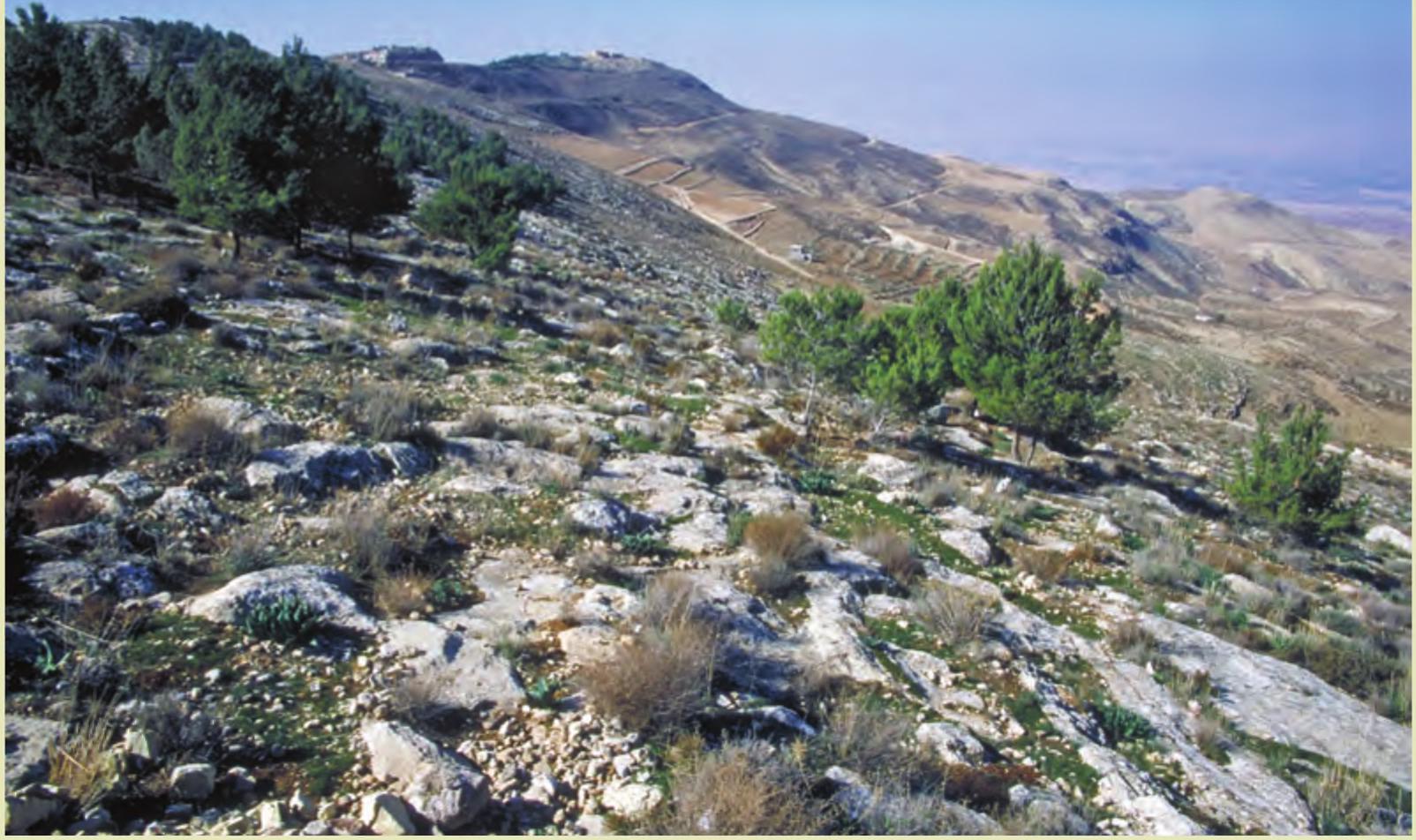
Mount Nebo can be seen in the distance in this view looking southwest toward the Dead Sea. Moses viewed the
Promised Land from Mount Nebo (Deut. 32:49).
©1995 by Phoenix Data Systems
Original illustrations
End of source page 308