PRINTED PAGE 262NKJV · STUDY EDITION
262 | Numbers 30:11
been decided in much the same manner as the case of the daugh-
ters of Zelophehad (ch. 27)—that is, on the basis of particular cases
that were brought before God for a decision.
31:2 Chapter 31 refers back to ch. 25, the debacle of Israel’s sin at
Baal Peor and the role that the Midianites played in orchestrating
the event.
31:3–6 The preparations for battle included setting apart a thou-
sand from each tribe, a way of ensuring the sense of participation
of the whole people in the war. Phinehas, the heroic figure who
stemmed a plague with his bold action (25:7, 8), was commander in
the field. As a priest, he led the armies of Israel with holy articles
and the signal trumpets. This was not an ordinary conflict; it was
a holy war, done in the name and power of God.
12 2 annulled or
invalidated
CHAPTER 31
2 a Num. 25:17
b Num. 27:12, 13
3 c Josh. 13:21
does make them void after he has heard
them, then he shall bear her guilt.”
16 These are the statutes which the
LORD commanded Moses, between a man
and his wife, and between a father and
his daughter in her youth in her father’s
house.
Vengeance on the Midianites
31
And the LORD spoke to Moses,
saying: 2 a “Take vengeance on the
Midianites for the children of Israel. Af
terward you shall b be gathered to your
people.”
3 So Moses spoke to the people, saying,
“Arm some of yourselves for war, and let
them go against the Midianites to take
vengeance for the LORD on c Midian. 4 A
thousand from each tribe of all the tribes
of Israel you shall send to the war.”
with an oath, 11 and her husband heard
it, and made no response to her and did
not overrule her, then all her vows shall
stand, and every agreement by which she
bound herself shall stand. 12 But if her
husband truly made them void on the day
he heard them, then whatever proceed
ed from her lips concerning her vows or
concerning the agreement binding her, it
shall not stand; her husband has made
them 2 void, and the LORD will release
her. 13 Every vow and every binding oath
to afflict her soul, her husband may con
firm it, or her husband may make it void.
14 Now if her husband makes no response
whatever to her from day to day, then he
confirms all her vows or all the agree
ments that bind her; he confirms them,
because he made no response to her on
the day that he heard them. 15 But if he
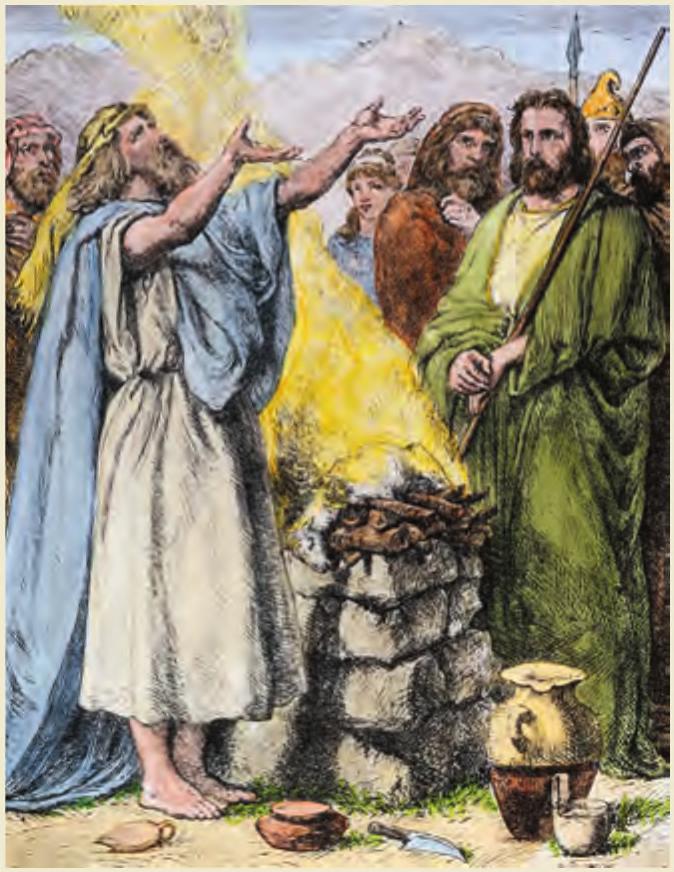
Ancient Hebrews offering a sacrificial lamb
© North Wind Picture Archives/Alamy
Sacrifices of Joy
God’s commands concerning sacrifices and offerings were given to people who were already in relationship with Him,
who were already part of the covenant community, and who were already His people. Sacrifices and offerings to God
were never to be understood as a means of salvation. Instead, God designed the sacrificial system in order to cultivate a
consciousness of Himself among His people. First of all, the sacrifices provided a catalyst, an occasion for dealing with a
person’s sin and for restoring a person before God. Furthermore, these sacrifices cultivated the person’s sense of perspec-
tive. The cleansing rituals of the priests who sacrificed the offerings
pointed to God’s holiness. God was infinitely greater than any one
person, and He certainly deserved everyone’s gratitude and praise.
A worshiper could physically express that praise to God through
a fellowship offering. Of course, this sacrificial system was by no
means cheap; all of the offerings were costly. But this fact impressed
on the worshiper that only one’s best could be given to God.
Sacrifices were not ends in themselves. God was primarily inter-
ested in the person. The mandatory sacrifices served to remind a
worshiper of his or her relationship to God. A person who brought
the right sacrifices, but whose heart was far from God, would never
please Him. The Old Testament writers stated again and again that
God is more concerned with a person’s heart (Gen. 4:1–8; Ps. 40:6–8;
Is. 1:10–18; Mic. 6:6–8). Hosea recorded God’s statement, “I desire
mercy and not sacrifice” (Hos. 6:6; see Matt. 9:13; 12:7). The animals
and the grain, the oil and the wine, the incense and the ash—all
were ultimately accompaniments to the presentation of oneself as
a living sacrifice to God (Rom. 12:1, 2).
The sacrifices and offerings in the Old Testament pointed for-
ward to the death of the Savior, Jesus (Heb. 9:26). The blood of bulls
and goats, the outpouring of wine, and the burning of oil had no
power to overcome sin. Yet because Jesus is perfect and is God’s
only Son, His death atones for sin (Heb. 10:1–10). Because of His
death, we can approach the holy God. The complex sacrificial sys-
tem shows how all of life, with its different spheres and rhythms,
belongs to God and can be lived with a sense of restoration and
gratitude toward Him.
Original illustrations
End of source page 297