PRINTED PAGE 234NKJV · STUDY EDITION
234 | Numbers 11:34
The people fell into a frenzy, killing the birds and gathering them
all through the night and on into the next day.
11:34 Kibroth Hattaavah (“Graves of Craving”) was a vast grave-
yard of needlessly craving, ungrateful people.
11:35 Hazeroth (“Enclosures”) allowed the people a respite from
the journey and its judgments.
12:1 The order of the names Miriam and Aaron suggests that
Miriam was the instigator of the attack against Moses. Note also
that the principal punishment falls on Miriam (v. 10). Pointing at
the Ethiopian woman whom Moses married seems to have been
merely a pretext for attacking Moses. Miriam and Aaron might have
had a disagreement with Zipporah, Moses’ wife (see Ex. 2:21), or they
might have been referring to a second wife who Moses married
without their approval. In any event, the real issue dividing Miriam
and Aaron from their brother was the special relationship Moses
had with God.
12:2 only through Moses: The prophetess Miriam (see Ex. 15:20)
had very high status in the camp. Certainly Aaron, through whom
God also spoke and who ministered before God as the high priest
(2:1; 3:1; 4:1), was also in a most privileged position. Nonetheless,
neither Miriam nor Aaron had the same proximity to God that Moses
had. This must have galled Miriam and her brother. The verse ends
ominously with the words And the Lord heard it. God was going
to act on what He had heard.
12:3 Some people argue that a very humble man would hardly
write about his unparalleled humility. Others contend that a humble
man who was writing through God’s inspiration might speak of his
own humility. Still others have suggested that the verse comes from
a later period and is a comment inserted to place the challenge
against Moses in perspective. Another possibility is that the Hebrew
word translated as humble may mean “miserable” in this context.
The events described in ch. 11 may have taken an enormous toll
on Moses. This verse may be a description of Moses’ utter sense
of brokenness as he experienced his brother and sister’s betrayal.
12:5 Then the Lord came down: Suddenly God spoke to Moses,
Aaron, and Miriam, and then descended dramatically in the midst
of the cloud. This theophany (appearance of God) was ominous. The
language of this verse is more directly physical than usual. God came
down, stood, and then called Aaron and Miriam forward.
12:6–8 The framework of this section is poetry, making the
34 1 Lit. Graves of
Craving
35 p Num. 33:17
CHAPTER 12
1 a Ex. 15:20, 21;
Num. 20:1 b Num.
11:1 c Ex. 2:21
1 criticized
2 Cushite
2 d Num. 16:3 e Ex.
15:20; Mic. 6:4
f Gen. 29:33; Num.
11:1; 2 Kin. 19:4; Is.
37:4; Ezek. 35:12, 13
4 g [Ps. 76:9]
5 h Ex. 19:9; 34:5;
Num. 11:25; 16:19
for c he had married an Ethiopian woman.
2 So they said, “Has the LORD indeed spo
ken only through d Moses? e Has He not
spoken through us also?” And the LORD
f heard it. 3 (Now the man Moses was very
humble, more than all men who were on
the face of the earth.)
4 g Suddenly the LORD said to Moses,
Aaron, and Miriam, “Come out, you
three, to the tabernacle of meeting!” So
the three came out. 5 h Then the LORD
came down in the pillar of cloud and
stood in the door of the tabernacle, and
called Aaron and Miriam. And they both
went forward. 6 Then He said,
the wrath of the LORD was aroused
against the people, and the LORD struck
the people with a very great plague. 34 So
he called the name of that place 1 Kibroth
Hattaavah, because there they buried the
people who had yielded to craving.
35 p From Kibroth Hattaavah the peo
ple moved to Hazeroth, and camped at
Hazeroth.
Dissension of Aaron and Miriam
12
Then a Miriam and Aaron 1 spoke
b against Moses because of the
2 Ethiopian woman whom he had married;
Bible Times & Culture Notes
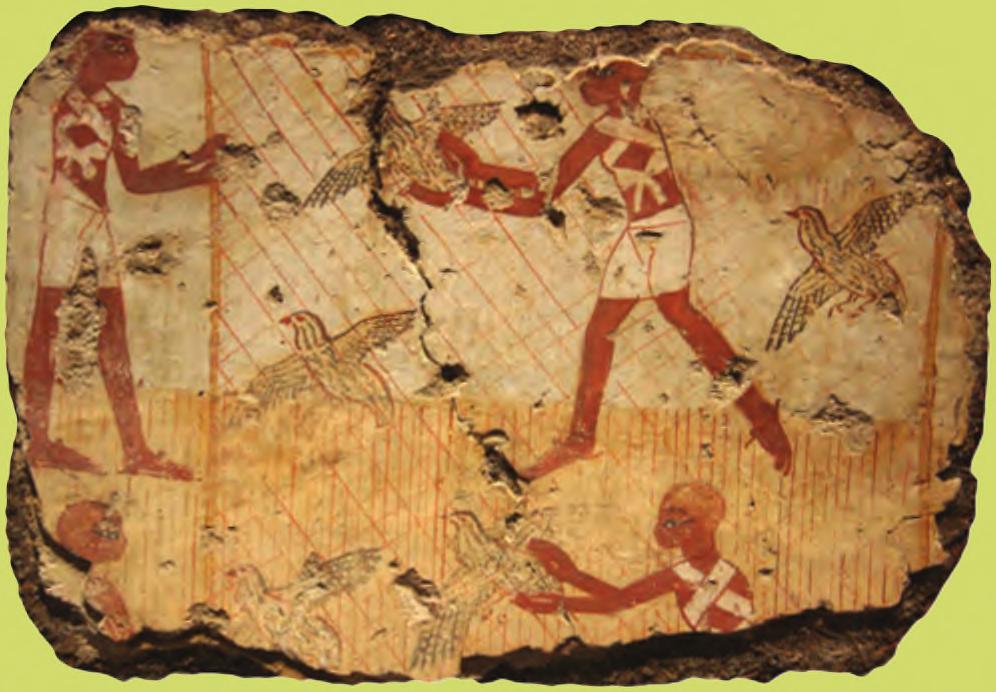
Quail
In Israel, the quail is a migrating bird
that arrives in droves along the shores
of the Mediterranean Sea. With their
strong flying muscles, these birds
can fly rapidly for a short time. When
migrating, however, they stretch their
wings and allow the wind to bear
them along. Sometimes they reach
land so exhausted after their long
flight that they can be caught by hand.
Most of the time quail remain on the
ground, scratching for food and help-
ing farmers by eating insects. Their
brown-speckled bodies are inconspic-
uous, but they often give away their
presence by a shrill whistle.
The Hebrew people probably ate
dried, salted quail while they were
enslaved by the Egyptians. When they
longed for meat in the Wilderness of
Sinai, God promised He would pro-
vide enough meat for a month. Then
He directed thousands of quail to their
camp, where the birds dropped in
exhaustion.
A portion of an Egyptian tomb painting from the tomb chapel of Nebamun
showing men catching quail, 1350 b.c., near Thebes
Baker Photo Archive. The British Museum.
Original illustrations
End of source page 269