PRINTED PAGE 2080NKJV · STUDY EDITION
2080 | REVELATION 7:5
7:5–8 Judah is placed first in this list of the Israelite tribes because
Christ, the Messiah, is the “Lion of the tribe of Judah” (see 5:5; Gen.
49:8–10). Reuben is next as Jacob’s firstborn (see Gen. 49:3, 4). Dan
and Ephraim are omitted, perhaps because of their gross idolatry
during the period of the judges, demonstrated by the incident in
Dan (see Judg. 18). Joseph and his son Manasseh are both includ-
ed, as is Levi, bringing the number of tribes to twelve.
4 f Rev. 14:1, 3
g Gen. 49:1-27
5 1 NU, M omit
sealed in vv. 5b-8b.
of the tribe of Manasseh twelve
thousand were sealed;
7 of the tribe of Simeon twelve
thousand were sealed;
of the tribe of Levi twelve thousand
were sealed;
of the tribe of Issachar twelve
thousand were sealed;
8 of the tribe of Zebulun twelve
thousand were sealed;
of the tribe of Joseph twelve
thousand were sealed;
of the tribe of Benjamin twelve
thousand were sealed.
f One hundred and forty-four thousand
g of all the tribes of the children of Israel
were sealed:
5 of the tribe of Judah twelve thousand
were sealed;
of the tribe of Reuben twelve
thousand were 1 sealed;
of the tribe of Gad twelve thousand
were sealed;
6 of the tribe of Asher twelve thousand
were sealed;
of the tribe of Naphtali twelve
thousand were sealed;
In Revelation there is a lot of symbolic language, and it can be difficult
to interpret. However, all major biblical interpretations agree that Christ
will return some time in the future!
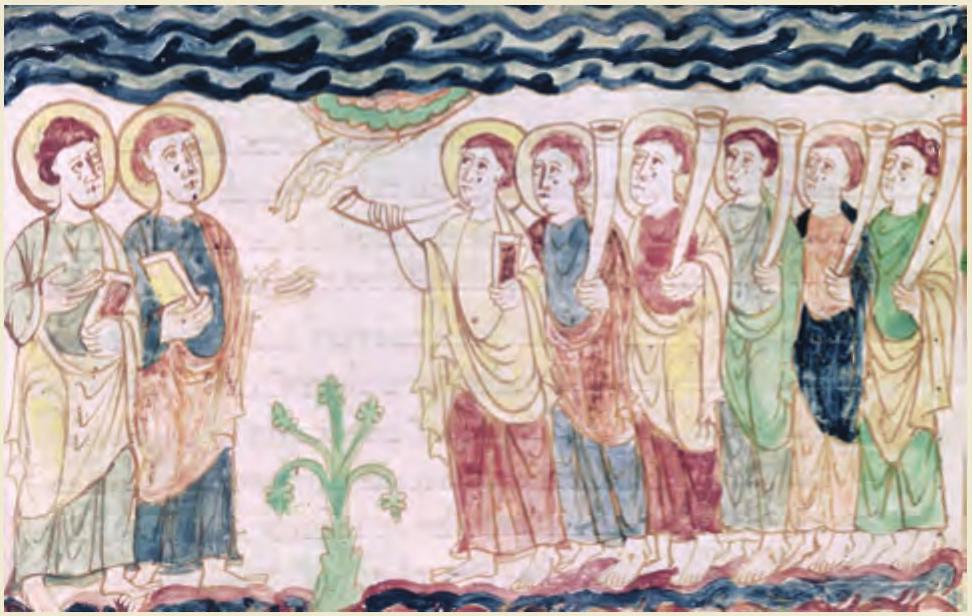
Ms 386 fol.25r Angels with Trumpets and the Earth Shaking, from the Apocalypse
of St. John, French School/Bibliotheque Municipale, Cambrai, France/Giraudon/The
Bridgeman Art Library
Interpreting Revelation
Interpreting Revelation has caused much debate, and at least four standard methods for interpreting the book have
developed. Preterists view the book as referring almost exclusively to first-century events. Historicists view the book as
referring to the unfolding of church history until Christ’s second coming. Idealists see the book as symbolizing the eternal
conflict between good and evil. Futurists see the book as mainly about the end times. Sometimes interpreters blend two
or more of these approaches.
Furthermore, the “thousand years” of 20:2–6 has been the basis of three different views of the millennium (the Latin
word for “thousand years”). The amillennial (no millennium) interpretation sees Christ as ruling spiritually in the church
now; Satan has been bound or at least hindered during this present church era. According to this view, there will be no
literal thousand-year reign; instead, Christ reigns through the church for an unknown number of years before He returns.
The postmillennial (after the millennium) interpretation understands that by the spread of the gospel the world will
become progressively more Christian. When the world becomes completely Christian there will be a millennium, then
Jesus will return in glory. The premillennial (before the millennium) view holds that Jesus Christ will return to earth to set
up His visible kingdom. At that time Satan will be bound for a thousand years.
Those who accept the premillennial position take specific views on when Christ will remove believers from the earth
before He returns (19:11–21). A comparison of the common symbolism of Daniel and Revelation, as well as time references
in Daniel 7:25; 9:27; 12:7 along with those in Revelation 11:2, 3; 12:6, 14; 13:5, seem to indicate that a seven-year period (see
Dan. 9:24–27), often called the Tribulation, will precede Christ’s return. Five different views have tried to explain the timing
between the Rapture of the church and the Tribulation. (The word rapture comes from the Latin translation of “caught up” in
1 Thess. 4:17.) Pretribulationists expect the
Rapture to take place before seven years of
tribulation. Midtribulationists say the Rapture
will occur midway through the seven-year
period. The posttribulation view states that
the church will go through the Tribulation,
but will be removed at the time of Christ’s
second coming. The prewrath view places
the Rapture between the mid- and post
tribulational points, before the climactic
wrath of God.
Each of these positions depends on a
different view of how the text of Revela-
tion should be interpreted. It is a good idea
to keep this in mind whenever you try to
understand a position or talk about it with
others. The central idea on which all these
views agree is that Christ will return some
time in the future, and that His return will
be a welcome sight to His people. Our hope
and prayer is the same as the apostle John’s:
“Come, Lord Jesus!” (22:20).
Original illustrations
End of source page 2115